
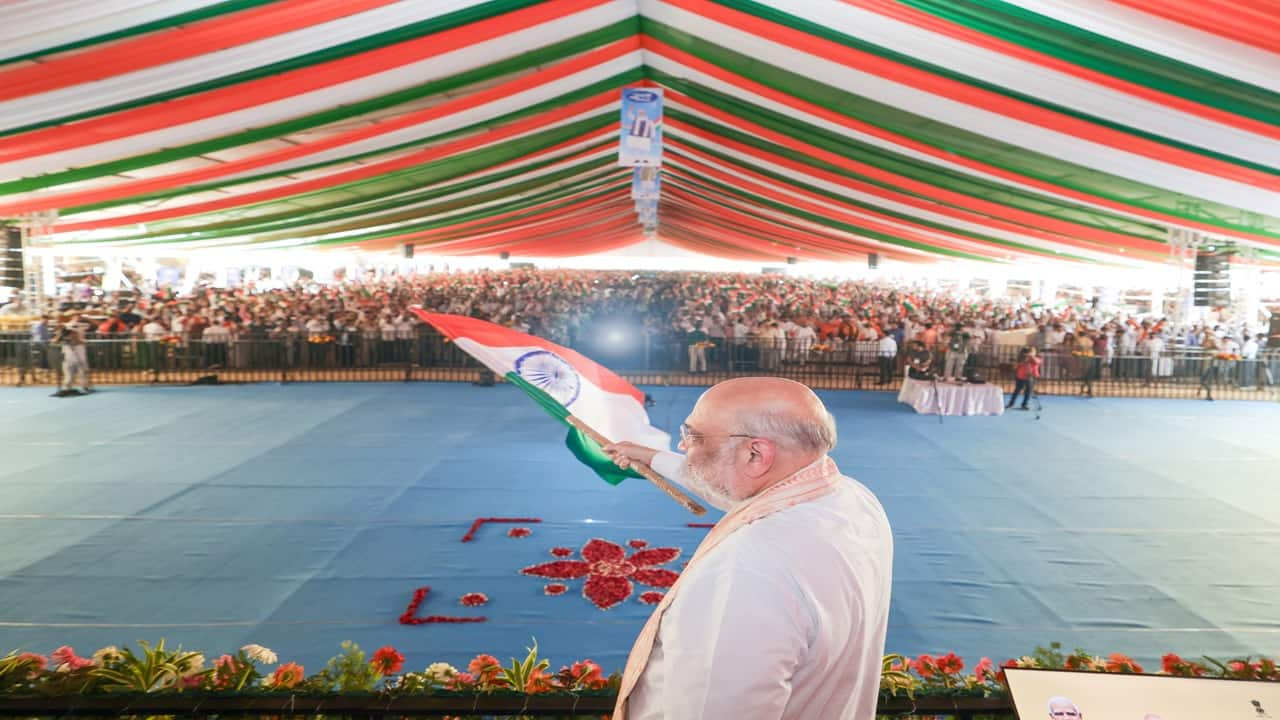
Union Home Minister Amit Shah turned 62 today, marking a career defined by key policy shifts. Since becoming Home Minister on June 1, 2019, he led the abrogation of Article 370 and the Citizenship (Amendment) Act. Shah also helped the BJP grow into the world’s largest party with many registered members.
Union Home Minister Amit Shah, who turned 62 today, has emerged as one of the most influential figures in Indian politics in his past 12-year career by expanding the BJP's political footprint across India since taking over the party's command as its President in 2014. Known in bureaucratic and political circles as a "man of commitment", took decisive decisions pertaining to national security, soon after he was appointed the country's Home Minister. The former BJP president has been remarkably successful in expanding the Bharatiya Janata Party's organisational footprint by leading the party from the front and securing one electoral victory after the other in state assembly elections. During his tenure as BJP President, the BJP became the world's largest political party with over 10 crore registered members. In 2013, Shah was appointed as National General Secretary of the BJP and in-charge of Uttar Pradesh. His painstakingly carried out efforts earned the BJP a historic success in the Parliamentary elections of 2014. He took over as BJP National President in July 2014, and from there onwards there is literally no looking back. By May 2018, in the direction of Shah, the BJP and its alliance partners were in government in 21 states, reflecting the scale of the party's electoral expansion Shah, who assumed charge as Union Home Minister in the Modi 2.0 government on June 1, 2019, took one of the most consequential and historical decisions within two months in office. It was the abrogation of Article 370, which had granted special status to the erstwhile state of Jammu and Kashmir. Later, in August 2019, the government moved to end the region's special constitutional status and reorganised the state into the Union Territories of Jammu and Kashmir and Ladakh. The move represented a major departure in the Centre's approach to Jammu and Kashmir and became one of the defining policy decisions of Shah's tenure. The government maintained that the changes would facilitate integration, development and improved security in the region. The decision also generated substantial political and legal debate, making it one of the most significant constitutional developments of the period. Shah's tenure has also been marked by major legislative changes like the Citizenship (Amendment) Act, 2019, which was passed by Parliament during the first year of his tenure. The legislation provides an expedited route to Indian citizenship for eligible Hindu, Sikh, Buddhist, Jain, Parsi and Christian migrants from Afghanistan, Bangladesh and Pakistan who entered India by December 31, 2014, subject to the Act's conditions and applicable exclusions. The government subsequently notified the rules for implementing the legislation in March 2024. Another major initiative was the introduction of three new criminal laws: the Bharatiya Nyaya Sanhita, the Bharatiya Nagarik Suraksha Sanhita and the Bharatiya Sakshya Adhiniyam. They replaced the Indian Penal Code, the Code of Criminal Procedure and the Indian Evidence Act, respectively, and came into force on July 1, 2024, with specified exceptions. The government presented the new codes as an effort to modernise criminal justice, strengthen provisions relating to crimes and technology, and place greater emphasis on investigation and time-bound judicial processes. Shah also pursued prison administration reforms. The Model Prisons Act, 2023, was prepared as a framework for states and Union Territories to modernise prison management and replace the colonial-era approach represented by the Prisons Act, 1894. Its adoption rests with the respective jurisdictions. Amendments to the UAPA and the National Investigation Agency Act, enacted in 2019, expanded the legal framework for tackling terrorism. The changes included provisions enabling the designation of individuals as terrorists under the UAPA and widening the NIA's investigative jurisdiction and powers. The campaign against Left-Wing Extremism (LWE) or Naxalism has been another major component of Shah's security agenda. Under Shah's direction, the MHA pursued a combination of security operations, intelligence coordination, infrastructure development and efforts to improve governance in affected areas. (With ANI inputs)