
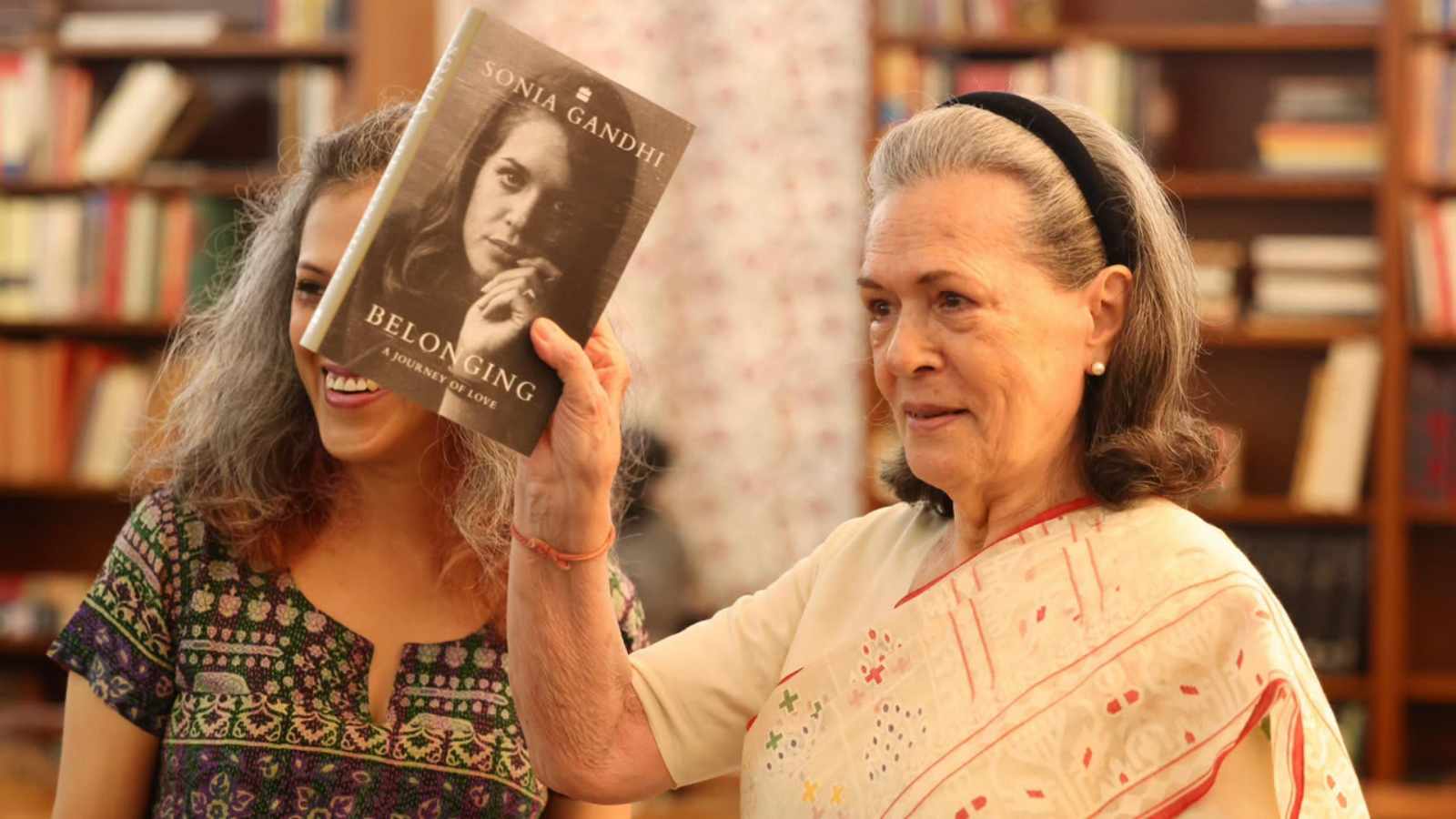
Sonia Gandhi’s new memoir is selling fast, sparking fresh debate about her political life. Tavleen Singh said, "I admire her courage and resilience." While the book shows charm, Singh feels it ignores key historical truths like the Emergency. Many readers now look at the Congress leader’s story with mixed feelings.
In a week in which the only political story has been Sonia Gandhi's memoir, it would be stupid to write about any other subject. But I tread on eggshells, as I say this. I am considered by the Congress party as her biggest enemy and routinely accused of 'hating the Dynasty'. So, I begin with a disclaimer. I do not 'hate' Sonia Gandhi and have often said that I admire her courage and resilience. If I were in her place, I would have fled back to Europe after Rajiv was killed and spent the rest of my life lotus-eating in Positano or Portofino.
She stayed and managed to become, for a while, India's most powerful politician, making her 'foreign origin' irrelevant. As one of the conscientious objectors to India having an Italian prime minister, let me admit that her foreign origin no longer matters. Not even her worst critics in the BJP bring this up anymore because whenever they try, they end up harming themselves more than her. Now let me come to her memoir, which is currently selling faster than any book in recent times.
Having bought it on day one, I could not put it down till I had finished it. She tells her own story with charm and extraordinary honesty. Sadly, this cannot be said about the political events she writes about. So, as someone who was an eyewitness to the things she writes about and as someone who truly believes that journalism is the first draft of history, I feel it my duty to correct some of the events she recounts. Her primary motivation seems to have been to defend the family honour, so even the scandal of Sanjay Gandhi being given the first chance to make an Indian car goes unquestioned. She does not notice that in licence raj days, there was something fishy about the prime minister's son being given this licence.
In her eyes, her mother-in-law was so perfect that she cannot be blamed even for the Emergency. She appears never to have learned that Indian citizens lost their fundamental rights and that anyone raising their voice against this was locked up. She is 'moved to tears' to see Indira Gandhi in a Tihar jail cell but forgets that the Rajmatas of Gwalior and Jaipur spent months in death cells that overlooked the gallows. She says that Mrs Gandhi regretted the Emergency. If so, she kept this a secret. In public she defended it and regretted only that press censorship had prevented her from getting feedback on the excesses committed in her name.
If Mrs Gandhi was blameless in her eyes, her husband was flawless and could do no wrong. She absolves him of the pogrom that killed more than 3,000 Sikhs in the first days of his becoming prime minister. She says he did his best to stop the violence and ignores the speech he made in which he defended the killings because 'when a big tree falls the earth shakes'. Weeks later came the Bhopal gas leak, and it was her husband's government who helped Warren Anderson flee to the United States to escape prosecution. In similar fashion, Ottavio Quattrocchi fled on the day that Chitra Subramaniam's excellent reportage found Bofors' bribe money in Swiss accounts in the name of him and his wife.
The list of other erased events is too long to recount, so I shall skip to her own tenure as India's de facto prime minister. She went to Gujarat after the 2002 riots and was 'in a state of stupor, gripped by horror and unable to speak' because of what she saw. If she had stepped out of her house in Delhi in 1984, she would have seen bodies in the streets and mobs of Congress party workers hunting for more Sikhs to kill. In Gujarat, Hindus and Muslims died. In Delhi, it was only Sikhs who were killed, which makes it the only pogrom ever by the Indian State.
you may like
Sonia Gandhi inherited from her mother-in-law a horror of the RSS but appears not to have understood that it was because of the massacre of the Sikhs in 1984 that Congress lost its 'secular' badge and paved the way for the BJP. Despite the hundreds of communal riots that happened under the Congress party's secular rule, it managed to retain the moral high ground until 1984. What Sonia inadvertently reveals through the many mistakes in her memoir is that she has still not fully identified what went wrong with the Congress party or worked out why it has still not regained its former dominance on our national political stage.
Everyone who has tried to comment adversely on her memoir has been reminded that it is her memoir and she has a right to her viewpoint. She absolutely does, but she does not have a right to distort facts in her attempt to whitewash the flaws of a family in which her 'Belonging' is beyond question. What is also beyond question is that she has proved convincingly that India is now her country and her home.
What worries me is that her India is still something that she sees through a telescope from a very privileged vantage point. But who am I to speak when the popularity of her memoir indicates that she remains a very popular politician in the eyes of ordinary Indians? The book is worth reading.