
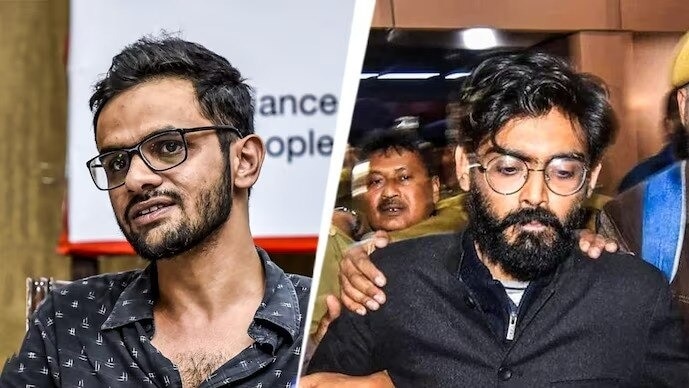
The Supreme Court will hear Sharjeel Imam and Umar Khalid's bail pleas on Wednesday. The activists challenged the Delhi High Court's refusal to grant them bail in a case under the UAPA. They have been in jail since 2020 and argued that the prosecution has not examined any protected witnesses.
The Supreme Court will hear Sharjeel Imam and Umar Khalid's renewed bail petitions on Wednesday. The pleas test prolonged UAPA detention as protected witnesses remain unexamined and a court-set deadline nears.
The Supreme Court is scheduled to hear on Wednesday petitions filed by activists Sharjeel Imam and Umar Khalid challenging the Delhi High Court's refusal to grant them bail in a case under the Unlawful Activities (Prevention) Act related to the alleged "larger conspiracy" behind the February 2020 northeast Delhi riots, Press Trust of India reported.
Imam and Khalid have sought bail on the grounds that the prosecution has not examined witnesses whose identities are protected and that the one-year waiting period set by the Supreme Court is nearing its end. They have been in jail since 2020.
According to the Supreme Court's cause list, a bench comprising Chief Justice Surya Kant and Justices Joymalya Bagchi and V Mohana is likely to hear the petitions.
In his petition, Imam said the charge sheet was filed on September 25, 2020. It named 18 accused, while the prosecution cited more than 900 witnesses, including 47 protected witnesses. He said that despite spending six years and nine months as an undertrial prisoner, the prosecution had not examined a single witness.
Khalid also cited the failure to examine protected witnesses. He argued that once the one-year waiting period expires, his continued imprisonment would violate Article 21 of the Constitution, which protects the right to life and personal liberty.
The Delhi High Court on September 30 refused to grant bail to Khalid and Imam. It said it was bound by "judicial discipline" and could not modify the Supreme Court's January 5 order, which allowed the two accused to seek bail after the examination of protected witnesses or the expiry of one year, whichever was earlier.
Khalid and Imam had challenged a trial court's July 4 decision rejecting their bail petitions for the third time since their arrest. The trial court said it had "no option but to follow" the Supreme Court's January 5 order and could neither consider the petitions nor grant relief.
The high court noted that while denying bail to the two accused in January, the Supreme Court had said their roles were different from those of the other co-accused and described them as the "ideological drivers" of the alleged conspiracy.
Khalid and Imam have been booked under the UAPA on allegations that they were among the masterminds of the February 2020 riots, which left 53 people dead and more than 700 injured, according to PTI. The violence broke out during protests against the Citizenship (Amendment) Act, 2019, and the National Register of Citizens.
Activist Khalid Saifi and former Aam Aadmi Party councillor Tahir Hussain, among others, were also booked for their alleged involvement in the larger conspiracy case, which is being investigated by the Delhi Police Special Cell. Imam was arrested on August 25, 2020, and Khalid on September 13, 2020.
On September 2, 2025, a Delhi High Court division bench denied bail to Khalid and Imam. On January 5, the Supreme Court upheld that verdict but granted relief to co-accused Gulfisha Fatima, Meeran Haider, Shifa Ur Rehman, Mohammad Saleem Khan and Shadab Ahmad.
A bench of Justices Aravind Kumar and N V Anjaria had observed that there was, at first sight, a case against Khalid and Imam under the UAPA. Rejecting their argument that the trial had been delayed, the court said they could file fresh bail petitions after the examination of protected witnesses or one year from the date of its order.
On May 22, the Supreme Court granted six months' interim bail to co-accused Abdul Khalid Saifi and Tasleem Ahmad. It also referred to a larger bench the issue of prolonged imprisonment of undertrial prisoners under the UAPA because of the law's strict bail conditions.
The Supreme Court will now consider Imam's and Khalid's renewed requests for bail, which are based on the prosecution's failure to examine protected witnesses and the approaching expiry of the one-year period fixed by the court.