
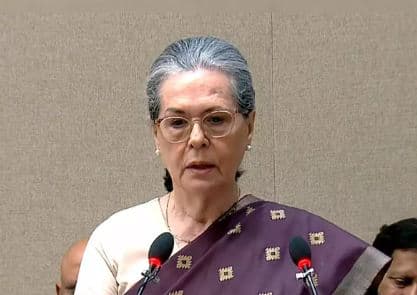
Sonia Gandhi said the 1975 Emergency was carried out constitutionally despite the curtailment of democratic rights. In an interview published on Saturday, she explained that Indira Gandhi was struggling to handle widespread unrest. She noted, "It was only after the Emergency that I came to know the true gravity."
Congress Parliamentary Party chairperson Sonia Gandhi said the imposition of the Emergency in 1975 was carried out constitutionally, while acknowledging that democratic rights were curtailed and habeas corpus was suspended. She also offered an account of the circumstances that led former Prime Minister Indira Gandhi to impose the Emergency, saying the then PM was struggling to deal with widespread unrest and deteriorating law and order. In an interview with The Hindu published on Saturday ahead of the release of her memoir, Belonging: A Journey of Love, Sonia Gandhi said she came to understand the gravity of the situation only after the Emergency was imposed.
"It was only after the Emergency that I came to know the true gravity of what had been happening. Yes, democratic rights had been curtailed and there was a suspension of habeas corpus, but it was done constitutionally," the former Congress president said. Looking back at the period from Indira Gandhi's perspective, Sonia Gandhi said the then prime minister was attempting to cope with what she described as rapidly deteriorating circumstances, including violent protests, arson and organised unrest. "Yet, when I take myself back to that period and try and see it from Mrs Gandhi's point of view, I see her struggling to cope with the rapidly deteriorating prevailing circumstances: violent protests, government offices and public transport set on fire, widespread organised unrest and even a call for the bureaucracy and armed forces to disobey orders," she said.
Sonia Gandhi added that hindsight offered a better perspective on the events and pointed out that Indira Gandhi had subsequently acknowledged the excesses committed during the Emergency, publicly expressing regret and apologising for them. On Sanjay Gandhi's role during Emergency Asked about Sanjay Gandhi becoming synonymous with the Emergency and whether the excesses could have been avoided had Indira Gandhi listened to her elder son Rajiv Gandhi and others, Sonia Gandhi said the responsibility and pressure extended beyond Sanjay. "It was not only Sanjay, though in the public mind he is often seen as synonymous with the Emergency.
There was a lot of pressure from some of her senior colleagues, and I think there were very few people around her like Rajiv who had a different point of view," she said. She added that Indira Gandhi eventually recognised the situation and took corrective measures. "I think eventually my mother-in-law began to understand the situation through her own wisdom and took actions to remedy it," Sonia Gandhi said. BJP accuses Sonia Gandhi of justifying Emergency Her remarks drew a sharp reaction from the BJP, with party spokesperson Pradeep Bhandari accusing her of attempting to justify the imposition of the Emergency and portraying Indira Gandhi as a victim.
In a post on X, Bhandari said Sonia Gandhi's remarks could not obscure the excesses committed during the Emergency. He also invoked former prime minister Rajiv Gandhi's controversial remark, "Ek bada ped girta hai to dharti hilti hai" (when a big tree falls, the earth shakes), made in the aftermath of the 1984 anti-Sikh riots. Bhandari further criticised the Congress leadership over its past political positions and accused the Gandhi family of resorting to vote-bank politics. The Emergency, imposed by then prime minister Indira Gandhi on June 25, 1975, remained in force until March 21, 1977. The period witnessed the suspension of civil liberties, restrictions on the press, arrests of Opposition leaders and curbs on political activity.
The Congress suffered a major electoral defeat in the 1977 general elections, bringing the Emergency to an end. Gandhi's 544-page memoir, Belonging: A Journey of Love, is scheduled to be published in India by HarperCollins India on November 10. The book is described as a personal account of her life, with politics serving as its backdrop and providing what Gandhi calls "a kind of framework". (With inputs from PTI)