
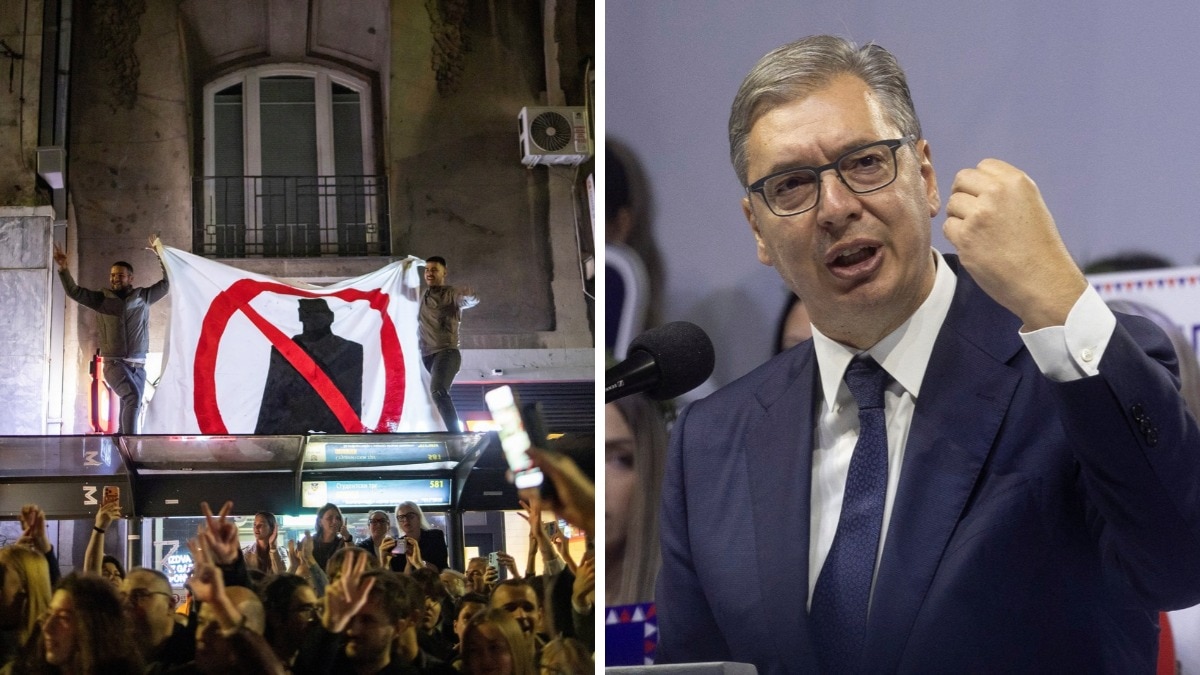
Serbia heads to a high-stakes parliamentary election as a student-led movement seeks to end Aleksandar Vucic's 12-year grip on power. The group, formed after a railway disaster killed 16 people on November 1, 2024, fielded 250 candidates. They said, "The candidates represent the values of a civilised society," seeking change.
A railway disaster that killed 16 people sparked a student-led revolt against corruption in Serbia. Nearly two years later, the movement is taking its fight to the ballot box, fielding 250 candidates with no background in electoral politics and seeking to end Aleksandar Vucic's 12-year grip on power.
Serbia is heading into a high-stakes parliamentary election, with a mass student-led movement seeking to end Aleksandar Vucic's 12-year grip on power and reshape the country's political landscape. The vote on Sunday marks the most serious challenge the long-serving leader has faced since his Serbian Progressive Party (SNS) came to power in 2012.
At the heart of the challenge is the Student List, a group that emerged from nearly two years of anti-corruption protests following the deaths of 16 people in the collapse of a concrete canopy at a railway station in Novi Sad on November 1, 2024.
The disaster, linked by protesters to alleged corruption and irregularities in infrastructure work, became a rallying point for public anger against the government. No official has been held accountable so far.
What began as student demonstrations soon grew into one of Serbia's largest protest movements in a generation, drawing support from people frustrated with corruption, political interference and what they see as an increasingly authoritarian system.
CAN THE STUDENT LIST TURN PROTESTS INTO POWER?
Now, instead of merely demanding accountability from the streets, the students are taking their fight to the ballot box with a list of 250 candidates selected through student-led assemblies at universities across the country. The candidates include academics, professionals, actors and farmers, many of whom have no background in electoral politics.
The list is headed by Ilija Srdanovic, a cardiologist and professor at Novi Sad University, although he is not the movement's designated leader and would not automatically become prime minister if the group wins.
The movement has deliberately avoided a conventional leadership structure, arguing that a collective approach offers an alternative to the concentration of power it accuses Vucic's government of encouraging.
Srdanovic, in an interview with BBC, has described his participation as a way of standing alongside students in their fight for change. The candidates, he said, represent the values of a civilised society that he believes the current regime has eroded.
For the students, the election is about more than replacing one political party with another. They have presented their campaign as a fight for accountability, freedom of speech and public safety, with the slogan "Serbia or Mafia?" directly challenging widespread perceptions of links between political power and organised crime.
The government has denied accusations of corruption and criminal connections, maintaining that it is tackling organised crime.
WHAT'S FUELLING ANGER AGAINST VUCIC'S GOVT?
The anger driving the movement is visible beyond the university campuses and protest rallies. In Krnjaca, a suburb of Belgrade, student volunteers campaigning door to door found residents eager to discuss problems ranging from corruption to neglected public infrastructure.
Poorly maintained roads, a bridge connecting the suburb to central Belgrade and a sewage system that repeatedly fails during heavy rain were among the local grievances.
Residents said promises to address some of these problems had gone unfulfilled, even as Serbia's economy expanded and luxury car showrooms appeared alongside neglected public spaces.
Corruption emerged as a recurring complaint. Critics have also accused the ruling SNS of maintaining close links with organised crime, allegations the government rejects.
FROM A RAILWAY DISASTER TO BALLOT BATTLE
The movement traces its roots to November 1, 2024, when a concrete canopy collapsed at the railway station in Novi Sad, Serbia's second-largest city, killing 16 people.
The station had recently undergone renovation as part of a flagship infrastructure project championed by Vucic, which included a high-speed railway link between Belgrade and Budapest.
The tragedy sparked widespread protests, which spread nationwide after students holding a vigil for the victims in Belgrade were attacked by a group linked to the ruling party, according to reports.
As the movement gained momentum, the students kept their distance from established opposition parties and resisted adopting a conventional leadership structure.
That approach has also helped them avoid the political infighting and personal attacks that have often weakened opposition movements in Serbia.
By putting forward candidates from different professional backgrounds, the Student List hopes to present itself as an alternative to the established political order rather than simply another opposition party.
VUCIC'S BIG BET ON SNAP POLLS
Vucic, who has served as deputy prime minister, prime minister and president since 2012, remains a formidable opponent. Supporters credit him with sustained economic growth and modernisation, including investments in highways, railways, schools and hospitals.
His appeal among a significant section of the electorate rests on the image of a strong leader who protects Serbia's national interests.
However, critics say his government has weakened democratic institutions, dominated the media landscape and failed to ensure accountability over the railway station disaster.
Vucic stepped down as president in September, five months before the end of his second and final term under the constitution, to contest the election with the aim of returning as prime minister.
By calling snap elections, he appeared to be seeking a fresh mandate before the student movement could consolidate its political challenge.
The students, however, have continued to campaign, drawing large crowds at rallies and taking their message directly to voters. Their final campaign gathering in Belgrade's Slavija Square reportedly attracted around 150,000 people, while the SNS held its own event with Vucic as the sole speaker.
The contrasting campaign styles reflect the central choice facing voters: a political system built around a dominant leader or a movement that promises collective decision-making and a break from established political practices.
Meanwhile, Vucic has sought to portray the student movement as foreign-backed, accusing its supporters of trying to destabilise the state. The students have rejected those allegations. The ruling party has also faced criticism over media bias and the use of public resources during previous elections.
VUCIC, STUDENTS IN A NECK-AND-NECK RACE
The election outcome remains difficult to predict. Opinion polls have varied widely, with some surveys placing the students ahead and others showing the ruling party in front.
An Ipsos poll published on Thursday put the SNS at 47 per cent and the Student List at 40 per cent, while an earlier survey by Serbia's Centre for Research, Transparency and Accountability and Stanford University found greater support for the students.
The competing figures underline the uncertainty surrounding a contest that could mark a turning point in Serbian politics. Analysts have warned that a close result, coupled with disputes over the legitimacy of the outcome, could raise the risk of unrest after voting.
International election observers reported an overwhelming advantage for the ruling party in the 2023 parliamentary election, citing unequal media coverage and the misuse of public office and resources.
The political contest also carries implications for Serbia's international relationships. Vucic has pursued a balancing act between the European Union, Russia and China, maintaining ties with Moscow and Beijing while keeping the prospect of EU membership open.
The Student List has focused primarily on domestic issues and has offered fewer details about its foreign policy priorities. Vucic has questioned whether the movement would maintain Serbia's relationships with Russia and China, warning that a change in government could put those ties at risk.
For the students, the immediate priority remains tackling corruption, restoring accountability and improving the functioning of public institutions. Their challenge is to translate the energy of a mass protest movement into electoral support strong enough to dislodge a leader who has dominated Serbian politics for more than a decade.