
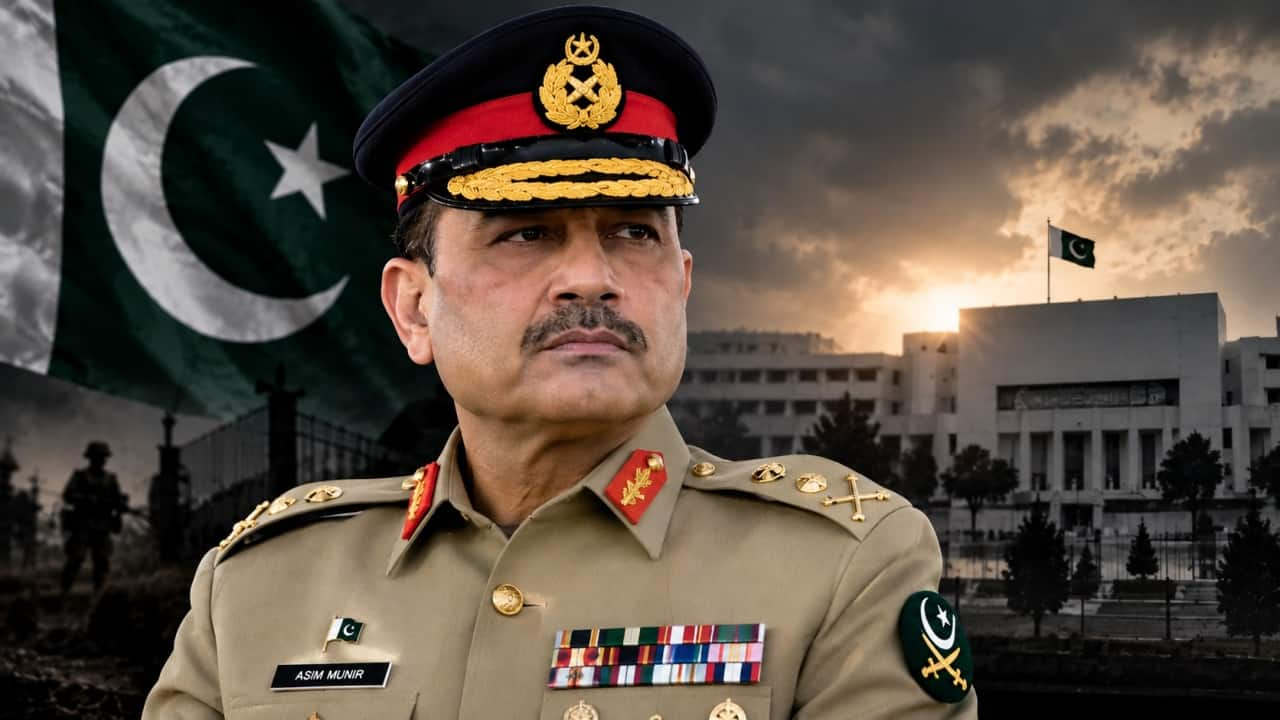
India accused Pakistan’s military of exploiting natural resources for personal gain at a UN meeting on Wednesday. Ambassador Parvathaneni Harish said, “Pakistanis would be served well if its real rulers, its military, used the country’s natural resources for the benefit of their population rather than self-aggrandisement.” He linked this to unrest.
Market Mastery
Webinar by Vishal Malkan
Find the weak links
in your portfolio by Vishal Malkan
India has launched a sharp attack on Pakistan's military establishment at the United Nations, accusing it of exploiting the country's natural resources for personal enrichment and alleging that the struggle over mineral wealth may be linked to recent political upheaval in the country.
Speaking at a UN Security Council Arria-formula meeting on natural resources and conflict on Wednesday, India's Permanent Representative to the UN, Ambassador Parvathaneni Harish, singled out Pakistan Army Chief Asim Munir, referring to an incident in which he displayed a wooden box of mineral stones to foreign leaders.
Harish suggested that the episode reflected the military's involvement in exploiting Pakistan's mineral resources. He also linked the issue to the reported dismissal of a provincial government and the imposition of emergency rule in the country.
“Their Army Chief was seen last September displaying a wooden box filled with mineral stones to foreign leaders, a clear indication of their army’s role in this exploitation, which is also believed to be behind the recent dismissal of a provincial government in Pakistan and imposition of a state of emergency there," Harish said.
The reference was to a meeting at the White House last year involving US President Donald Trump, Pakistan Prime Minister Shehbaz Sharif and Munir. Images from the meeting showed the Pakistani Army chief gesturing towards an open wooden case containing mineral samples as Trump looked on, with Sharif standing nearby.
'Real rulers' should use resources for Pakistanis, says India
The Indian envoy argued that Pakistan's mineral wealth should be used to improve the lives of its people rather than serve the interests of the military leadership.
“Pakistanis would be served well if its real rulers, its military, used the country’s natural resources for the benefit of their population rather than self-aggrandisement. They would also be served better if the Pakistani army stops fomenting conflict for their neighbours, which is actually boomerang-ing back to bite their own country," Harish said.
His remarks came during a meeting convened by Liberia to examine how natural resources can contribute to conflict or support peace and development.
Harish also accused Pakistan of using the discussion to raise the Indus Waters Treaty, saying New Delhi had not intended to bring bilateral disputes into the forum.
“Mr. Chair, it was not our intention to bring other issues into this forum, but my delegation is compelled to respond to the comment made by the delegation of Pakistan that has chosen to misuse today’s discussion to peddle its propaganda. Our position on the Indus Waters Treaty remains clear and consistent and has been articulated at multiple fora," he said.
India pushes for local benefits from mineral wealth
Beyond its criticism of Pakistan, India outlined its position that natural resources should contribute to economic development and directly benefit communities in resource-rich regions.
Harish warned that illegal extraction and trafficking of natural resources could finance armed groups and prolong conflicts. He also pointed to Liberia's experience of moving from conflict towards recovery, saying, “Liberia’s own journey from conflict to recovery lends particular weight to this exchange."
India argued that existing international mechanisms should be strengthened instead of creating additional frameworks. Harish cited the Kimberley Process, which seeks to prevent the trade in conflict diamonds while allowing legitimate trade to continue.
“Our experience is that cooperation works best when it is voluntary, consensus-based, and nationally led in an environment of friendship and goodwill. The Kimberley Process is an instructive example. By bringing together governments, industry, and civil society, it has curbed the trade in conflict diamonds while keeping legitimate trade open. As chair of the Kimberley Process in 2026, India is committed to strengthening its effectiveness and inclusiveness. Existing and tested mechanisms deserve to be fully utilised, and wherever feasible replicated, before new frameworks are contemplated," he said.
The envoy also highlighted India's mining framework, under which companies are required to contribute towards the development of communities living in areas where minerals are extracted.
India cautions against expanding UN Security Council's role
Harish further called for the UN's principal bodies to operate within their respective mandates, cautioning against expanding the Security Council's role into areas better addressed by other institutions.
He said international peace and security should remain the Council's primary responsibility, while sustainable development and natural resource governance should be addressed by the General Assembly, the Economic and Social Council (ECOSOC) and other relevant bodies.
“As these discussions evolve, we should preserve the distinct mandates of the principal organs of the United Nations. The Security Council’s responsibility is the maintenance of international peace and security. Broader questions of sustainable development and resource governance belong to the General Assembly, the ECOSOC, and other relevant bodies. The Peacebuilding Commission, given its inclusive composition, can support nationally owned efforts in this area. India stands ready to share its experience and to work with all partners towards practical, consensus-based approaches that enable natural resources to drive sustainable development and lasting peace," he said.