
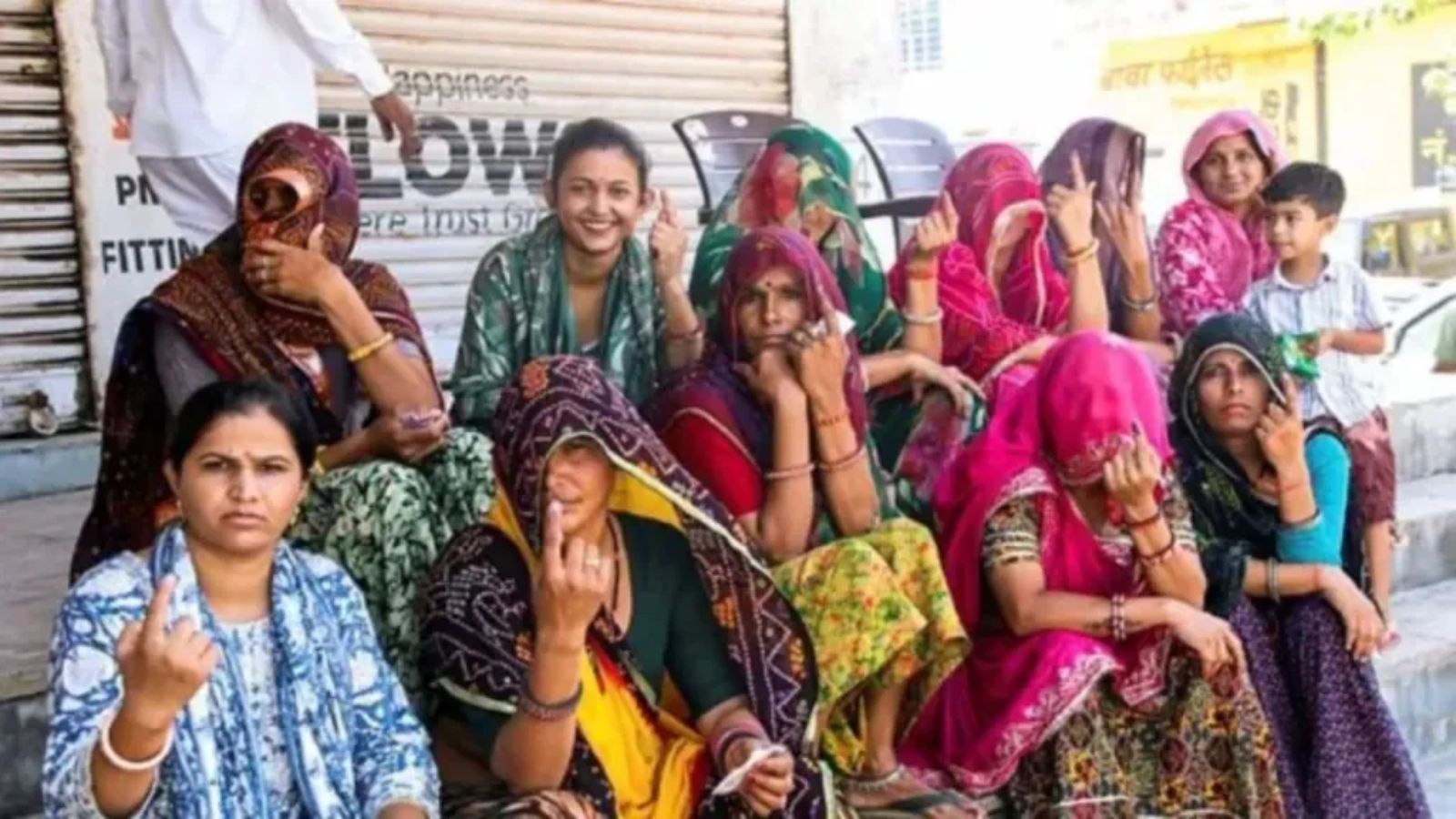
Congress holds an early lead in the Rajasthan panchayat elections, staying ahead in 13 Zila Parishads and 144 Panchayat Samitis. These polls serve as a major test for Chief Minister Bhajan Lal Sharma. With over 2.7 crore votes polled, the results show how rural voters feel about the current government.
Congress marginally ahead in 13 Zila Parishads against BJP's 10. In Panchayat Samitis, Congress was ahead in 144 Samitis against BJP's 88.
Almost three years into Bhajan Lal Sharma taking the oath as Rajasthan Chief Minister, the second major test of his government is underway Friday in the counting of votes for Zila Parishad and Panchayat Samiti candidates in 37 out of 41 districts.
In December 2023, the BJP had virtually sidelined all its major faces in Rajasthan, including two-term former CM Vasundhara Raje, and experimented with Sharma -- a first-time MLA.
Along the way, there have been a few hiccups and setbacks, with Sharma benefitting from his clean image but often ailing from alleged indecisiveness. However, at the party level, it became crystal clear that the party, and not individual leaders in the state, are supreme. The cult of personality associated with Raje and some second-rung leaders in the state was wiped out bit by bit, in 2023, and in the years before and after.
Vote on experiment
In these circumstances, the Panchayat Raj Institutions (PRI) polls are being seen as an indicator and a measure of the success - or limitations - of that experiment: from a more centralised process to a decentralised one. The urban local body polls in September indicated partial success with the difference between the BJP and the Congress in terms of vote share being just 0.91 per cent even as the ruling party went on to form Boards in most of the urban bodies.
The Urban Local Bodies (ULB) polls also indicated that if the BJP lacked in electoral strength, it made up for it through organisational heft; however, the BJP's wins also came amid alleged coercive action by authorities.
Rural support base
While the BJP is considered more of an urban party, the Congress sees its strength in rural areas. However, in Rajasthan, the ruling party generally fares better in both urban and rural local body polls. Having come very close to the BJP in terms of numbers in urban polls, the Congress is upbeat about the PRI results. Over the past few weeks, its leaders have maintained that the party will fare better in the PRI polls than it did in urban polls.
Across all 41 districts, over 2.7 crore votes were polled, translating into nearly every third person in Rajasthan voting in these elections. The vote share of political parties will then certainly be a mandate of sorts on how things stand, two years before the state goes to polls.
Narrative and perception
Depending on how they go, the results may give ammunition to either the BJP or the Congress for the next two years. With BJP known to extract maximum benefit even out of small wins, a favourable result for the party will go a long way in managing its perception ahead of next Assembly polls.
For the Congress, a win in PRI polls will be a stamp of approval on what it terms is a dissatisfaction with the Sharma government and its policy paralysis.
Question of CM
Till date, there have been discussions if and when the BJP will undertake a cabinet expansion/reshuffle in Rajasthan. While there have been discussions on various occasions - fuelled in part by the BJP leaders themselves - there has been no discussion on replacing Sharma as CM.
If the results indicate strong winds in favour of the Congress, the BJP may rethink its strategy, which may include replacing Sharma as CM ahead of 2028 to check anti-incumbency and manage perception.
Anger vs status quo
If polling in urban or rural body polls generally favours the ruling party, it is mainly because the party in power has the ability to leverage its incumbency at the grassroots. In other words, the control of the state government brings with it considerable influence over the flow of funds to local bodies, apart from local administration. As per state's Economic Review 2025-26, over Rs 10,000 crore was earmarked for the PRI through the centre and the state in 2025-26.
Hence, while a vote for BJP may indicate status quo and contentment with the state government, a significant vote in favour of Congress may be read as immense dissatisfaction with the ruling dispensation.