
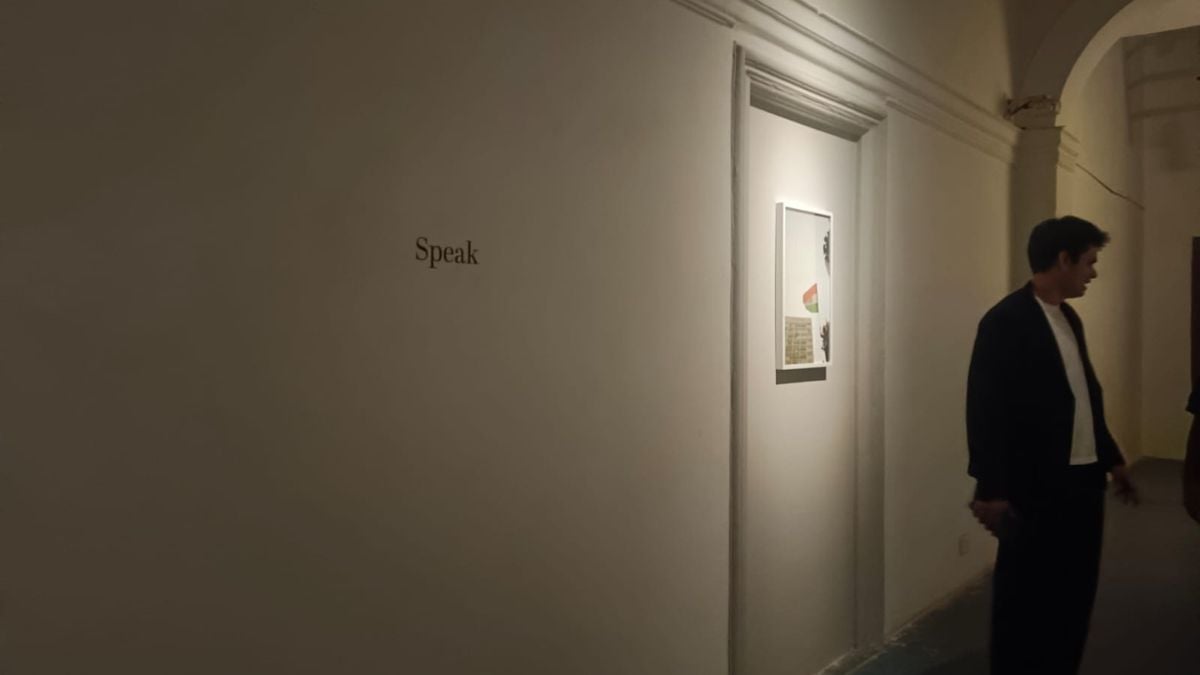
Raihan Vadra’s exhibition at Bikaner House has empty wall space after 75 photos were taken down. Vadra said, “I was told that Bikaner House felt the photos were too political.” The venue objected to his protest images just hours before the opening, despite approving his exhibition proposal on 30 June.
His photographs documented the protests in Delhi over the past six months and formed a substantial part of an exhibition that also features wildlife photography and abstract works. Vadra says Bikaner House objected to the “political nature” of the protest images, despite having approved his exhibition proposal on 30 June last year and receiving the layout a week before the opening.
“I was told that Bikaner House felt the photos were too political. They were mostly photos from the youth movements. Over the last six months, I thought, as an artist, it was my duty to document and display those images,” Vadra said. “I was told by the people in charge that the timing of the exhibition coincides with what’s happening, so it’s incorrect to show these images and that maybe we could show them at a later date.”
The artist says he had already removed overt political messaging from the photographs and that the venue did not raise objections until the final hours. He claims he was ultimately given a 3.30 pm deadline to remove works deemed political and added that the exhibition layout was subsequently shared with the venue a week before the opening, without any objections being raised.
“I then shared the layout with them a week in advance, and they didn’t say anything to me. Today, they said, ‘Oh, we couldn’t see that layout properly.’ So, I was like, ‘But you didn’t raise that with me in the one week before.’”
Bikaner House management, Vadra claimed, first contacted him at around 6 pm Tuesday.
“If you had told me even two days ago, I could have maybe done something about it. But four hours before my show, how much would you rearrange 75 figures? Not that I was going to replace them, but, you know, it doesn’t make sense,” he said.
Vadra said Bikaner House subsequently cited its booking policy, which prohibits political content. But Vadra said he had already removed political messaging from the photographs.
“Now, I believe that all art is political and timing has nothing to do with it. So, if you are going to be in an art space, then you can’t say you are not going to show political art?” Vadra questioned.
He added that the organisers had already made up their mind.
“To be honest, they didn’t even properly look at the photos when they came and discussed it with me today. So, I think they had already made up their mind.”
A press note issued before the exhibition had noted how the photos were simply a visual documentation of the people and the armed forces at the protests, “with no added commentary”. “Not a single photograph taken by me contains any derogatory or inflammatory content of any kind,” the press note said.
Vadra also said he had pointed to a political installation that had been displayed at Bikaner House in September last year while discussing the venue’s policy.
Now, he says he has no choice but to take the photos down.
“Putting these shows together takes a lot of hard work and time,” he said. “So, I decided that I would take them down and display these images in another show, at a place where it’s more feasible to show them.”
Two Tiranga pictures
Vadra said it was initially agreed that Bikaner House management would communicate its final decision soon. But he didn’t hear from the organisers until an hour before his show was scheduled to start.
He claimed Rohit Kumar, the Principal Resident Commissioner of Bikaner House, then inspected the rooms where the photographs were displayed and told him that all works deemed “political” would have to be removed by 3.30 pm.
Vadra also alleged that Kumar telephoned the Chief Secretary of Rajasthan and another officer at the Chief Minister’s Office before conveying the decision to him.
Then, Vadra and his team began taking down the photographs. They initially replaced the works with blank frames, but Vadra said the venue subsequently told them that the frames also had to be removed.
The only two photographs Vadra did not remove were images of the national flag. But he said they wanted them removed as well.
Vadra initially refused.
“I will not take down a picture of the Indian Flag,” he said.
But eventually he had to comply so that the exhibition could continue until 25 October.
The dispute, Vadra said, was not simply about whether the photographs could be considered political. He maintained that his intention had been to document the protests rather than make a political statement.
“There weren’t any images that had slogans or anything like that. I removed those on my own decision because I didn’t want to drag all that into this. So, it was just a documentation of the movements of the last few months,” he said.
Vadra also said his family background did not determine the purpose of the exhibition.
“I am from a political family, but I am not a political person, you know, whatever that means. The whole point was that I was documenting the protests,” he said.
Just a catalogue
A catalogue is now being shared with visitors, allowing them to see the photographs that had been intended for the exhibition and had occupied the walls before they were taken down.
The title ‘No Idea Is Final’ also reflects the way Vadra approached the exhibition, he said, as he repeatedly changed direction while putting it together.
“It was more to do with the concentrated period when I was planning this show, when I was jumping from, ‘Okay, I want to do this,’ to, ‘No, I want to do that,’” he said. “So, I kept jumping from one idea to another. At the end of it, I was like, ‘None of these ideas are for you’. I feel that’s the way I try to live my life. I don’t try to stick to or be rigid about anything.”
His photographs of recent protests showed police personnel detaining demonstrators during the protests against BJP leader Dharmendra Pradhan over NEET irregularities and against Chief Election Commissioner Gyanesh Kumar, while another featured his uncle in the chaos.
The 75 photographs, however, are not being abandoned.
Asked whether he planned to exhibit them again, Vadra said he had already begun looking for another venue in Delhi. The exhibition is also scheduled to travel to Bengaluru in December, where he said he would display the photographs.
“Yeah, 100%. Ideally, I would have liked to have announced it today. But I made a whole bunch of calls and was unable to find a venue where I could say that I’ll do this next week,” he said. “But I will also try to display them in Delhi once.”