
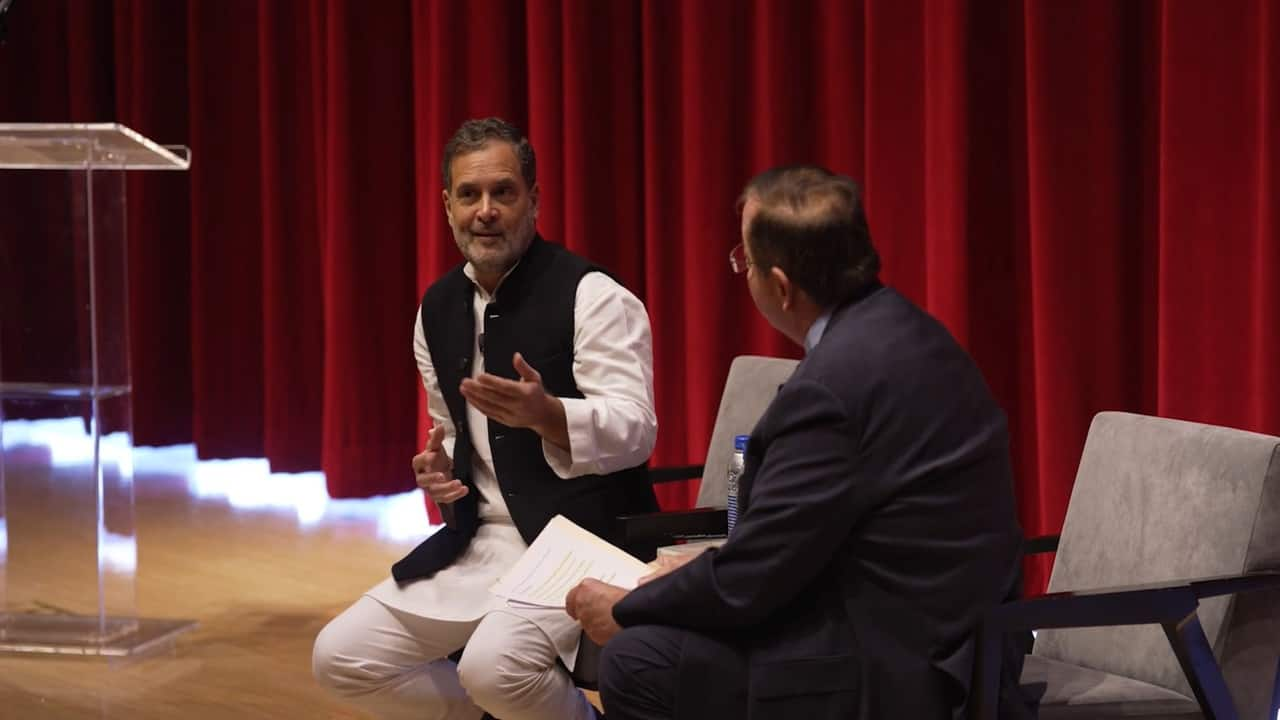
Congress leader Rahul Gandhi on Thursday criticised India’s foreign policy amid the Iran war. He said the country has stepped back from playing an active role in global affairs. "We have suddenly stepped back and decided we are not going to be players on the stage," he said during interaction.
Congress leader Rahul Gandhi on Thursday criticised India's foreign policy approach amid the Iran war, saying the country has lost the independent geopolitical voice it once commanded and has stepped back from playing an active role in global affairs. Speaking at the University of Chicago during an interaction titled 'The Iran War & India's Role in the World', Gandhi said India could not remain unconcerned about developments across the world, particularly at a time when geopolitical conflicts were having a direct impact on economies and livelihoods. He said the Iran war had magnified existing economic challenges, including the concentration of wealth and power among a handful of businesses, the destruction of small and medium enterprises and rising unemployment.
"The Iran war magnified the impact. It pushed people over the edge. It increased prices and created inflation," Gandhi said, referring to the economic consequences of the conflict. India's changing foreign policy approach Questioning India's current position in global geopolitics, Gandhi said the country had historically maintained an independent foreign policy approach despite having strategic partnerships with different nations. He said that since Independence, India had developed a sophisticated understanding of international affairs, maintaining relationships with different countries while retaining its independent position.
"From the time of Independence, India always had a very sophisticated geopolitical understanding. We had partnerships and relationships, but we had a mind of our own," he said. Gandhi argued that India's size and strategic importance naturally gave it a significant position in global affairs. However, he alleged that the country had recently stepped back from playing an active role on the international stage. "We have suddenly stepped back and decided we are not going to be players on the stage," he said. He also referred to India's historical association with the Non-Aligned Movement, saying the country had once been among the leading voices advocating an independent position in international affairs.
"We were the leaders of the Non-Alignment movement when we got Independence. That voice which I want India to have on the global stage is missing," Gandhi said. On India's approach towards US, Russia Gandhi clarified that he was not opposed to India maintaining strong relationships with the United States or continuing its longstanding partnership with Russia. However, he said such relationships should not come at the cost of India's independent geopolitical perspective. "I don't have a problem with having a very strong relationship with the US, no problem with India's old relationship with Russia.
But we have a view that I see is missing," he said. Taking a swipe at Prime Minister Narendra Modi's emphasis on personal relationships with global leaders, Gandhi questioned whether international diplomacy could be built around friendships between political leaders. "Our PM talks in terms of friendship. Trump is my friend, Putin is my friend. Do you think geopolitics is going to work because that guy is your friend?" he asked. Gandhi argued that global leaders operate within larger political and economic structures, and their decisions are not necessarily determined by personal relationships.
"He is leading a structure, he has a whole economic structure sitting under him. He is not going to take a decision on whether he likes you or doesn't like you," he said. He also expressed surprise over Pakistan's participation in negotiations related to the Iran conflict, arguing that India and Pakistan operate at fundamentally different scales in terms of their global standing and international relationships. "I am shocked Pakistan entered into the negotiations. We are historically and fundamentally different than Pakistan," said Gandhi. He pointed out that India maintained relationships with the US, Iran and Russia, suggesting that its geopolitical position should allow it to play a more significant role in international negotiations.
On the emerging global security order Gandhi also spoke about the need for a new global security architecture, arguing that the international order established after World War II was designed primarily by Western powers and no longer reflected the changing distribution of global influence. He said the next global architecture would have to be shaped by multiple civilisations and major geopolitical powers, rather than being dominated by a single bloc. "The last security structure was built after World War II and it was built by one civilisation. It was built and designed by the West," he said. "The next global architecture will not be built by one civilisation but will be built by multiple civilisations.
US, China, India, Middle East, Russia, everyone will have a role in it," he added. Explaining India's potential role in such an arrangement, Gandhi pointed to the country's population of 1.5 billion people and its strategic position in the international system. He also referred to the military strength of the US, the influence of the Middle East over oil supplies and the growing importance of connectivity and modern technology in changing how power is exercised. Gandhi said the emerging global order should be based on greater participation and consultation, rather than being shaped by a handful of powerful countries.
"We want an order that is designed not only by speaking but listening," he said.