
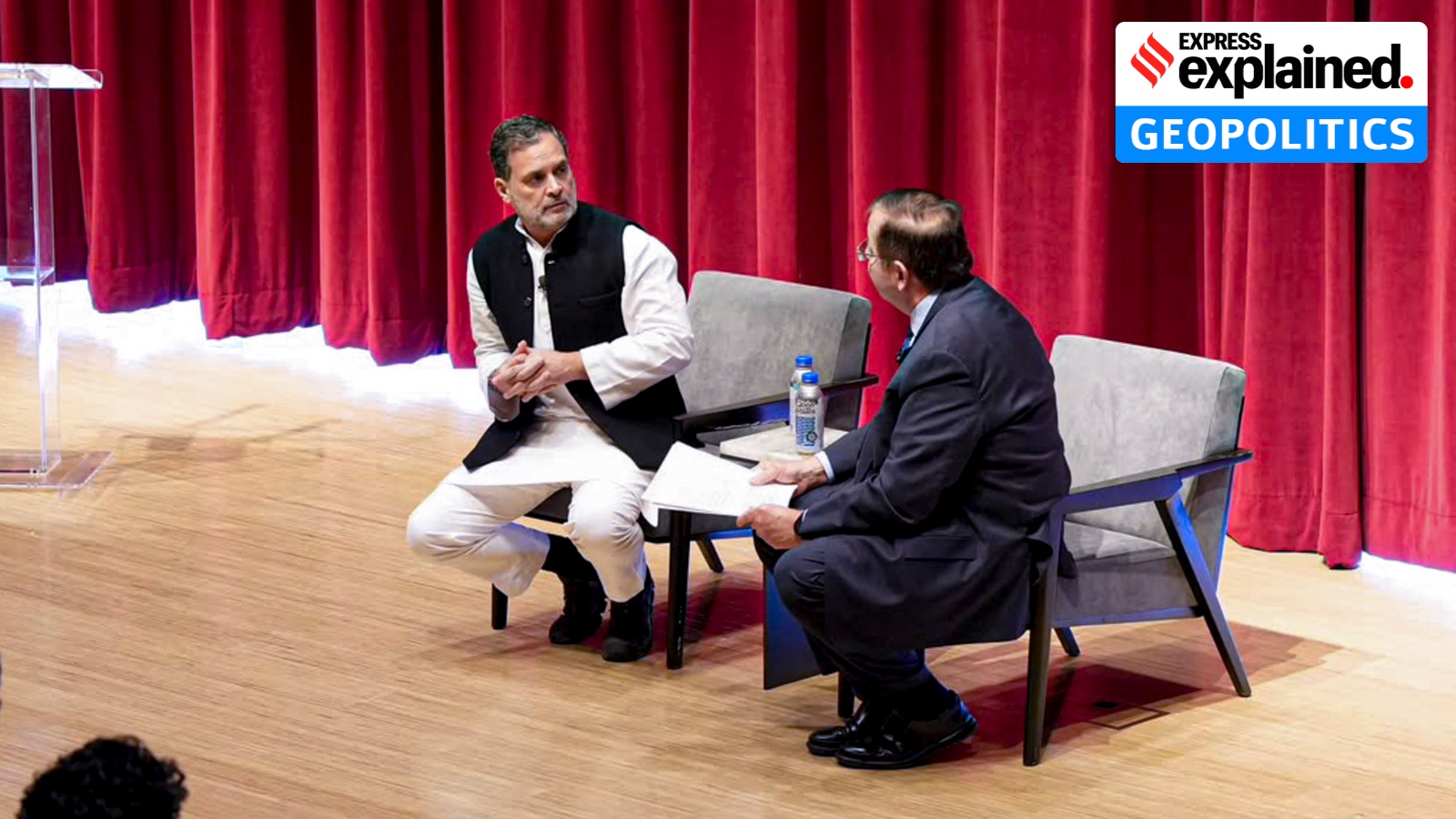
Rahul Gandhi said India must keep a strong relationship with Israel for strategic reasons like buying weapons. He noted, "We have strategic interests, including buying the best weapons for our armed forces. But that cannot mean silence on Gaza." His comments show a shift from his party’s usual critical stance.
Lok Sabha Leader of the Opposition and Congress leader Rahul Gandhi spoke this week about India needing to maintain its relationship with Israel due to "strategic reasons".
Gandhi condemned Hamas's October 7, 2023 attacks and Israel's actions against Palestinians, while adding that he supported a "strong relationship" with Israel. "We have strategic interests, including buying the best weapons for our armed forces. But that cannot mean silence on Gaza," he said.
The comments come at a time when Israel has received global criticism, including from its longstanding ally, the United States. They also differ from the stronger, more critical stance adopted by key members of the Congress Party so far.
India has historically supported the cause of Palestinian statehood, even as it has, of late, deepened relations with Israel. A key factor in this trajectory is defence ties, and one milestone was the 1999 Kargil War. Over the years, The Indian Express has extensively reported on and explained the history and the shifts. This article brings together those explainers to provide a one-stop guide.
Where India stood on Israel, Palestine historically
As The Indian Express earlier reported on India-Israel ties, India recognised the State of Israel soon after it was created in 1948. The establishment of full diplomatic relations would take four more decades, influenced by how national leaders perceived the issue at the time.
Jawaharlal Nehru and Mahatma Gandhi opposed the creation of a State based on religion -- a view in line with their opposition to the Partition of India. India's position with regard to Palestine was also guided by the consensus in the Arab world, the Non-Aligned Movement, and the United Nations.
On January 10, 1975, India recognised the Palestine Liberation Organisation (PLO) as the sole and legitimate representative of the Palestinian people and permitted it an independent office in New Delhi.
Notably, this stance was retained during the first non-Congress government at the Centre in 1977, led by the Janata Party. Addressing a public meeting arranged by the Indo-Arab Friendship League on January 28, 1978, then External Affairs Minister Atal Bihari Vajpayee asked the Non-Aligned Movement and all those who believed in peace and justice in the world to "raise their voice in protest against the injustice being meted out to Palestinians".
India's changing ties with Israel
Former West Asian studies professor PR Kumaraswamy earlier wrote that over time, factors like the Cold War's end and the willingness of Arab countries to negotiate peace, as well as India obtaining arms from Israel during the 1962 China War and the Indo-Pakistani wars in 1965 and 1971, hinted at a sense of "shared security" with Israel.
Following his 1984 electoral victory, Prime Minister Rajiv Gandhi initiated some contacts with Israel, which "became an integral part of the pragmatic, non-ideological approach to foreign policy pursued by Narasimha Rao."
As earlier reported, the Arab countries' neutral position during the 1962 war and their support for Pakistan in later conflicts did not go down well with many, including the BJP. Things changed in West Asia when Iraq invaded Kuwait in 1990. The PLO lost its political leverage on account of its support for Saddam Hussein. Around that time, the Soviet Union disintegrated, and this prompted India to make drastic changes in its policy towards West Asia.
Palestinian President Yasser Arafat was in India on January 19-20, 1992. During a meeting with Prime Minister P V Narasimha Rao, he was told that India's establishment of the relationship with Israel would be helpful for the Palestinian cause. He was told that New Delhi could exert influence on Israel only if it had an ambassador in Tel Aviv. Arafat came on board.
He then famously told a press conference in New Delhi: "Exchange of Ambassadors and recognition (of Israel) are acts of sovereignty in which I cannot interfere... I respect any choice of the Indian government". This would prove to be a game-changer. India formally established diplomatic ties with Israel on January 29, 1992, around 10 days after Arafat's public approval.
The defence factor in India-Israel ties
By the time of the Kargil war in 1999, full diplomatic ties with Israel came in handy. The Indian Air Force (IAF) desperately needed precision bombs to target Pakistani intruders hiding in the caves and bunkers in Kargil's mountains. After political approvals, IAF leaders reached out to their Israeli counterparts, who wasted no time. Israel is understood to have dug into its emergency stockpiles and shipped them to India's air bases within days.
In his visit in 2015 to Israel, then President Pranab Mukherjee had acknowledged and appreciated Israel's support during the war and thanked it for providing "critical defence supplies".
India responded to this decisive show of support by organising a series of high-profile visits to Israel in 2000, with external affairs minister Jaswant Singh leading the first-ever Indian bilateral visit to the country. Home Minister L K Advani also visited that summer.
More recently, India has been the biggest purchaser of Israeli weapons over the last decade, especially between 2015 and 2019, including drones, missile systems, sensors, surveillance technology and border-control equipment.