
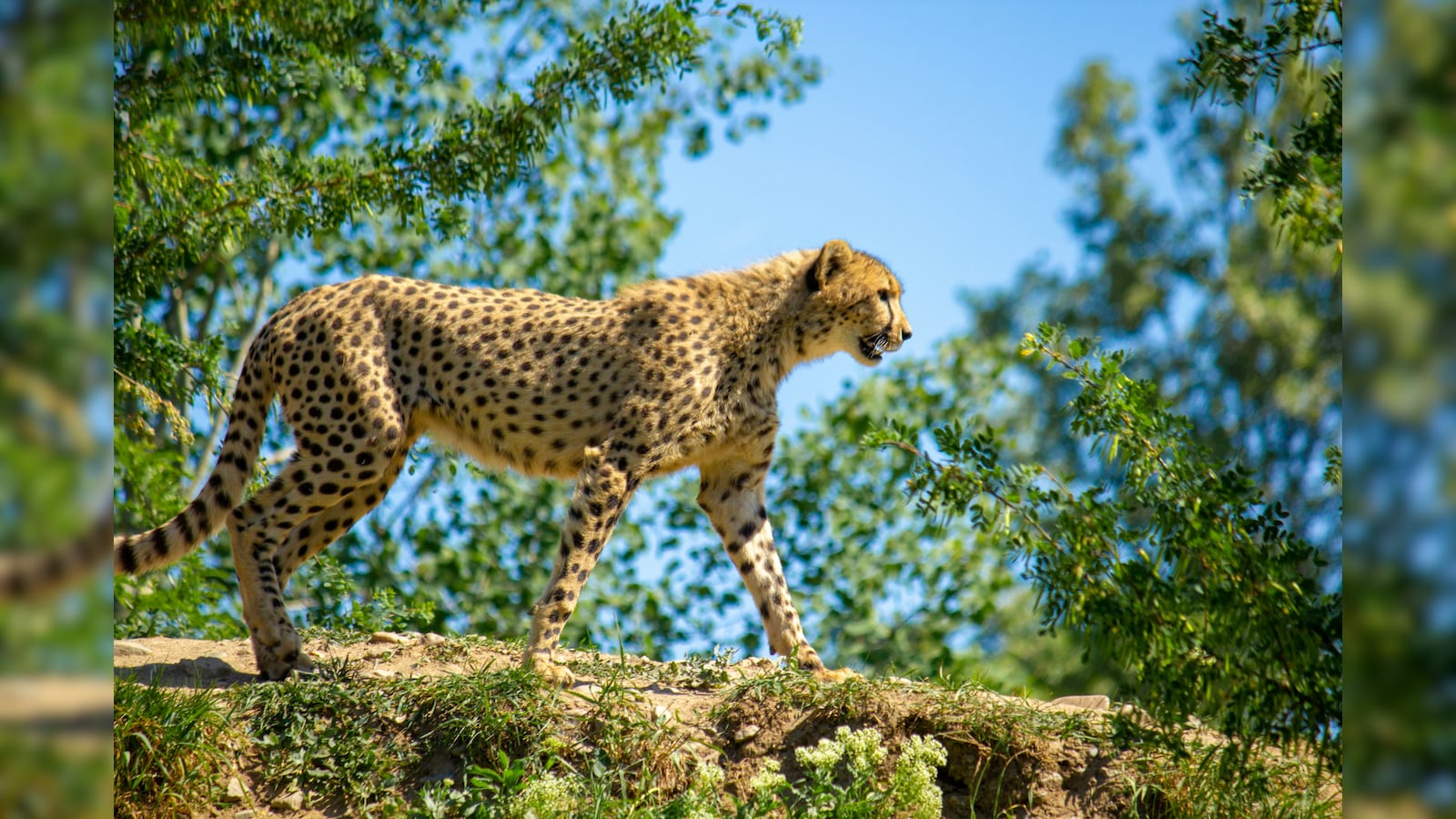
A 19-month-old cheetah cub named KNG22 died on October 27 after being shot five times. Found injured outside Kuno National Park on October 25, the cub could not survive despite surgery. This marks the first fatal shooting since Project Cheetah started in September 2022, raising concerns about animal safety.
The death of a 19-month-old cheetah cub after it was allegedly shot five times has dealt a major blow to Project Cheetah, India's ambitious initiative to reintroduce the big cats. For the first time since the project was launched in September 2022, a case involving the fatal shooting of a cheetah has been reported. The Centre has dispatched a high-level team to investigate the incident, while the Madhya Pradesh government has constituted a Special Task Force.
The cub, identified as KNG22, was the offspring of female cheetah Nirva. It was found injured outside Kuno National Park in Madhya Pradesh on October 25. Emergency surgery at a veterinary hospital led to the recovery of five firearm pellets from its body. Despite efforts to save it, the cub died on the morning of October 27.
The incident has raised serious questions about the safety of cheetahs as they venture beyond protected areas, bringing them closer to villages, farms and human settlements.
Cheetah cub KNG22 died of gunshot wounds
Photo Credit: NDTV Photo
How Did KNG22 Die?
On October 25, KNG22 was found injured outside Kuno National Park, in compartment number 748 of the Morena Territorial Forest Division, under the Sheopur Territorial Forest Division's jurisdiction, according to the information provided by forest officials.
Read | India-Born Cheetah Gives Birth To 5 Cubs At Kuno National Park
A forest department team rescued the cub the same day. Initial X-rays revealed multiple foreign bodies inside its body, prompting officials to shift it to Nanaji Deshmukh Veterinary Science University (NDVSU) in Jabalpur for further treatment.
A CT scan at the university revealed extensive damage to internal organs, bones and the nervous system. During emergency surgery, veterinarians removed five firearm pellets from the cub's body.
Despite medical intervention, KNG22 died on the morning of October 27.
A press note issued by Madhya Pradesh's Principal Chief Conservator of Forests (Wildlife), Dr Samita Rajora, and a statement issued by the Press Information Bureau in Delhi at 7.52 am on October 28 confirmed the incident.
According to the medical assessment, the animal was shot at close range.
The case marks the first reported instance of a cheetah being fatally shot since the launch of Project Cheetah.
Project Cheetah was launched in 2022. NDTV Photo
Project Cheetah
Launched on September 17, 2022, Project Cheetah aims to re-establish a viable population of cheetahs in India after the species became extinct in the country.
A total of 29 cheetahs were brought to India from abroad in three phases: eight from Namibia in 2022, 12 from South Africa in 2023 and nine from Botswana in February 2026.
According to the figures provided, 24 cheetahs, including adults and cubs, had died by September 2026. The death of a cub born to female cheetah Asha on October 12 reportedly took the toll to 25. The death of KNG22 on October 27 brought the cumulative figure to 26.
The material also records the death of Gaurav, also known as Elton, a cheetah from Namibia, on September 21, reportedly due to weakness and dehydration.
Read | Cheetah Cub Dies In Madhya Pradesh, 5 Pellets Recovered From Body
The reported current population of cheetahs stood at 58 before KNG22's death - 52 at Kuno, four at Gandhi Sagar and two at Veerangana Durgavati Tiger Reserve (VDTR).
Cheetah Deaths In Previous Years?
Cheetan population In India is estimated to be at 58 currently
Photo Credit: PIB
Until the death of KNG22, the reported cheetah deaths had been attributed to disease, injuries, accidents and other natural or unexplained causes, rather than shooting.
2023: Eight deaths
The first year of the programme recorded eight deaths, the highest annual toll at the time. The reported causes included kidney disease, a fatal fight during mating involving female cheetah Daksha, septicaemia following maggot infestation in collar-related wounds, and heart failure.
2024: Accidents and unexplained deaths
Cheetah Pawan died after drowning in a drain, while Shourya died under circumstances that were not immediately established.
2025-26: Cub deaths and injuries
Four cubs died in May, with predation suspected. Another female cheetah, KGP-11, died after being injured in Morena district.
The killing of KNG22 represents a different kind of threat. Unlike deaths caused by disease or accidents, the incident points to the possibility of deliberate human violence against a reintroduced wild animal.
India First Born Cheetah Mukhi at Kuno MP
The Challenge Beyond The Protected Forest
Forest officials believe one of the biggest challenges facing Project Cheetah lie not within the protected areas themselves, but along their edges, where forests meet villages, agricultural fields and roads.
As cheetahs explore larger territories, some have moved beyond Kuno and travelled towards the Rajasthan and Uttar Pradesh borders. Such movements increase the possibility of encounters with people and livestock.
The incident raises questions about the effectiveness of existing monitoring arrangements, the availability of safe corridors and the preparedness of forest and police personnel in territorial forest divisions beyond the core reserve.
How Are Cheetahs Monitored?
Authorities have put several measures in place to monitor the animals, reduce conflict and expand their available habitat.
Radio collars and drones: Cheetahs living in the open are monitored through radio collars, supplemented by drone surveillance.
Cheetah Mitras: More than 350 local volunteers have reportedly been engaged to raise awareness among villagers and help authorities manage interactions between people and cheetahs.
Fencing: Gandhi Sagar has a fenced area covering 65 square kilometres, while VDTR has a 418-hectare enclosure. Madhav National Park has a 13-kilometre-long stone wall.
Increasing prey availability: Chital, nilgai and chinkara have been introduced into designated habitats to strengthen the prey base.
Expanding Kuno's landscape: A proposal seeks to increase Kuno's area from 748 square kilometres to 1,800 square kilometres. An additional 541 square kilometres has also reportedly been ordered to be added.
Developing new habitats: Gandhi Sagar is being developed as a second home for cheetahs, while Nauradehi, now part of Veerangana Durgavati Tiger Reserve, is being developed as another habitat to distribute the population across a wider area.
A Cheetah with her cubs at Kuno National Park
NDTV Photo
Madhya Pradesh And Centre Launch Probe
The Madhya Pradesh government constituted a Special Task Force comprising forest and police officials on October 27, the day of the cub's death.
On October 28, the Union Ministry of Environment, Forest and Climate Change dispatched a high-level team to investigate the incident.
The investigation is expected to examine the available evidence, ballistic findings and the circumstances surrounding the shooting. It will also review security and monitoring protocols, with findings to be submitted to the Union ministry.
The proposed areas of investigation include:
Security audit: Establishing how the cheetah moved outside the protected area and whether gaps in monitoring contributed to the incident.
Joint forest-police patrols: Strengthening patrols in territorial forest divisions where cheetahs may come into contact with people.
Illegal firearms: Investigating the possible use of illegal weapons and intensifying enforcement against unauthorised firearms.
Habitat security: Reviewing whether fencing or other protective measures should be strengthened in selected reserves.
Community participation: Exploring eco-tourism and other livelihood opportunities to give local communities a direct economic stake in cheetah conservation.
The investigation will be crucial in determining whether KNG22 was deliberately targeted, who was responsible and whether lapses in security allowed the incident to occur.
A Cheetah at Kuno National Park. NDTV Photo
A Grim Historical Parallel
The killing of KNG22 also evokes a tragic chapter in India's wildlife history. In 1947-48, Maharaja Ramanuj Pratap Singh Deo of the erstwhile princely state of Korea, in what is now Chhattisgarh, is widely credited with shooting India's last three recorded Asiatic cheetahs. Historical accounts say the ruler hunted the animals following complaints that a wild animal was threatening livestock and people.
The cheetah subsequently became extinct in India. In 1952, the Indian government officially declared the species extinct in the country.
More than seven decades later, Project Cheetah was launched to reverse that loss by bringing cheetahs from Africa and establishing a population in India.
The death of KNG22 is not comparable to the historical extinction event in scale, but it is a stark reminder of the threats to a species that India is trying to restore.