
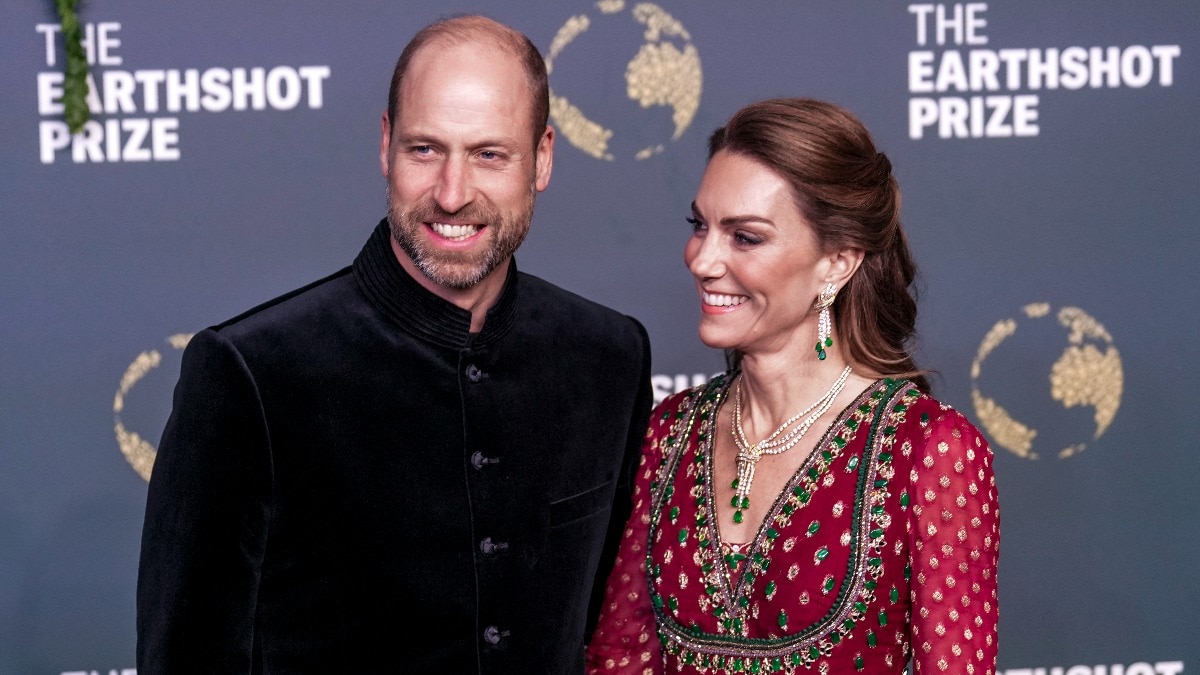
Prince William has Indian roots through his great-great-great-great-great-grandmother, Eliza Kewark. Research showed she was born in 1790 in the Bombay Presidency. DNA tests in 2013 confirmed this South Asian connection. Susan Harvard said, "I am certain that William has heard all about it from them" at the Spencer family home.
A black bandhgala by Manish Malhotra for Prince William and a sindoori-red, hand-embroidered anarkali for Kate Middleton brought Indian design to the centre of the royal couple's Mumbai visit. The sartorial tributes were hard to miss. But there was another Indian connection William could have acknowledged: one in his family tree. Why, then, has the future King of Britain never spoken publicly about his Indian ancestry?
The answer lies in a woman whose story has all the makings of a period drama, complete with forbidden love, social prejudice, an imperial power structure and an abandonment that left her to fend for herself.
According to UK’s The Telegraph, the woman’s name was Eliza ‘Betsy’ Kewark. Born in 1790 to an Armenian father and an Indian mother in the Bombay Presidency, she was William’s great-great-great-great-great-grandmother. And while her descendants would eventually find their way into the British aristocracy, Eliza herself was sidelined by the family she helped create.
The story was first pieced together by Susan Harvard, an academic, art restorer and sheep farmer who spent more than two decades researching Eliza’s life. The Indian connection runs through William’s mother, Princess Diana, whose Spencer family has reportedly known about this branch of its ancestry for years. Harvard believes William himself may have long been aware of his desi roots.
"There are letters in Armenian from Eliza in the library at Althorp [the ancestral seat of the Spencer family], and I am certain that William has heard all about it from them," she told The Telegraph.
THE DNA THREAD
The connection has a scientific basis.
In 2013, researchers led by Dr Jim Wilson of the University of Edinburgh analysed DNA samples from two living descendants of Eliza who shared a maternal lineage with the late Princess Diana. The tests identified a rare strand of mitochondrial DNA, inherited through the maternal line, linking William to the South Asian subcontinent.
The finding was described as "unassailable" by Wilson and the team at Scottish company BritainsDNA, per an India Today report published in 2013. The genetic marker had been recorded in only a handful of people, most of them from India, along with one person from Nepal.
An ANI report that June said the discovery had prompted a hunt for distant relatives and cousins in India, particularly in Gujarat’s Surat. Eliza’s origins had previously been described as Armenian, but the genetic evidence suggested she was at least half-Indian.
The finding also means William may be among the first British monarchs to have a documented genetic connection to the Indian subcontinent. There is, however, a biological footnote: mitochondrial DNA passes from mothers to their children, but William cannot pass this particular maternal-line marker on to his own children.
But how did Eliza’s lineage end up in the DNA of British aristocrats?
AN UNSUITABLE GIRL
Eliza married Theodore Forbes, an ambitious East India Company official. Born and bred in the Scottish Highlands, Theodore was shipped off to India in 1809 after getting a local girl pregnant.
Due to Eliza’s Armenian heritage, the couple wed in an Armenian church ceremony and spent years together as Theodore rose through the Company’s ranks.
But the marriage existed in a world governed by racial hierarchies. Armenian ancestry was considered socially acceptable by the standards of the time; Indian ancestry was not.
Theodore was the son of a Scottish laird whose lineage reached back to the twelfth century and included the Earls of Angus and Douglas. Needless to say, his family was not happy with his choice of partner.
"The head of house told him not to have his wife and children in Bombay," Harvard told The Telegraph. She also found a letter instructing Theodore to "live his life with due propriety".
Such was the stigma that, in official records, Eliza couldn’t be presented as the wife of an up-and-coming East India Company official. Instead, she was described as his housekeeper.
Theodore eventually sent their daughter, Katharine Scott Forbes, known as Kitty, to Scotland, intending to follow. Their son, Alexander, remained with Eliza. Theodore did make the journey home in 1820, but died aboard the ship Blenden Hall.
His death left Eliza in an increasingly desperate position. Under his will, her monthly allowance was reduced to Rs 100. Kitty, meanwhile, was left Rs 50,000 and grew up in relative comfort with her grandparents.
Fourteen years later, Eliza appealed to Theodore’s relative, Sir Charles Forbes, for financial help. He passed her letter on to her children. What happened next remains unclear. The children either never received it or chose not to respond. Eliza disappeared from the historical record.
BRITISH ROYAL FAMILY TREE’S INDIAN ROOTS
Kitty went on to marry James Crombie, whose family made woollen coats. Their descendants gradually entered more prominent circles. One branch eventually led to Ruth Roche, whose daughter Frances married Johnnie Althorp, the future Earl Spencer.
Their daughter was Diana, who married the then-Prince of Wales (now King Charles III) and became the mother of William.
It is a long and unlikely journey from Eliza’s life in the early 19th century to the royal household of today. But the genetic link offers William something more than an unusual footnote to his ancestry. It connects his family history to a country whose relationship with the British monarchy is inseparable from the colonial yoke.
That is also where the story becomes complicated. Theodore’s career was built within the East India Company, which extracted Indian wealth and eroded the subcontinent’s political independence. Eliza’s abandonment was part of a wider pattern in which women and families left behind by Company officials rarely figured in the grand narratives of empire.
Perhaps that historical baggage explains Prince William’s silence. Embracing his Indian connection would also entail confronting the colonial rule that marginalised his long-lost ancestor.
But William’s Mumbai visit offered an opportunity to do both. Acknowledging Eliza would have been a poignant gesture: one that recognised a woman whose story was nearly erased, yet survives through him.
Harvard has a message for the Prince. "I think the moment has finally come when Prince William should say: ‘I am proud of the Indian ancestry I have,’" she said.