
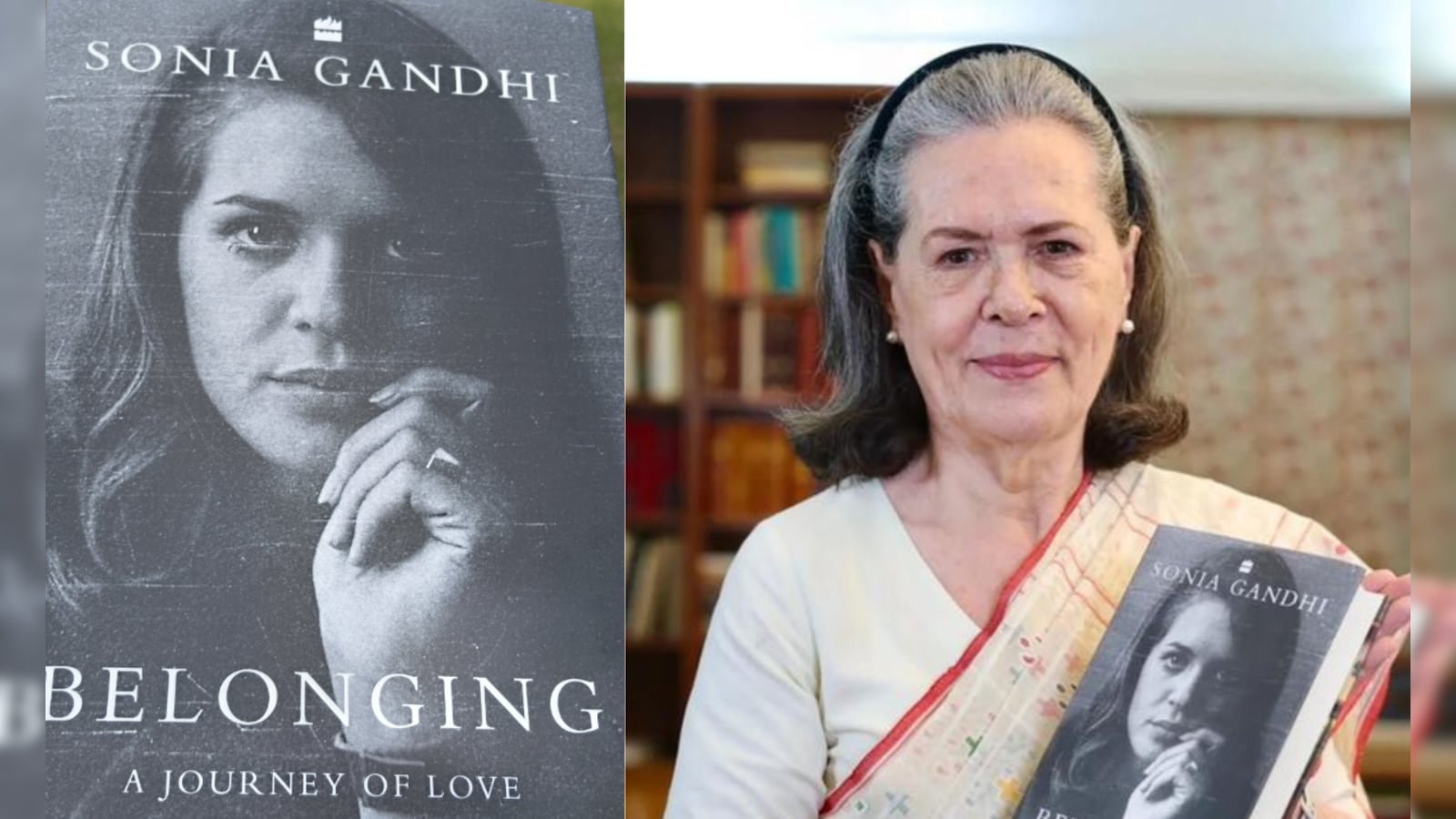
Sonia Gandhi’s memoir, Belonging: A Journey of Love, omits the Indo-US Civilian Nuclear Deal and the Pokhran nuclear explosions. These events shaped modern Indian politics, yet they find no place in her book. The UPA-I government faced a major test on 22 July 2008 to save this landmark nuclear agreement.
Sonia Gandhi's memoir surprisingly leaves out almost any discussion on the Indo-US Civilian Nuclear Deal, and bizarrely there is no mention of Pokhran nuclear explosions that changed global geo-politics
Sonia Gandhi with her memoir "Belonging: A Journey Of Love'
NDTV Photo
New Delhi:
Political memoirs are often judged as much by what they leave out as by what they include. In Sonia Gandhi 'Belonging: A Journey of Love', she offers a sweeping account of her extraordinary journey from a young woman in Italy to the heart of Indian politics. The memoir revisits family tragedies, the lives and legacies of Indira Gandhi and Rajiv Gandhi, the turbulent decades that shaped modern India, the rise of the Congress Party, the challenge posed by its rivals and her own evolution into one of the country's most influential political figures.
Yet remarkably, one of the most consequential political and strategic episodes of the United Progressive Alliance (UPA) era finds no place in the narrative. The Indo US Civil Nuclear Deal, arguably the defining achievement of Prime Minister Manmohan Singh's government and the issue that brought his administration closest to collapse, is not mentioned at all.
The Prime Minister Manmohan Singh-led UPA-I government faced its toughest parliamentary test on 22 July 2008 when it sought a vote of confidence after the Left Front withdrew support over the India-US civil nuclear agreement. The government survived by a margin of 275 votes to 256, allowing it to proceed with the landmark nuclear deal and complete its term until the 2009 general election.
Manmohan Singh staked his government for the Indo-US nuclear deal
Photo Credit: AFP Photo
The omission stands out because the nuclear agreement was not a routine policy initiative. It was the issue that came to define the second half of the UPA government's first term. It dominated political discourse, fractured long standing alliances, triggered a major parliamentary confrontation and tested the resolve of both Manmohan Singh and Sonia Gandhi in ways few other issues ever did.
More importantly, it fundamentally transformed India's place in the world. The agreement ended decades of nuclear isolation imposed after India's nuclear tests at Pokhran and opened the doors for international civilian nuclear cooperation. Historians and strategic experts continue to regard it as one of the most significant foreign policy achievements of independent India.
To understand why its absence from Sonia Gandhi's memoir is so striking, it is important to recall the political circumstances surrounding the agreement. Following India's nuclear tests at Pokhran in 1974 and again in 1998, the country found itself outside the global nuclear commerce regime. International restrictions and sanctions prevented India from accessing civilian nuclear technology and fuel despite its growing energy requirements. Successive governments sought a pathway out of that isolation but no breakthrough proved possible until negotiations between New Delhi and Washington culminated in the landmark civil nuclear agreement during the premiership of Manmohan Singh.
India conducted its first nuclear test Codename 'Smiling Buddha' on May 18, 1974, in Pokhran, Rajasthan
Photo Credit: Archive
The deal represented far more than cooperation on nuclear power generation. It amounted to an international recognition of India's status as a responsible nuclear power despite remaining outside the Nuclear Non Proliferation Treaty (NPT). It also marked the beginning of a new strategic partnership between India and the United States.
For Manmohan Singh, the agreement was not merely another diplomatic success. He repeatedly argued that it would help India meet its future energy needs, provide access to advanced technology and secure the country's place in the emerging global order.
However, what appeared abroad as a diplomatic triumph quickly became a political nightmare at home. The Left parties, whose support was crucial for the survival of the UPA government, strongly opposed the agreement. They argued that closer strategic ties with Washington would compromise India's independent foreign policy. As differences hardened, relations between the Congress and the Left deteriorated rapidly. What began as a policy disagreement evolved into a struggle over the government's survival?
The confrontation reached its peak in 2008. The Left parties withdrew support to the government, plunging the country into a political crisis. The UPA suddenly faced the possibility of losing its majority in Parliament. For weeks, uncertainty gripped New Delhi. Political negotiations intensified. Allies weighed their options. The future of the government hung in the balance. Few issues in modern Indian politics have generated such drama. At stake was not only the future of the nuclear deal but also the continuation of the government itself.
Throughout this period, Manmohan Singh remained committed to the agreement. He regarded it as a strategic imperative and appeared willing to risk his government in pursuit of what he viewed as India's long term national interest. The Prime Minister repeatedly maintained that India could not remain permanently excluded from global nuclear commerce and that history would vindicate the agreement. The confidence with which he defended the deal elevated his image from that of a cautious technocrat to a leader prepared to stake his political future on a matter of principle.
What makes the absence of this episode from Sonia Gandhi's memoir particularly surprising is that while she was initially reticent about the benefits of the deal, later, she herself publicly stood by the Prime Minister during the crisis. When the fate of the government was uncertain and political opposition was mounting, Sonia Gandhi did not distance herself from the agreement. Instead, she publicly defended it. In July 2008 she unequivocally declared that "the nuclear deal is good for India." She backed the government's position and effectively stood shoulder to shoulder with Manmohan Singh as the administration prepared for the trust vote that would determine its survival.
The government survived. The deal survived. History recorded it as one of the most important moments of the UPA era. Yet when Sonia Gandhi looks back at her political life in 'Belonging', there is no account of those dramatic months, no recollection of the parliamentary battle, and no discussion of the tensions with the Left and no reflection on the significance of the nuclear agreement itself.
The silence extends beyond the civil nuclear deal to India's larger nuclear journey. The memoir devotes significant attention to many landmark events that shaped India's political trajectory, but the country's nuclear milestones receive little attention. This is notable because India's nuclear programme has profoundly influenced its geopolitical standing.
Sonia Gandhi seen with Manmohan Singh in this picture from 2004
Photo Credit: AFP
The Pokhran test of 1974, conducted during the premiership of her mother-in-law Prime Minister Indira Gandhi, announced India's arrival as a nuclear capable state. The Pokhran II tests of 1998 under Prime Minister Atal Bihari Vajpayee transformed India's strategic profile, triggered international sanctions and ultimately laid the groundwork for the diplomatic engagement that produced the civil nuclear agreement a decade later.
Together, Pokhran and the nuclear deal reshaped India's relationship with the world. Few developments of the past half century have had such far reaching strategic consequences. Yet readers searching Sonia Gandhi's memoir for an assessment of these events will find almost nothing.
Indeed, references to nuclear matters in the memoir are surprisingly sparse. Sonia Gandhi mentions the devastation of Hiroshima and Nagasaki while discussing the global dangers posed by nuclear weapons and India's traditional advocacy of disarmament. She also recalls the outlook of leaders such as Jawaharlal Nehru, who championed peace and opposed nuclear conflict.
Sonia Gandhi writes "disarmament was a worldwide peace movement to rid the world of nuclear weapons, following the terrible atomic bombing of Hiroshima and Nagasaki, and Jawaharlal Nehru was amongst the first world leaders to champion it globally. Rajiv's commitment to both causes-nonalignment and disarmament-was an important plank of his foreign policy. He presented at the UN in 1988 a meticulous step-by-step and time-bound action plan for a non-violent and nuclear weapons-free world, but the nuclear powers were not ready for an idea ahead of its time."
Writing on the post Pokhran visit of President Bill Clinton in 2000, Sonia Gandhi writes: "[he] was staying at the Sheraton hotel with his daughter, Chelsea, and his delegation in 2000 when I called on him with our foreign minister. Friendly, informal, and exuding confidence, he appeared more keen to give us his own views and predictions about Kashmir-"a nuclear flashpoint," in his words, "one of the most dangerous places on earth"-than to pay attention to our point of view."
However, these references are general discussions about nuclear weapons and international affairs rather than reflections on India's own nuclear programme.
The most direct reference to India's nuclear history appears in a brief passage discussing how some foreign powers viewed Indira Gandhi during a period of heightened international tension. Sonia Gandhi notes that certain countries regarded Indira Gandhi as too independent after the liberation of Bangladesh and following what she describes as "the explosion of a nuclear device." That short phrase is the closest the memoir comes to acknowledging the historic Pokhran test of 1974. There is no detailed discussion of the circumstances that led to the test, the international reaction it generated or the profound impact it had on India's strategic identity.
That brevity is remarkable because both Pokhran and the Indo-US Civilian Nuclear Deal produced geopolitical consequences that continue to shape India today. The first demonstrated India's nuclear capability. The second ended decades of nuclear isolation. Together they altered India's standing in the international system and helped define its emergence as a major power.
Memoirs are, of course, personal works. Authors choose what to emphasize and what to leave aside. No autobiography can include every event. Yet some omissions inevitably attract attention because of the sheer significance of what is missing. The absence of the Indo US Civil Nuclear Deal from Sonia Gandhi's memoir falls squarely into that category. The agreement was not only a milestone in India's strategic history. It was the moment when the government she led politically and the Prime Minister she supported publicly came closest to losing power. It tested coalition politics, reshaped India's foreign relations and remains one of the defining legacies of the UPA era.
Interestingly, may be if Sonia Gandhi ever writes a sequel to her autobiography the Indo-US Civilian Nuclear Deal may feature prominently since the same National Democratic Alliance (NDA) that opposed parts of the deal and stalled it for a decade finally in 2025 passed the landmark SHANTI Act endorsing almost everything that was part of the original UPA deal. After all India's clean energy requirements only increased and by and large domestic nuclear policies have had universal support from across the aisle.
For that reason, the silence is difficult to overlook and is almost deafening. In a memoir that chronicles some of the most dramatic chapters of modern Indian politics, the issue that nearly brought down the government, secured India's re-entry into global nuclear commerce and transformed its strategic future is absent. Pokhran receives only a passing reference to an "explosion of a nuclear device." The civil nuclear agreement receives no mention at all. For historians, political observers and students of the UPA years, that omission may ultimately prove as fascinating as any of the stories that Sonia Gandhi chose to tell.
Got a follow‑up question on this article? Go on
How may i help you today
Show full article
Track Latest News Live on NDTV.com and get news updates from India and around the world