
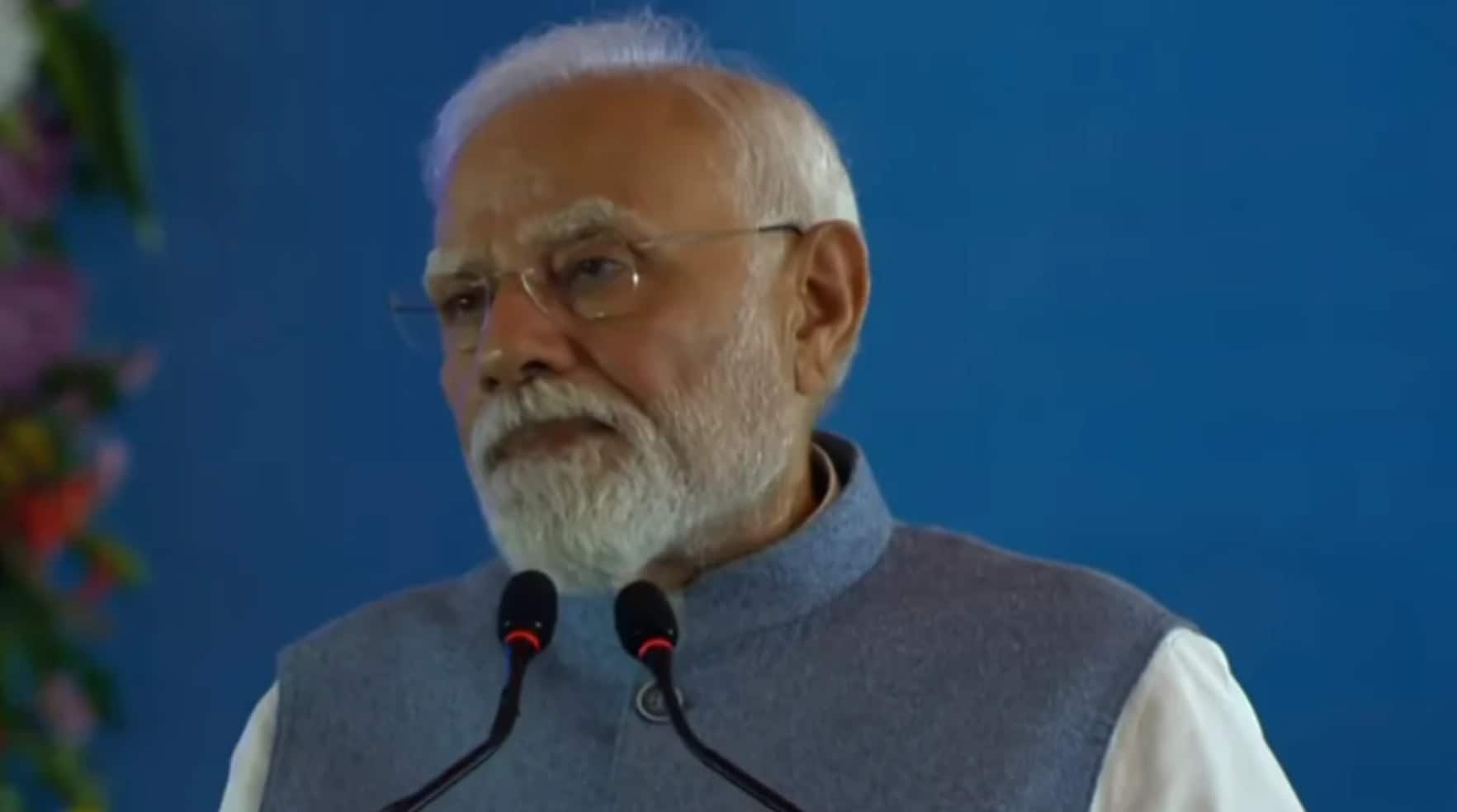
Prime Minister Narendra Modi said on Saturday that his appeal to buy less gold helped people save money. He compared this to Lal Bahadur Shastri’s call to skip one meal. Modi said, "An ordinary person like me asked to buy less gold; the countrymen bought less gold, and gold prices fell."
Prime Minister Narendra Modi on Saturday said his appeal to Indians to avoid purchasing gold unless necessary for a year had helped people save money, drawing a parallel with former prime minister Lal Bahadur Shastri's call to skip one meal during a period of food shortage. Addressing the fifth National Skill Convocation Ceremony at the Indira Gandhi Pratishthan in Lucknow, Modi recalled that he had urged people to cut down on gold purchases a year ago and said the response demonstrated that Indians continued to possess the same spirit of collective participation that they had displayed during Shastri's appeal.
"An ordinary person like me asked to buy less gold; the countrymen bought less gold, and gold prices fell," the prime minister said. Recalling Shastri's appeal, Modi said, "I am happy, just as Lal Bahadur Shastri ji had asked the countrymen to skip one meal, and this country obeyed his call; my country still holds that same character." He added that people had subsequently approached him to say that following his suggestion had helped them retain their money. "Today, people are telling me, 'Modi ji, you spoke, we listened to your advice, and our money was saved,'" he said. Modi's remarks came amid a broader discussion on the country's response to his appeals on spending and investment.
He also referred to his 2023 statement in Parliament encouraging people to invest in Public Sector Undertakings (PSUs) of the Government of India. "Today, you must have seen a big discussion going on in the media and on social media, where everyone is saying that Modi ji had said in Parliament in 2023 to invest money in the Government of India's Public Sector Undertakings (PSUs) and you will become prosperous," he said. The prime minister claimed that his suggestion had initially attracted ridicule but that subsequent developments had vindicated it. "At that time, people mocked me, and today history is a witness that those who invested became prosperous," he added.
BJP national spokesperson RP Singh also backed Modi's remarks on gold purchases, claiming that the prime minister's appeal had influenced buying patterns during festivals. "There is no doubt that the impact of the Prime Minister's appeal was visible across the country today. This time, people did not buy gold or silver for the festivals. Instead, they melted their old gold to make new jewellery and met their needs," Singh said. He further claimed that while gold and silver prices were climbing internationally, domestic prices had remained under control and declined. Apart from these issues, Modi spoke extensively about the importance of vocational education and traditional craftsmanship, particularly at a time when artificial intelligence is raising concerns about employment.
"There is a lot of discussion about AI, but remember that no one can take away the livelihood of a person who possesses skills," he said, stressing that practical abilities would remain valuable despite technological changes. The prime minister said India was transitioning towards becoming the world's skill capital and predicted that people with professional expertise would command greater recognition than those relying solely on academic qualifications. "Times are changing. Skilled individuals will command greater respect than those who merely hold certificates," he said. Modi also spoke about the historical decline of India's traditional crafts, alleging that successive invasions damaged the country's skill-based economy and targeted its artisans.
"When invaders came to India, their first attack was on our skills. They knew that the craftsmanship of Indians was making the country great and prosperous, and sought to destroy it by cutting off the thumbs of artisans," he said. He further accused British colonial rulers of weakening indigenous vocational systems through education policies. Referring to British politician Thomas Babington Macaulay, Modi said the education framework introduced during colonial rule prioritised producing clerical workers rather than encouraging traditional skills. "The British were more sophisticated. They changed their methods.
(British politician Thomas Babington) Macaulay imposed an education system that reduced our skill-based system to producing clerks," he said. He added that even after Independence, conventional clerical employment continued to receive greater social recognition, while vocational training and traditional craftsmanship remained neglected. The prime minister also emphasised parity between technical and vocational education, saying students enrolled in Industrial Training Institutes (ITIs) deserved the same recognition as those studying at Indian Institutes of Technology (IITs). "Be it IIT or ITI, for me, students are the treasure, strength and future of the country," he said.
Modi announced that India would host the 2027 WorldSkills Competition in Greater Noida, Uttar Pradesh.