
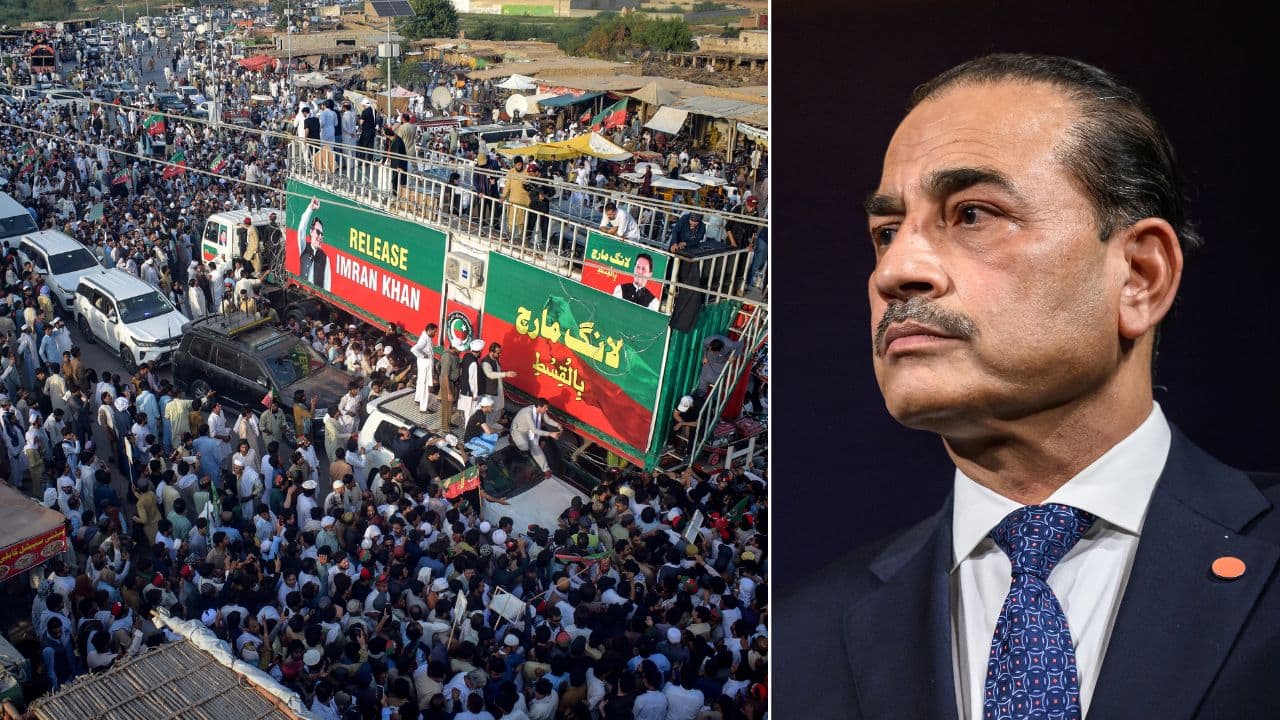
Pakistan imposed emergency in the Khyber Pakhtunkhwa region, sparking a fresh confrontation between the federal government and Imran Khan’s party. PTI leader Shehzad Akbar accused army chief Asim Munir of seeking to redraw provincial boundaries. Asad Qaiser opposed the intervention, declaring: "Governor's rule is unacceptable, emergency is unacceptable." The party continues.
Days after Pakistan imposed emergency in the Khyber Pakhtunkhwa (KP) region, a senior leader of Pakistan's jailed former prime minister Imran Khan's party has accused army chief Field Marshal Asim Munir of seeking to redraw provincial boundaries to consolidate the military establishment's control over the country. The move to impose emergency in the region controlled by Imran's party has triggered a fresh confrontation between the federal government and the Pakistan Tehreek-e-Insaf (PTI). Shehzad Akbar, who served as an accountability minister in Khan's government, alleged in an interview with The Print that the imposition of emergency rule in the PTI-governed province was part of a broader attempt to weaken provincial autonomy and bring control over natural resources and financial allocations under the military-backed establishment. He told The Print that Munir poses a real risk to Pakistan's national security, alleging that once he redraws the whole demography and geography of the country, it will be easy to reverse the distribution of financial resources. He added that the proposals to divide Pakistan's provinces into smaller administrative units could help reverse the devolution of financial powers to provinces and strengthen the military establishment's influence over resource distribution. The allegations come as Pakistan's federal government, led by Prime Minister Shehbaz Sharif, faces mounting opposition over its decision to impose emergency rule in KP, suspend the PTI-led provincial government and authorise the deployment of Army troops in the province. The government has justified the intervention by citing deteriorating security conditions and the provincial administration's alleged failure to cooperate with federal authorities in tackling Islamist militancy. The PTI has described the move as a "coup disguised as an emergency". PTI leaders challenge emergency rule PTI chairman Barrister Gohar Ali Khan called the emergency a "serious political mistake" and an "undemocratic measure", arguing that the people of KP had a constitutional right to the mandate they had given the party. He warned that peace could not be achieved by weakening provincial autonomy or creating a confrontation between the federation and the province. The party, he said, would challenge the decision through constitutional, legal and democratic forums. Former National Assembly speaker Asad Qaiser also opposed the intervention, declaring: "Governor's rule is unacceptable, emergency is unacceptable." Qaiser said the PTI was opposed to terrorism but accused federal policies of contributing to the crisis. He demanded the implementation of the peace jirga's unanimous resolution and described the emergency as "a robbery on the constitutional rights of the province." Junaid Akbar, the PTI's KP president, said the party's long march would continue despite the federal government's intervention. Asad Umar, another close aide of Imran, said that Shehbaz Sharif and President Asif Zardari had not merely signed emergency and governor's rule but had begun a process that could "dismantle the existing system." He warned that all political parties risked being "buried in this political grave." The PTI's opposition comes amid reports that students at Peshawar University have also protested against emergency rule, raising slogans against the imposition of emergency and governor's rule. Military deployment and dispute over resources An order issued by Pakistan's Ministry of Interior and Narcotics Control on October 11 authorised the deployment of Army troops and resources in KP under Article 245 of the Constitution. The deployment is intended to protect citizens, property and government installations and will remain in force for the duration of the emergency proclamation. The order also gives the KP governor responsibility for determining the number of troops and military assets required, in consultation with the Military Operations Directorate at the Army's General Headquarters. The intervention has also brought the province's mineral resources into focus. Akbar alleged that the PTI-led government had resisted proposals involving the extraction of mines, minerals and rare earth elements that the federal government had been discussing with the United States. Separately, security sources cited by CNN-News18 claimed that the military establishment wanted greater control over KP's mines and minerals, while the provincial government had opposed direct military involvement in decisions concerning these resources. Akbar warned that attempts to redraw provincial boundaries could provoke resistance, particularly in Sindh, where the Pakistan Peoples Party (PPP) draws much of its political support and provincial identity remains a sensitive issue. "We cannot have another Sir Radcliffe in the form and shape of Field Marshal Asim Munir to say, I'm going to draw new boundaries with my pen," he told The Print. He was invoking the British lawyer who chaired the boundary commissions that divided British India in 1947. Sir Radcliffe Sir Cyril Radcliffe was a British lawyer who was chosen to chair the boundary commissions in 1947, tasked with drawing the borders that partitioned British India into the independent nations of India and Pakistan. Despite having no prior experience in India and spending only a few weeks in the country, he drew lines on a map that separated millions of people from their homelands, triggering massive displacement and sectarian violence. Today, invoking his name serves as a historical warning about the dangers of outside authorities arbitrarily redrawing regional boundaries without regard for local populations. The National Finance Commission (NFC) Award governs the distribution of financial resources between the federal government and the provinces. The 18th Constitutional Amendment, passed in 2010, significantly expanded provincial autonomy. Islamabad sets up committee to oversee KP Meanwhile, Sharif has formed an 11-member committee headed by Deputy Prime Minister Ishaq Dar to oversee governance and security in KP following the imposition of emergency rule, according to a report by Dawn. The committee was formed informally, with no official notification issued, the newspaper reported, citing a source close to the prime minister. It will monitor governance and security issues daily and report to Sharif. The federal government has also formed an 11-member KP Advisory Council, described as the governor's cabinet, to administer the province. Minister of State for Law Barrister Aqeel has said the emergency and governor's rule could extend beyond six months, depending on the security situation.