
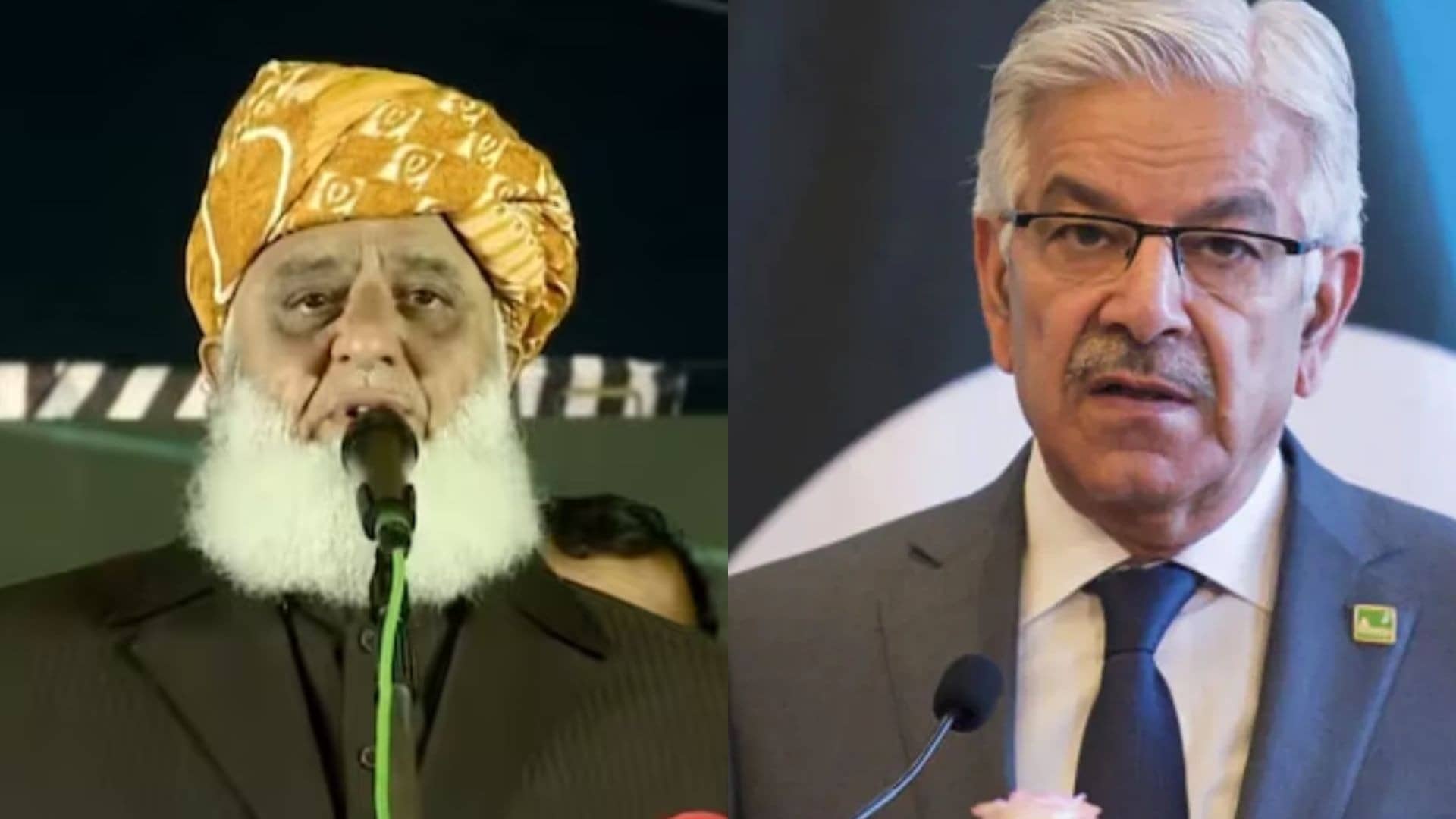
Pakistan’s MP mocked Defence Minister Khawaja Asif in the National Assembly for sitting idle while Chief of Defence Forces Asim Munir held talks in Tehran on October 26. The Jamiat Ulema-e-Islam-Fazl Chief questioned why defence diplomacy happened in Iran while the minister stayed in Islamabad, exposing who runs the country.
Pakistan's MP mocked Defence Minister Khawaja Asif in National Assembly saying defence agreement being made in Iran while minister sitting in Parliament and invoked his own 'sharam-haya' catchphrase as Asim Munir held Tehran talks under Makkah pact.
Islamabad: Pakistan's Defence Minister Khawaja Asif, never short of a soundbite himself, found the tables turned on him inside Parliament when Maulana Fazlur Rehman decided to use Asif's favourite lecture against him. In a moment that had the National Assembly in splits and the clip racing across social media, the Jamiat Ulema-e-Islam-Fazl Chief pointed straight at the treasury benches and asked why defence diplomacy was happening in Iran while the man who is supposed to be the defence minister was sitting idly in Islamabad.
It was classic political theatre, but behind the laughter was a brutal exposure of who actually runs Pakistan. The Shehbaz Sharif government, with the parade of ministers who love microphones, was once again shown to be a front office, while the real files are handled elsewhere.
Who Was In Tehran When The Minister Was In Islamabad?
The analysts clarified that Rehman's jibe was not a stray joke, but it landed because of what was happening on October 26 in Tehran. Although Asif was warming his seat in the Assembly, Pakistan's Chief of Defence Forces (CDF) Field Marshal Asim Munir was sitting across the table from Saudi Defence Minister Prince Khalid bin Salman and Turkish Intelligence Chief Ibrahim Kalin. As per reports, the 3 met Iranian President Masoud Pezeshkian and other top officials.
The meeting was held under the Makkah Joint Defence Agreement, signed in August by Pakistan, Saudi Arabia and Turkey, which essentially says an attack on one is an attack on all three. As officially spun, the Tehran agenda was to prevent fresh escalation, address security fallout from Houthi attacks on Saudi Arabia and explore how to restart negotiations between the United States and Iran. In the middle of nowhere, with no one listening, Pakistan has kept projecting itself as a self-proclaimed mediator between Washington and Tehran.
If the open mockery in the Parliament was not enough to show where power lies, Interior Minister Mohsin Naqvi had also tagged along with Munir on an earlier Iran trip in August. The message could not be clearer, but it pointed out that when it comes to war, peace and pacts, Pakistan's failed marshal, Munir, is the foreign minister, defence minister and chief diplomat rolled into one, while Khawaja Asif is left to explain why he was not even invited.
Maulana Fazlur Rehman, the veteran Pashtun cleric-politician from Dera Ismail Khan in Khyber Pakhtunkhwa who leads the Deobandi-rooted JUI-F with the deep network in seminaries across KP and Balochistan, is no stranger to calling out this charade. The JUI-F, unlike Imran Khan's PTI built around one man's cult or the PPP's dynastic centre-left legacy, mixes religious conservatism and Sharia advocacy with hard electoral arithmetic, and Rehman knows how to read the room.
Asif's Feeble Defence And Rehman's Wider Attack On The Sharif Script
Cornered as meme material in the National Assembly, Khawaja Asif tried to salvage some dignity on Thursday. As reported by Karachi daily Dawn, Asif denied that a defence pact was being negotiated in Tehran or that it had anything to do with his ministry. He claimed that Asim Munir had taken on the role of promoting peace and dialogue in the region and bringing regional countries together, and that the Tehran meeting was simply not his ministry's mandate.
"We have signed two defence pacts -- the Makkah Defence Alliance and the Badr MoU. I was involved in those pacts as I am the defence minister," Asif was quoted as saying by Dawn, adding that it was not the defence ministry's mandate. He then accused Rehman of political opportunism and urged him to show restraint, saying diplomatic efforts should be acknowledged despite differences.
Rehman, who was not done with the first wave of hammer blows, tore into the federal government's handling of politics and security, saying there is a difference between using the Constitution and misusing it. He questioned the logic of removing a provincial government for failing on terrorism, asking why the same yardstick was not applied to Balochistan. "If it's about failure, then Balochistan is two degrees ahead in the failure of the war against terrorism," he said, wondering why emergency measures were not imposed there.
"The way to bring about change is not to bring a revolution and overturn everything; rather, even for that, one must go to the people," he said, before adding a line that summed up his party's grievance, in which he said, "Is your blood sacred, and my blood wasted? This won't do; you will have to give respect."
The episode has once again exposed Pakistan's open secret for the world to see that under Shehbaz Sharif's civilian facade, the real decisions on defence, foreign policy and regional pacts are stamped in Rawalpindi by Asim Munir, not in Islamabad by Khawaja Asif. Although the on-paper minister was left to defend his irrelevance and beg for restraint, Rehman's laughter-filled jibe has forced the uncomfortable question back into the spotlight.