
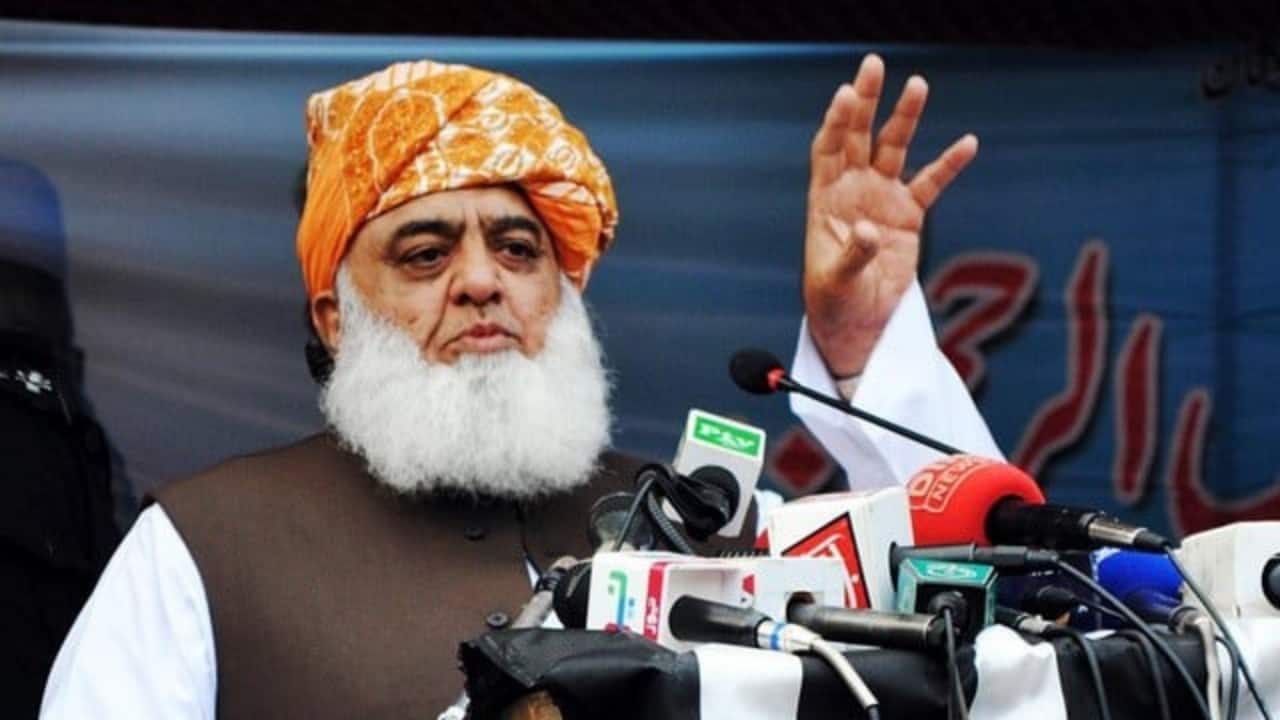
Maulana Fazlur Rehman warned Pakistan’s military leadership against concentrating power, invoking the 1971 fall of Dhaka. He criticised the Shehbaz Sharif government and Army Chief Asim Munir for ignoring political rights. During his address, he said, "Pakistan is not your family's property," while questioning the recent emergency rule in Khyber Pakhtunkhwa.
Pakistan's military leadership has been warned against concentrating excessive power in its hands by senior opposition leader Maulana Fazlur Rehman, who invoked the 1971 Fall of Dhaka as a reminder of the consequences of ignoring political rights and provincial autonomy. The chief of Jamiat Ulema-e-Islam (F) has questioned the growing concentration of authority around Army Chief Field Marshal Asim Munir, warning that excessive power could eventually become a burden for those who wield it. His remarks also target the broader political and institutional system under the Shehbaz Sharif government. Fazlur Rehman drew a parallel with December 1971, when Pakistani forces surrendered in Dhaka following the war that led to the creation of Bangladesh. He recalled how General Yahya Khan had vowed to continue fighting across streets, fields, factories and mountains shortly before the surrender. The comparison served as a warning against relying on military strength and declarations of authority while neglecting political legitimacy, provincial rights and public representation. His criticism comes amid a fresh confrontation over the federal government's decision to impose emergency rule and suspend the Pakistan Tehreek-e-Insaf (PTI)-led government in Khyber Pakhtunkhwa (KP). The province is governed by Imran Khan's party, whose founder and former prime minister remains in jail. 'Pakistan is not your family's property' Fazlur Rehman has accused Pakistan's military establishment and the ruling coalition of exercising power as though the country and its institutions belonged to them personally. "Pakistan is not your family's property," he said, questioning the authority of those making decisions about the country's future without giving its people a meaningful role. His remarks challenge the concentration of power around the military leadership and raise questions about the space available to political parties in Pakistan's decision-making process. The JUI-F chief also criticised what he described as the unequal treatment of security personnel and political workers by the state. "I weep when soldiers are martyred, but you smile when my workers are killed," he said. Fazlur Rehman argued that political cooperation could not be expected from parties and citizens if their rights were disregarded and force was used against political opponents. He maintained that state institutions must respect the lives and rights of political workers if they expect support from the political establishment. Emergency rule in Khyber Pakhtunkhwa sparks fresh confrontation The dispute over Khyber Pakhtunkhwa has added to Fazlur Rehman's criticism of the federal government and Pakistan's military establishment. He has opposed the imposition of emergency and governor's rule in the province, accusing the government of abandoning the possibility of reaching a political settlement with the PTI. The move to suspend the PTI-led provincial government has intensified the debate over provincial autonomy, the authority of the federal government and the role of state institutions in managing political opposition. Fazlur Rehman's intervention places these developments against the backdrop of Pakistan's 1971 breakup, when the country's political crisis culminated in the surrender of its forces in Dhaka and the emergence of Bangladesh. By invoking that episode, the opposition leader has warned Pakistan's powerful institutions against treating centralised authority as a substitute for political accommodation. His remarks come as questions over civilian governance, provincial autonomy and the balance of power between elected representatives and the military continue to shape Pakistan's political confrontation.