
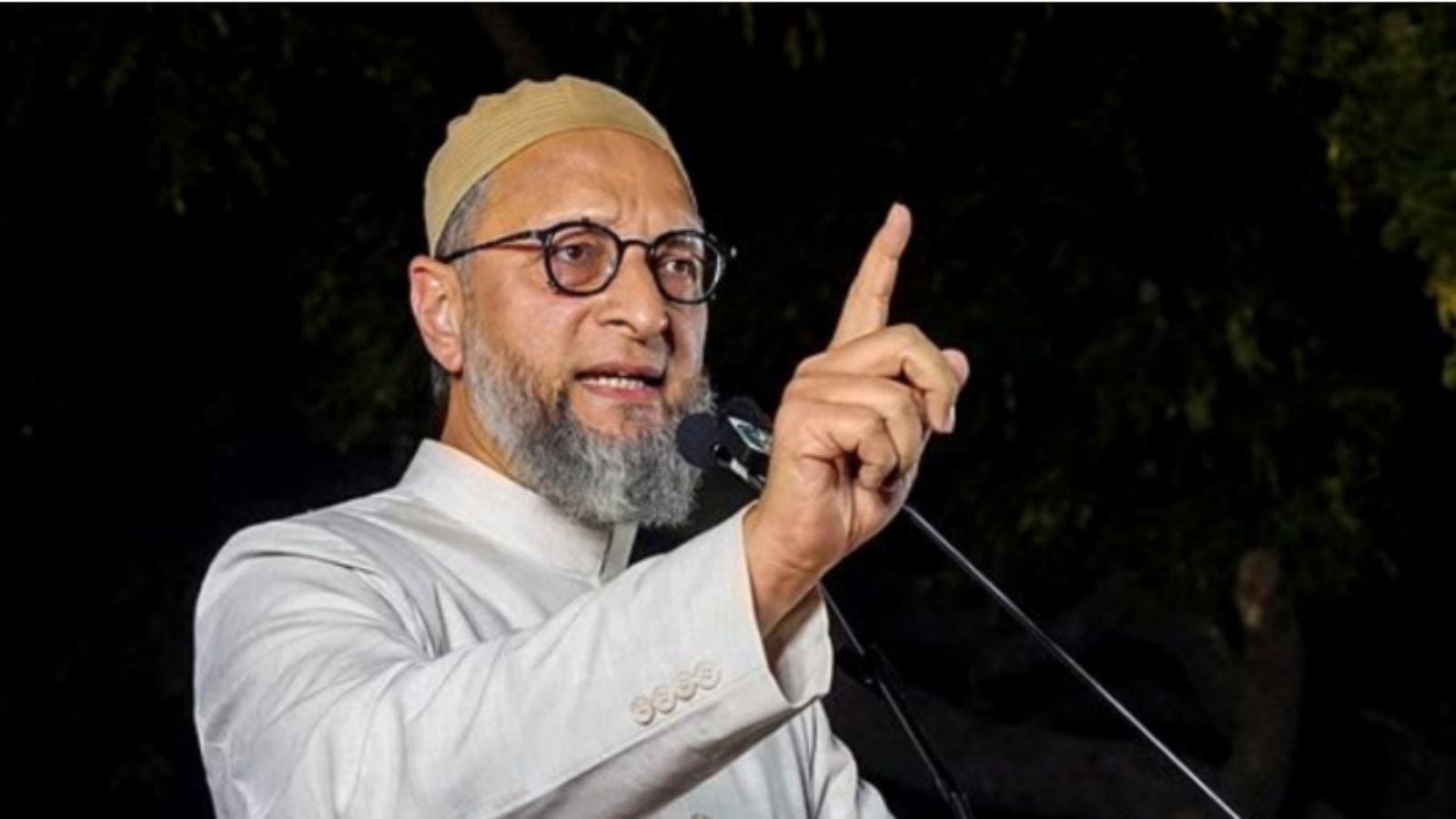
AIMIM chief Asaduddin Owaisi named Chandra Shekhar Aazad as the CM face for the Uttar Pradesh Assembly polls. On November 12, Owaisi said, "Abdul sirf puncture hi kyun banaye, woh mukhyamantri bhi ban sakta hai." This choice left party leaders scrambling to explain why they picked an alliance partner instead.
AIMIM chief's decision to settle on Nagina MP as his coalition's CM face for the Uttar Pradesh Assembly polls has left some of his party leaders scrambling to explain it.
On November 12, AIMIM chief Asaduddin Owaisi said on X, "Abdul sirf puncture hi kyun banaye, woh mukhyamantri bhi ban sakta hai (Why should Abdul only repair punctures? He can become the chief minister too)." He was referring to a derogatory stereotype of Muslims often used by the supporters of Hindutva to make the case that Muslims could even become CMs.
Two days later, while announcing an alliance with the Azad Samaj Party (Kanshi Ram) for the coming Uttar Pradesh Assembly polls, Owaisi named his alliance partner's chief Chandra Shekhar Aazad the CM face of the Samajik Parivartan Morcha (Social Change Front, or SPM).
The announcement, which came after Owaisi repeatedly appealed to Muslims to support independent political leadership for the community, has left AIMIM leaders scrambling to explain their party's decision.
"We are talking about equality and equity. Aazad has made them (our political opponents) restless. They can never accept him standing up to them," Owaisi has said, explaining his decision to back Aazad, the MP from Nagina.
Aazad in a recent interview to The Indian Express said his key promises as the SPM's CM face would be to ensure not just free but free and fair education, healthcare for all as well as prohibition. Leaders of both parties have offered different arguments to justify the alliance's CM face.
AIMIM harps on representation
An AIMIM leader said the SPM had both numbers as well as political chemistry in its favour. "Both communities (Dalits and Muslims) are comfortable with each other. Together, they account for around 40% of Uttar Pradesh's population. Our message was clear - 'Abdul ab dari nahi bichayega (Abdul will no longer lay carpets at the political programmes of other parties)'. We have called for political representation and independent leadership. This alliance will deliver both," the leader said.
Another AIMIM leader said the party's earlier offer of an alliance to the Samajwadi Party (SP) had been based on the demand for political representation. "When we had offered an alliance to (SP chief) Akhilesh Yadav ji, political representation was our only demand. Had the SP accepted our offer, the chief ministerial face would have been from the SP," the leader said.
AIMIM spokesperson Shadab Chouhan skirted the question. "Our government will give equal representation to Muslims and others on the basis of their population share and number of MLAs," he said.
'Aazad more popular in UP'
Azad Samaj Party (Kanshi Ram) leaders were more direct in their justification, citing Aazad's popularity and Dalit credentials. "He (Aazad) belongs to the Dalit community, which has been in power in the state in the past. Our party has a stronger organisational structure across the state. When the alliance contests elections in Andhra Pradesh or Telangana, Owaisi sahab will be the CM face," said the party's Uttar Pradesh vice-president Saurabh Kishore.
He said the Azad Samaj Party had taken the lead in preparations for the Assembly elections, having announced probable candidates for 87 seats, while the AIMIM had declared candidates for only three. Another leader offered a different explanation, saying that projecting a Muslim leader could have intensified communal polarisation, potentially pushing Dalit voters towards the BJP.
"If the alliance had projected a Muslim leader as its chief ministerial face, the polarisation could have been stronger. In that situation, Dalits might have gravitated towards the BJP because of the BJP-RSS campaign along Hindu-Muslim lines. Also, since Aazad is a Dalit, rival parties would be wary of attacking him strongly, much like they hesitate to target BSP chief Mayawati for fear of hurting Dalit sentiments," the leader said.
The Aazad-Owaisi team
Aazad and Owaisi first joined hands during last year's Bihar Assembly elections, along with OBC leader Swami Prasad Maurya's Apni Janata Party. However, the alliance had not announced a chief ministerial candidate.
The AIMIM contested 28 seats and won five, securing 15.24% of the votes. The ASP(K), which fielded candidates in 18 constituencies, failed to win any seat and forfeited its deposit in all of them, polling 2.68% of the votes.
An Azad Samaj Party leader attributed the alliance's limited performance in Bihar to its weak organisational structure and the absence of a joint campaign by Owaisi and Aazad.
"The party did not have a strong organisation in Bihar at the time of the elections. The alliance was announced there by the local state presidents of both parties, and there was no joint campaign by Owaisi and Chandrashekhar. But in Uttar Pradesh, both leaders will address joint public meetings, and we will contest the elections more strongly," the leader said.
Aazad and Owaisi are scheduled to address a rally in Lucknow on November 26, after which the SPM's seat-sharing is likely to be finalised.