
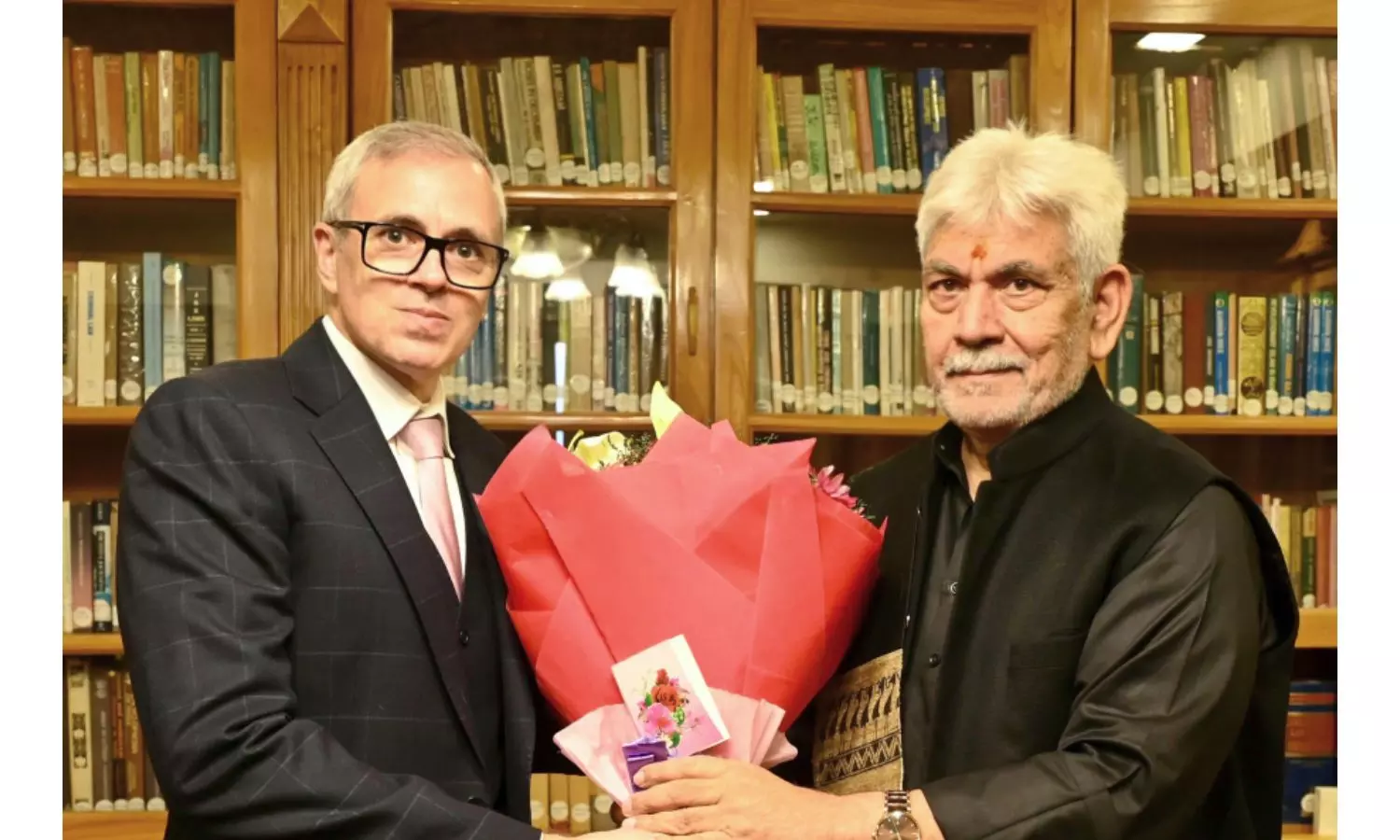
Jammu and Kashmir Chief Minister Omar Abdullah met Lieutenant Governor Manoj Sinha on Saturday to discuss a cabinet reshuffle. Abdullah said the exercise would happen early next week. He asked party members to stop lobbying for spots. Only three slots are open, so he must balance many political expectations carefully.
SRINAGAR: Jammu and Kashmir Chief Minister Omar Abdullah on Saturday met Lieutenant Governor Manoj Sinha at Lok Bhavan here to seek a suitable date for the long-anticipated reshuffle and expansion of his Council of Ministers, a move that is expected to trigger significant political realignments within the ruling alliance and reshape the functioning of the government.
Speaking to reporters after the meeting, Abdullah indicated that the cabinet exercise would be carried out during the first few days of next week. He disclosed that the list of ministers had already been finalised following detailed consultations with National Conference (NC) president Farooq Abdullah and that he had requested the Lt. Governor to allocate time for the swearing-in ceremony and associated formalities.
The Chief Minister also appealed to party colleagues and aspirants for ministerial berths to refrain from lobbying, making it clear that the decisions regarding the composition of the ministry had already been taken. His remarks come amid heightened political activity and widespread speculation over potential inclusions and exclusions in the new-look cabinet.
The impending reshuffle is being viewed as one of the most significant political decisions taken by the Omar Abdullah government since assuming office. The exercise carries both administrative and political implications, particularly as the government attempts to strengthen governance while navigating coalition dynamics, regional aspirations and intra-party expectations.
The political calculations surrounding the cabinet expansion have become increasingly complex. The Chief Minister faces a delicate balancing act as he seeks to accommodate NC legislators aspiring for ministerial positions, address demands from alliance partner Congress, retain the confidence of smaller allies and ensure adequate regional, social and community representation within the government.
The challenge is further constrained by the provisions of the Jammu and Kashmir Reorganisation Act, 2019, which limits the size of the Council of Ministers in the Union Territory to a maximum of nine members, including the Chief Minister. With six positions already occupied, only three vacant slots remain available. Political observers, therefore, believe that any meaningful expansion is likely to involve a substantial reshuffle, including the replacement of some sitting ministers, rather than a simple addition of new faces.
The possibility of such a restructuring fuelled intense lobbying within the NC. Several legislators are understood to be pressing their claims for inclusion in the ministry, arguing that the government requires fresh leadership, renewed momentum and broader regional representation. Speculation also gathered pace following reports that the Chief Minister may have obtained resignations from existing ministers in preparation for a wider cabinet overhaul, although the party has neither confirmed nor commented officially on such reports.
The NC and Congress together secured a comfortable majority in the J&K Assembly following the 2024 elections. However, while the NC assumed office and formed the government, the Congress opted to support the administration from outside. As the government enters a crucial phase marked by governance challenges, developmental priorities and rising public expectations, Abdullah appeared keen to transform the alliance into a full-fledged power-sharing arrangement.
The proposal, however, exposed divisions within the Congress. A powerful faction led by Jammu and Kashmir Pradesh Congress Committee (JKPCC) president Tariq Hameed Karra remains opposed to joining the ministry at this stage. Karra is said to be firmly committed to his publicly stated position that Congress should not become part of the government until the restoration of J&K's statehood. He reportedly believes that any departure from that stand could be perceived as a compromise on a core political commitment. For many Congress workers and supporters, the restoration of statehood remains a non-negotiable objective, and joining the government before achieving that goal could weaken the party's credibility.
Apart from cabinet-related issues, the Chief Minister also addressed several matters of public concern. On reports of Umrah pilgrims from J&K being stranded in Saudi Arabia, he said the issue was being actively pursued with the Ministry of External Affairs. The Chief Minister added that the J&K Government was prepared to provide financial assistance from its own resources, if necessary, to facilitate the return and welfare of the affected pilgrims.
Responding to a question on the regulation of dentistry and related professional matters, Abdullah said the relevant business rules would need to be examined before determining whether the issue fell within the jurisdiction of the Union Government or the elected government of J&K.
On matters relating to the China border, the Chief Minister maintained that such issues fell within the domain of the Government of India and the administration of the Union Territory of Ladakh.
Meanwhile, NC president Farooq Abdullah delivered a strongly worded political message while addressing a workers' convention in Baramulla, urging people to display courage, remain united and stand firmly for their rights. He warned that the people of J&K would risk being marginalised if they failed to confront the challenges before them collectively.
"Jammu and Kashmir is passing through difficult times. If you have the courage, we will fight them; if you do not, you will perish," SeniorAbdullah said, calling on people to speak the truth and defend their rights without fear. He argued that communities survive and progress only when they possess the courage to resist injustice and work collectively for their future.
The veteran NC leader stressed that change would not come automatically and that sustained public engagement was necessary to secure political and constitutional rights. While emphasising that people of J&K did not wish to stand against the country, he said they had every right to seek justice and fulfilment of promises made to them.
He also renewed the NC's demand for the restoration of statehood, recalling that the Centre had assured political leaders that statehood would be restored after the completion of delimitation and Assembly elections. He expressed disappointment that the commitment remained unfulfilled despite both processes having concluded.
Calling for unity across religious and sectarian lines, the NC president urged people to rise above differences and present a collective voice in defence of their interests. He remarked that governments and rulers may come and go, but lasting change could only be achieved through public solidarity and resilience.
Expressing concern over what he described as declining awareness of J&K's political history among younger generations, he urged the youth to understand the region's past and the circumstances that shaped its constitutional and political journey. He reiterated that the people of J&K had never denied their Indian identity and had consistently associated themselves with the democratic and secular ideals represented by Mahatma Gandhi and Jawaharlal Nehru.
The former chief minister also launched a fresh attack on the People's Democratic Party (PDP), alleging that its alliance with the Bharatiya Janata Party (BJP) had ultimately paved the way for the constitutional changes of August 2019, which resulted in the abrogation of J&K's special status and its reorganisation into a Union Territory.