
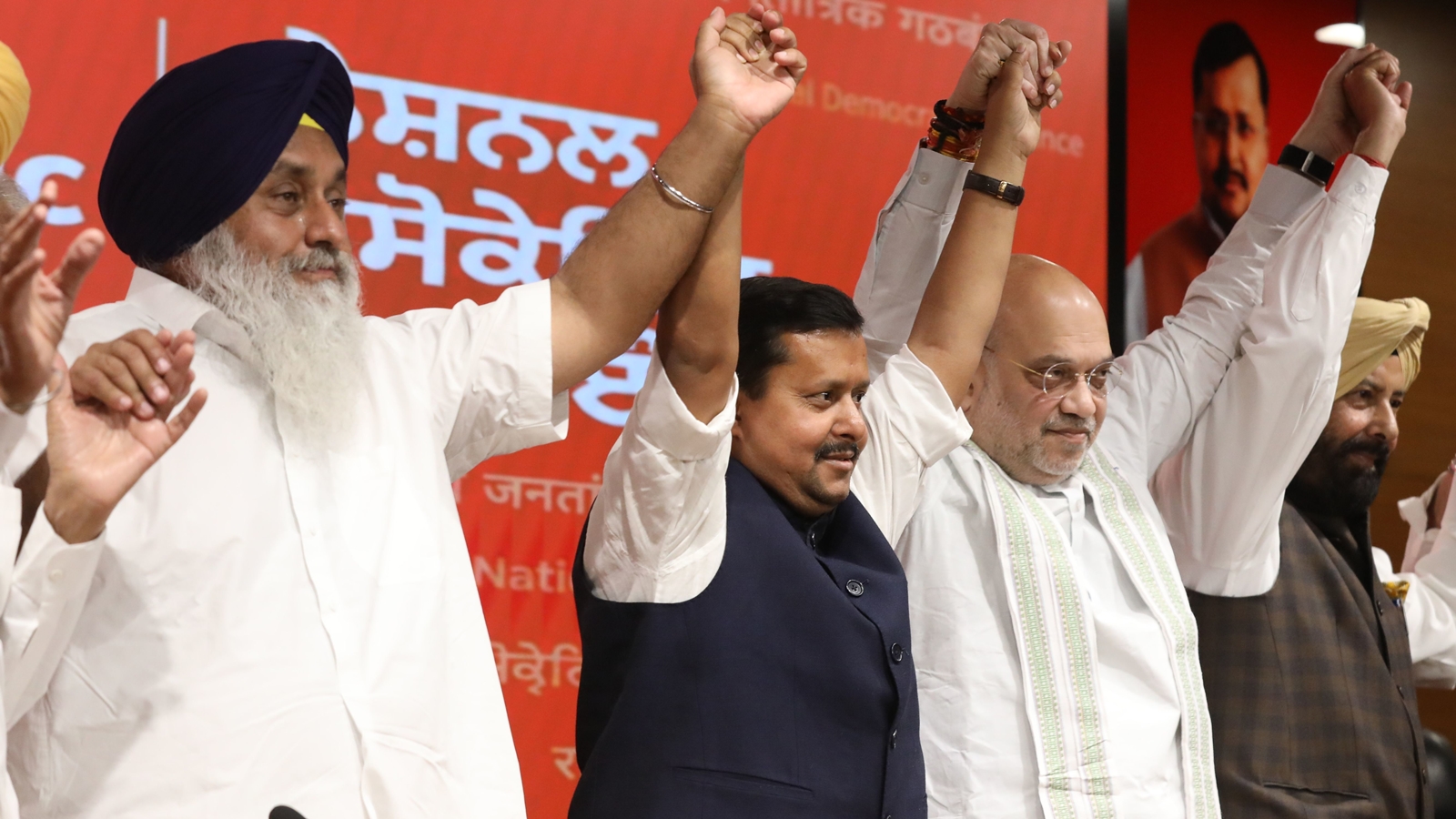
Union Home Minister Amit Shah announced the Akali Dal-BJP alliance on Tuesday. The partners hope to repeat their past success, but the road ahead looks tough. The BJP grew its vote share in the 2024 Lok Sabha elections, while the Akalis work hard to regain their lost ground in Punjab.
There was a sense of déjà vu as Union Home Minister Amit Shah announced the Akali Dal-BJP alliance on Tuesday. Late five-time CM Parkash Singh Badal had famously described it as a "nau-maas da rishta", a bond that he saw as a guarantor of communal peace in the state.
While the partners may see the reunion as a winning proposition, replicating their past success of forming three governments together, beginning in 1997, will require hard work. The alliance has been out of power since 2017.
Punjab presents a tough electoral battlefield as it heads to the polls early next year.
The ruling Aam Aadmi Party (AAP) is fighting a make-or-break battle as it seeks another term on the strength of its welfare record, while a resurgent Congress appears to have finally got its warring leaders to close ranks.
While Shah has reassigned the title of "big brother" to the Akalis, saying that the Shiromani Akali Dal (SAD) would play the senior partner's role and that the Chief Minister would be from the party, the BJP is unlikely to be content with playing second fiddle as it did in the past. The BJP nearly doubled its vote share to 18.56% in the 2024 Lok Sabha elections, giving it a lead of over five percentage points over the Akalis, who polled 13.42%.
Over the past six years, the BJP has tried hard to reinvent itself in Punjab. It has inducted several Jat Sikh leaders, many of them from the Congress, and sought to shed its earlier image of a party largely identified with Hindu traders. It has also made a sustained pitch for Dalit votes. Dalits account for over 32% of Punjab's population, according to the 2011 Census. The Prime Minister's visit to Dera Ballan, where he sought the blessings of its chief, Sant Niranjan Das, and the launch of a yatra earlier this week to mark the 650th birth anniversary of Sant Ravidas underline the importance the BJP is attaching to this constituency.
The Akalis, meanwhile, are working hard to regain lost ground. There are some signs of revival, with veterans such as Prem Singh Chandumajra and former Shiromani Gurdwara Parbandhak Committee (SGPC) chief Bibi Jagir Kaur returning to the party fold.
The anger in the countryside against the now-repealed farm laws also appears to have abated, with two farmer organisations recently aligning with the Akalis.
However, the emergence of the Akali Dal (Waris Punjab De), led by Khadoor Sahib MP Amritpal Singh, and the Akali Dal (Punar Surjit), under former acting Akal Takht Jathedar Giani Harpreet Singh, poses a challenge to the SAD's claim over Panthic votes. Amritpal's return to the state on three-hour custodial parole to attend his grandmother's cremation demonstrated his support among sections of the youth and the Panthic constituency.
The BJP, which has brought in not just Congress leaders but also their political ambitions, is unlikely to settle for the 23 seats it contested in the past.
A new Punjab
The political ground in Punjab has shifted after five years of AAP rule. The border state was among the first to embrace this "new" party in 2022.
The Arvind Kejriwal-led party may not have transformed Punjab as it had promised, but it has taken welfare measures to a new high. Nearly 90% of households receive 300 units of free electricity every month. For the first time in the state's history, eligible women have also begun receiving monthly financial assistance under the Mukh Mantri Mawan Dhiyan Satkar Yojana, launched in July. Now it is going to the polls with a balance sheet of tangible measures instead of mere promises.
While the war on drugs and corruption is the main plank of the revived alliance, voters are unlikely to be swayed by rhetoric alone this time. The Opposition has consistently blamed the alliance, the Akali Dal in particular, for the drug menace in the state.
In 2017, Bhagwant Mann, then an AAP MP and now Chief Minister, made the anti-drug campaign deeply personal, targeting the Badal family with his popular ditty "Kikli".
The alliance's biggest challenge is to convince voters that it has a workable remedy for the state's ills, many of which the Opposition lays at its door. And a mere manifesto will not do. It will have to walk the talk.