
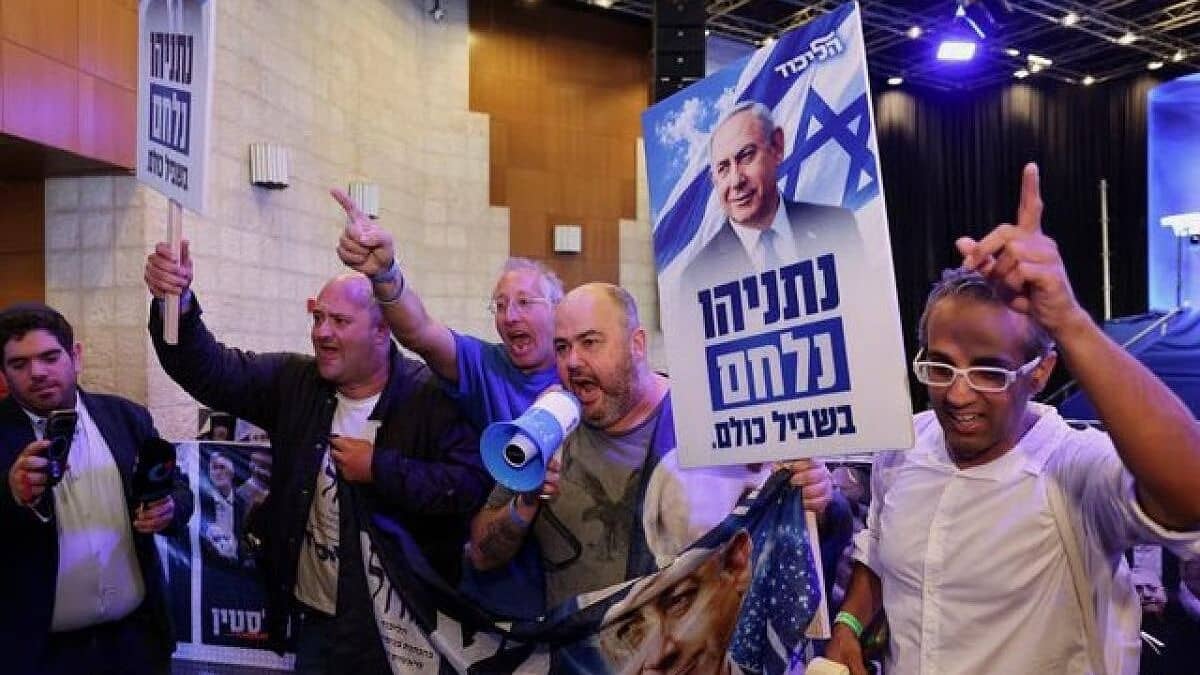
Benjamin Netanyahu’s political bloc failed to secure a majority in the general election, with final results confirming a fragmented parliament. His Likud party got 27 seats, but the bloc only reached 53. With the new Knesset set to take oath on November 10, coalition negotiations will decide the future government.
Benjamin Netanyahu's Likud emerged as Israel's largest party with 27 seats, but his bloc secured only 53, leaving coalition negotiations and Arab parties' support crucial to government formation.
Jerusalem: Israeli Prime Minister Benjamin Netanyahu's political bloc has failed to secure a majority in the country's general election, with the final results confirming a fragmented parliament and setting the stage for coalition negotiations. Although Netanyahu's Likud emerged as the single-largest party, the alliance supporting him won only 53 seats in the 120-member Knesset, falling short of the 61 required to form a government.
The opposition bloc, led by centrist Yashar party chairman Gadi Eisenkot, secured 48 seats, while Arab political factions collectively won 19 seats. Their numbers could prove crucial in determining who forms the next government, as neither of the two main blocs has secured enough support to govern independently.
The Central Elections Committee released the final results on Friday, October 30. The newly elected 26th Knesset is scheduled to be sworn in on November 10.
How Are The 120 Seats In Israel's Knesset Divided?
According to the final results, Likud secured 27 seats, while Eisenkot's Yashar finished second with 21. B'Yachad won 12 seats, followed by the Joint List with 11.
The Democrats and Ra'am secured eight seats each. Yisrael Beytenu, United Torah Judaism and Otzma Yehudit won seven seats apiece, while Shas and Religious Zionism secured six each.
Three smaller political groups failed to cross Israel's electoral threshold of 3.25 per cent. The Reservists received 2.7 per cent of the vote, People of Israel secured 1.7 per cent, while Charedi Public received 0.2 per cent.
Voter turnout stood at 77.9 per cent, with 5,716,665 votes cast.
The final official results will be submitted to Israeli President Isaac Herzog on November 4, following checks for possible errors and other inquiries.
Can Netanyahu Or The Opposition Form The Next Government?
With neither major bloc reaching the required 61 seats, attention has now shifted to possible alliances and coalition negotiations.
One possibility is an opposition-led minority government under Yashar chairman Gadi Eisenkot, with support from Arab parties from outside the government. However, Ra'am leader Mansour Abbas reportedly described such an arrangement as unlikely or impossible during a meeting with party members, according to Channel 12 News.
So far, only The Democrats have expressed openness to including Arab-majority parties in a government arrangement.
Another possibility is a unity government involving Netanyahu's Likud, Eisenkot's Yashar, Naftali Bennett's Together movement and Avigdor Lieberman's Yisrael Beytenu. Such an arrangement could potentially secure a majority in the Knesset.
However, this appears difficult as opposition parties had campaigned on removing Netanyahu from power, while the prime minister remains dependent on his far-right and ultra-Orthodox allies.
Under the government formation process, Herzog will consult representatives of political parties before inviting the candidate considered most likely to form a government.
If the first candidate fails, another lawmaker could be given the opportunity. If the process remains unsuccessful within the stipulated timeframe, Israel could eventually face fresh elections.
Netanyahu Camp's Election Fraud Claims Trigger Investigation
The announcement of the final results has come amid allegations of foreign interference and voter fraud, with Netanyahu's Likud party intensifying its accusations against Arab political groups.
In a post on X, Likud claimed that "the elections in Israel were stolen by Arab parties". The party said it had submitted evidence of alleged electoral fraud to the police, Shin Bet and the Central Elections Committee, demanding an investigation and prosecution of those responsible.
The allegations remain unsubstantiated. Arab-majority lists and Qatar have rejected claims of foreign funding to influence voting, while election authorities have pushed back against suggestions of widespread electoral misconduct.
Central Elections Committee chairman Noam Sohlberg formally asked Shin Bet chief David Zini to investigate suspicions that foreign entities may have attempted to influence voting patterns in the Arab sector.
Shin Bet confirmed that it was examining suspected irregularities but clarified that the investigation was not intended to "cast aspersions or place blame on an entire sector that went out to vote in a democratic and lawful manner".
Acting Central Elections Committee Director General Dean Livne also described claims of widespread electoral misconduct as "entirely groundless". The committee maintained that there was no empirical evidence indicating systematic compromise of the election process.
Meanwhile, Eisenkot accused Netanyahu of attempting to undermine the election outcome and said the opposition would resist any move to delay the opening of the new Knesset.
He also announced plans to introduce legislation on universal military conscription and establish a State Commission of Inquiry into the October 7 massacre. Both proposals are expected to be presented after the new parliament convenes on November 10.
Netanyahu and Finance Minister Bezalel Smotrich, who leads the Religious Zionism-Zehut party, have also reportedly met to coordinate their next steps following the election.
Argentine President Javier Milei congratulated Netanyahu on what he described as the Likud party's "great victory". In a post on X, Milei said Likud "has once again become the leading force in Israel".
"Once more, you have demonstrated the strength of your leadership, even in the face of polls and predictions against you. Argentina and Israel will continue to be strategic allies against those who challenge our Western values," Milei said.
For now, Likud's position as the largest party has not translated into a clear governing mandate. With coalition negotiations ahead and the role of Arab parties still uncertain, Israel faces a potentially prolonged period of political uncertainty.