
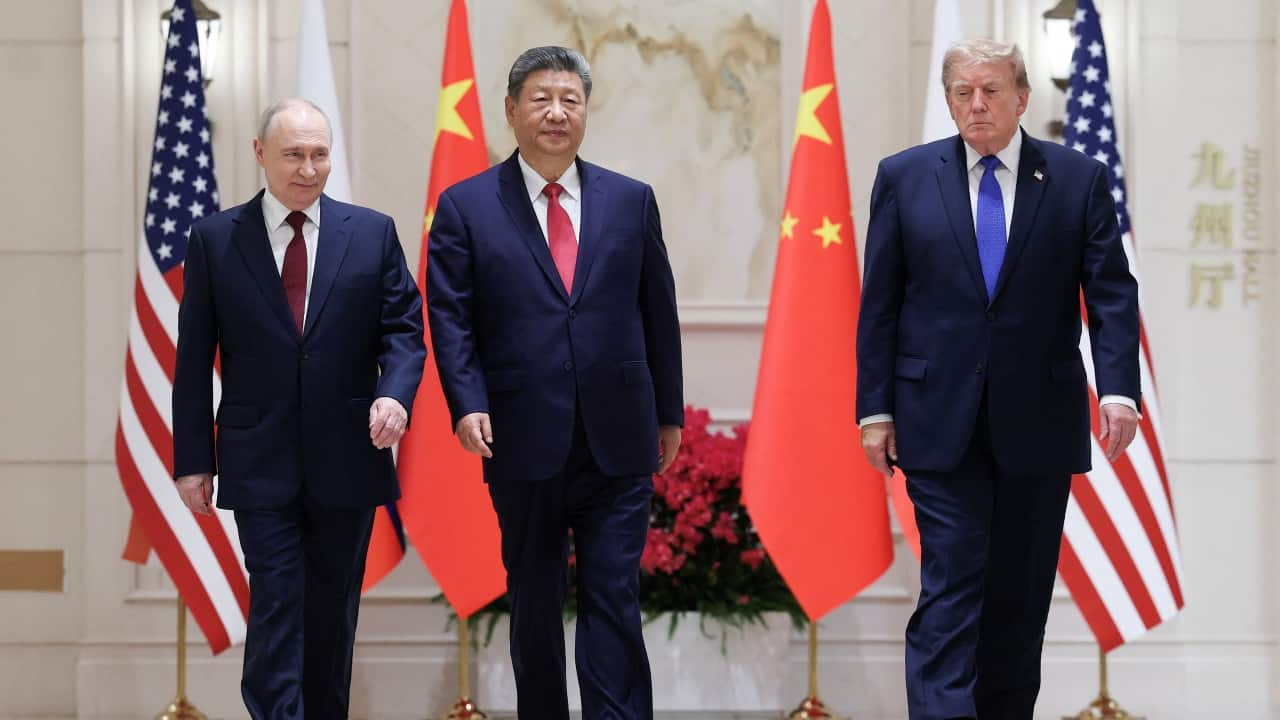
Donald Trump, Xi Jinping, and Vladimir Putin met in Shenzhen on Thursday for a historic trilateral summit. The leaders discussed nuclear security and global stability for 90 minutes at Kylin Villa. While they agreed that a nuclear war cannot be won, the meeting produced few concrete outcomes on other issues.
The first-ever trilateral meeting between the leaders of the United States, China and Russia brought Donald Trump, Xi Jinping and Vladimir Putin together in Shenzhen on Thursday, in a gathering that was projected as an effort to promote global peace and strategic stability amid escalating geopolitical tensions. Held at Kylin Villa on the sidelines of the Asia-Pacific Economic Cooperation (APEC) summit, the meeting lasted approximately 90 minutes, beginning at 4:27 pm local time and concluding around 5:57 pm. The three leaders sat around a large round table, with Xi chairing the discussions. Most of the deliberations took place behind closed doors.
The Kremlin subsequently released a four-point joint statement agreed upon by the leaders. Chinese state media also published a "peace declaration" outlining commitments on nuclear security, energy supplies and international cooperation. However, the meeting produced few publicly announced concrete outcomes. Its significance lay largely in bringing the leaders of the world's three largest nuclear powers together, even as the absence of Ukraine and European representatives raised concerns about major powers discussing international affairs without those directly affected. Here are the key takeaways from the historic Trump-Xi-Putin summit.
1. Nuclear arms control emerges as a common priority Nuclear security featured prominently in the discussions, with all three leaders expressing the need to prevent nuclear conflict and reduce associated risks. The joint declaration reaffirmed the principle that "a nuclear war cannot be won and must never be fought." It also committed the three countries to holding discussions on reducing nuclear risks and preventing nuclear proliferation. Trump called for nuclear arms reductions, while acknowledging the difficulty of giving up such weapons once a country possesses them. Xi went further in his opening remarks, calling for a comprehensive ban on nuclear weapons and their complete elimination.
Chinese state media quoted him describing the nuclear threat as a "Sword of Damocles" hanging over humanity. Xi also urged the three countries to prevent nuclear war and uphold the Non-Proliferation Treaty. The issue assumes significance amid the expiry of the previous US-Russia nuclear arms control treaty in February 2026 and continuing differences over China's participation in future disarmament negotiations. 2. Ukraine remains a major point of difference The war in Ukraine featured in Putin's opening remarks and Trump's discussions with the Russian president, but Xi did not mention the conflict in his address.
Putin said the three countries had several converging interests in resolving regional conflicts, "including, of course, the conflict in Ukraine." Trump and Putin also discussed the Ukraine conflict during their separate bilateral meeting, which lasted around 40 minutes. Kremlin aide Yuri Ushakov said the discussions covered a possible settlement and bilateral relations, but neither side made particularly significant announcements ahead of the trilateral. The absence of Ukrainian representatives from the summit, however, raised concerns in Kyiv that major powers could discuss the country's future without consulting it.
European governments were also not represented at the table. Ukrainian President Volodymyr Zelensky had expressed concerns in October that a meeting involving Trump, Xi and Putin could result in decisions affecting Ukraine without its participation. 3. Xi emerges as the central figure in the summit As the host, Xi controlled the setting and staging of the historic gathering, giving China an opportunity to present itself as a central player in discussions on global security. The Chinese president chaired the meeting and placed emphasis on cooperation, mutual respect and peaceful coexistence. Chinese state media said Xi outlined four principles for relations among the three powers: mutual respect, peaceful coexistence, mutually beneficial cooperation and dialogue.
He also urged the leaders to respect each other's sovereignty, political systems and core interests, while avoiding actions that crossed their respective red lines. On economic relations, Xi called for an end to Cold War thinking and advocated greater trade instead of decoupling. He also called for coordination to protect energy markets and supply chains. Xi described the gathering as having "groundbreaking significance" and said the world remains peaceful when major powers live in harmony, but risks descending into chaos when they clash. The venue, Shenzhen, also carried significance for the Chinese president, whose father helped establish China's first special economic zones there.
4. Putin gets an opportunity to restore Russia's global standing For Putin, the summit offered an opportunity to appear alongside the leaders of the United States and China at a time when Russia remains isolated by Western sanctions over its invasion of Ukraine. The Russian president described the three countries as victors in World War II, saying they shared responsibility for maintaining international peace. He also argued that the United States could contribute to global stability through constructive cooperation and claimed that Europe was facing a "humiliating decline". Putin further maintained that Western sanctions had largely lost their effectiveness.
The summit's photographs reinforced the image of Russia participating as an equal in discussions involving the world's other two major powers. Xi stood at the centre, with Putin on his right and Trump on his left. The Kremlin also said Putin left his separate meeting with Trump in an "excellent" mood, although it acknowledged that no major announcements had emerged from the discussions. 5. Trump seeks to project a different approach to foreign policy Trump described the gathering as a historic moment and told the other two leaders that they had a special responsibility to maintain open, respectful and constructive dialogue.
"We are really making history," he said. The US president argued that previous leaders had often avoided engaging with countries they disagreed with. He said his administration was following a "different course" in foreign policy and also raised the issue of protecting national sovereignty from "rogue globalist organisations." Trump also praised Xi and described their relationship as "very special". Following his bilateral meeting with the Chinese president, Trump said the United States and China shared a firm position that Iran must not acquire nuclear weapons. He added that both countries had an interest in maintaining energy flows through the Strait of Hormuz.
6. Energy cooperation and petroleum supplies feature in the declaration The joint statement outlined plans for the three countries to increase the production and supply of refined petroleum products. Chinese state media also described the leaders as committing to stable energy flows between their countries. Xi called for greater coordination to safeguard energy markets and supply chains, while Putin said energy security should form part of the discussions on global and regional affairs. Trump also highlighted the shared interest of Washington and Beijing in keeping energy moving through the Strait of Hormuz, a key route for global oil supplies.
7. UN reforms and immunity for state officials find mention The four-point statement released by the Kremlin also addressed reforms at the United Nations and the immunity of state officials. The leaders committed themselves to advancing UN reforms and described immunity for state officials as being "of fundamental importance". The statement also cautioned against the International Criminal Court (ICC) exceeding its authority. These issues featured alongside the commitments on nuclear security and petroleum supplies in the joint declaration. 8. Trump holds separate meetings with Xi and Putin The trilateral summit followed a series of bilateral engagements involving the three presidents.
Xi and Putin met on Wednesday for approximately two hours. Xi said the China-Russia relationship had brought stability and certainty to a turbulent world and called for the emergence of a multipolar global order. On Thursday, Trump held separate meetings with Putin and Xi before the three-way gathering. The Trump-Putin meeting lasted around 40 minutes. Trump was accompanied by Secretary of State Marco Rubio and Treasury Secretary Scott Bessent. Putin's delegation included Foreign Minister Sergei Lavrov, Finance Minister Anton Siluanov, Kremlin aide Yuri Ushakov and special envoy Kirill Dmitriev.
Trump called Putin his "friend". Ushakov said the leaders discussed Ukraine and bilateral relations, but did not make any significant announcements. Trump subsequently described his meeting with Xi as "incredible". Before the talks, he had suggested that he would press Beijing to purchase more American agricultural products. Xi, meanwhile, said US-China relations had remained generally stable and improved during Trump's presidency. 9. The summit delivers symbolism, but few concrete outcomes Despite its historic nature, the Shenzhen meeting produced limited publicly announced agreements beyond the joint declaration.
The leaders did not make joint oral statements to the media after the discussions. Even the separate Trump-Putin meeting ended without any major announcement. The summit had been organised at relatively short notice, making its staging and symbolism important elements of the gathering. The three presidents were photographed together against a backdrop carrying the summit's name in three languages. Putin invoked the shared history of the three countries as World War II victors, while Xi used the imagery of a "Sword of Damocles" to underline the dangers posed by nuclear weapons. The gathering also drew comparisons with the 1945 Yalta Conference, where major powers discussed the post-war international order.
With Ukraine and Europe absent, concerns persisted that the three countries could discuss global arrangements without the participation of smaller states and those directly affected by their decisions. 10. How the idea for the trilateral summit took shape The proposal for a meeting involving Trump, Xi and Putin had been discussed for several months. In early September, a senior Russian aide suggested that the three leaders could meet at the next APEC summit. Asked whether Trump and Putin had discussed the possibility during a phone call, Kremlin spokesman Dmitry Peskov replied, "Undoubtedly." Trump expressed openness to a joint meeting in October, as discussions between the three countries gathered pace.
The White House confirmed the summit on November 13. The leaders also arrived with long histories of bilateral engagement. Putin and Xi have met more than 40 times since the Chinese president took office in 2013 and regularly address each other as "dear friend". Trump and Putin have met face-to-face seven times, most recently in Alaska in August 2025. Xi and Trump have held eight face-to-face meetings, including the Chinese president's September state visit to Washington. The Shenzhen summit added a new dimension to these relationships by bringing all three leaders together for the first time.
While the meeting did not produce a comprehensive agreement on Ukraine, nuclear disarmament or other major international disputes, it established a precedent for direct engagement among the three powers. Its joint declaration outlined areas for cooperation, while the absence of Kyiv and European representatives kept concerns over great-power diplomacy firmly in focus.