
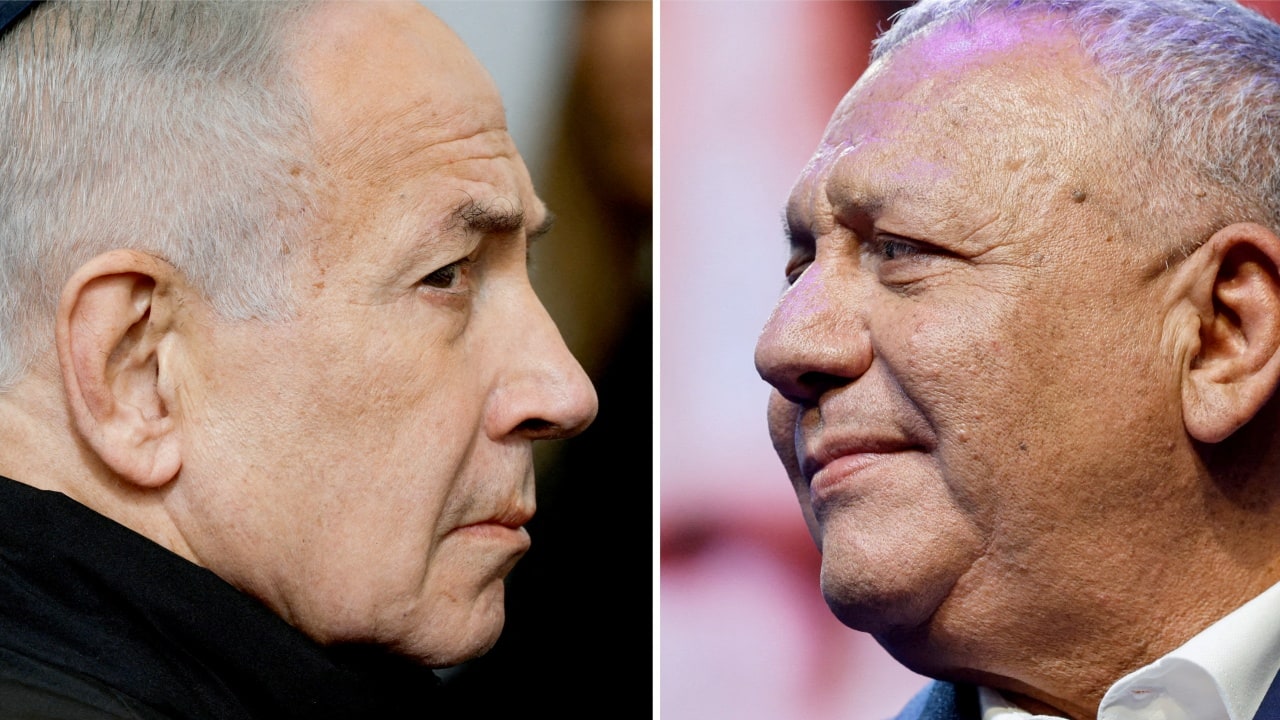
Prime Minister Benjamin Netanyahu said he is open to joining a national unity government proposed by Gadi Eisenkot. Netanyahu called the move an absolute necessity on Monday. Eisenkot, who got a mandate from President Isaac Herzog on Sunday, wants to lead the coalition to fix the country's deep political crisis.
Israel's political uncertainty deepened on Monday after Prime Minister Benjamin Netanyahu indicated he was open to joining a national unity government proposed by opposition leader Gadi Eisenkot, a day after the former military chief offered to bring the ruling Likud party into a coalition under his leadership. "I am ready to enter into discussions with any party to explore forming a national unity government, which is an absolute necessity," Netanyahu said, signalling a possible willingness to consider Eisenkot's proposal. Eisenkot, who received a mandate from President Isaac Herzog on Sunday to form the next government, had reached out to Netanyahu's Likud and the far-right Religious Zionist Party led by Finance Minister Bezalel Smotrich.
However, he made it clear that any such arrangement would have to be under his leadership. "If members of Likud and the Religious Zionist Party truly believe this is a time for unity, as they told the president, I cannot conceive of any reason why they would not support a government under my leadership and the principles I have presented," Eisenkot said. The 66-year-old former military chief has 28 days to put together a government, even though his bloc does not have a clear majority in the 120-member Knesset. He has described the situation facing Israel as an emergency and called for what he termed a national emergency government.
"We are in a state of emergency, approaching a point of no return for the State of Israel," Eisenkot said at the ceremony where he received the mandate from Herzog. "We must form a national emergency government. This will require creative and unconventional political steps." Eisenkot has sought to position himself as a leader capable of bridging Israel's political divisions, while accusing Netanyahu's tenure of bringing the country to a historic crisis. He has also pointed to Israel's growing diplomatic isolation, including concerns raised by some of its closest allies over its policies and military campaigns.
"We are in the midst of a devastating diplomatic crisis. Even our closest friends and strategic allies are saying their relationship with Israel must be reassessed," he said. The numbers behind Eisenkot's challenge During consultations with Herzog last week, Eisenkot secured recommendations from parties representing 67 lawmakers, compared with 46 for Netanyahu. However, the figure included Arab-Israeli parties, whose support remains contentious among several potential coalition partners. Eisenkot could initially attempt to govern with a minority in parliament, relying on support from Arab-Israeli lawmakers from outside the coalition while seeking to bring additional parties on board.
Such an arrangement would face significant challenges. Assaf Shapira, a political expert at the Israel Democracy Institute, said a government beginning with only 48 lawmakers in the 120-member parliament would be exceptionally fragile, requiring extensive negotiations on individual pieces of legislation. Eisenkot's efforts have also opened up discussions over the role of ultra-Orthodox parties, whose support could help him secure a parliamentary majority. Their longstanding exemption from compulsory military service has become a major source of resentment in Israel, particularly as reservists continue to serve repeated tours of duty.
Avigdor Liberman, a former Netanyahu ally who has since become one of his strongest critics, has signalled openness to working with ultra-Orthodox parties despite previously taking a hard line against their military-service exemption. He has maintained that he supports conscription for all Israelis but said removing Netanyahu from power required difficult political decisions. Opposition leader Naftali Bennett has also criticised the exemption, although he has not publicly responded to Liberman's latest position. Eisenkot has said he wants to end violence against Palestinians by extremist settlers in the occupied West Bank and has questioned whether Netanyahu has a mandate for another military attack on Iran.
However, he has broadly supported several of the incumbent government's military decisions.