
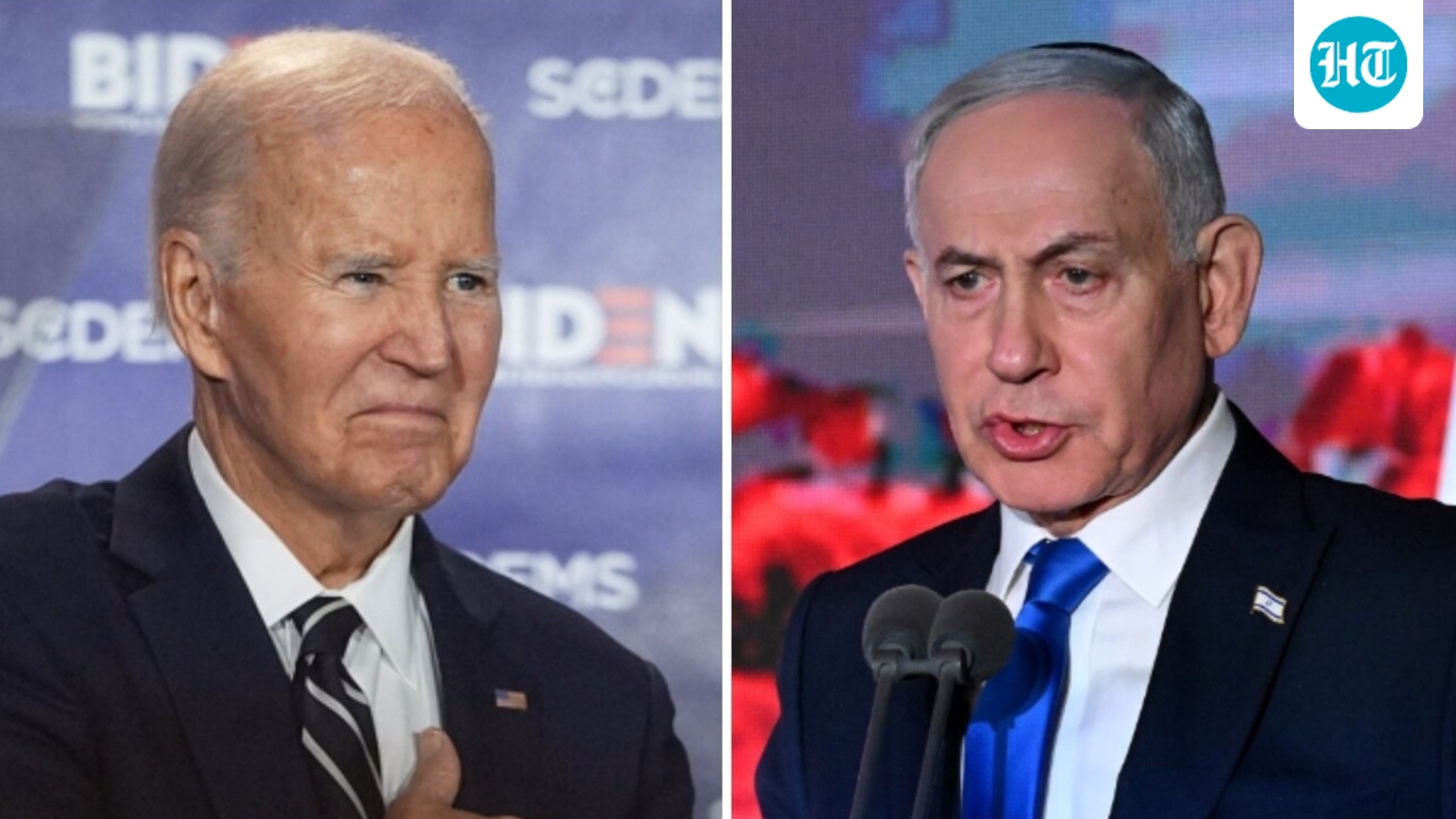
Former US president Joe Biden writes in his new memoir that Benjamin Netanyahu failed to keep promises to limit civilian deaths in Gaza. Biden said, "Bibi had no qualms about making promises he had no power -- or intention -- to keep." The book releases on November 17 following the conflict.
Israeli caretaker Prime Minister Benjamin Netanyahu repeatedly promised to limit civilian casualties in Gaza but failed to honour his assurances, says former US president Joe Biden in his forthcoming memoir.
In the book, Promise Me, America, the 83-year-old writes that he repeatedly raised concerns with Netanyahu over the civilian toll of Israel's bombardment following the October 7, 2023, Hamas attack. Biden says he privately urged the Israeli prime minister to take steps to protect civilians but his pleas fell on deaf ears. The memoir is set to be released on November 17. Its excerpts were published by CNN on Friday.
"I had been calling on Israel to take precautions to reduce civilian suffering since the beginning of the conflict," Biden wrote. "I had expressed these concerns privately in many conversations with Bibi, who acknowledged the damage that these rising casualties were doing to Israel's image, and to US support for the war."
"But a familiar pattern established itself: He would promise to do more, and then another aggressive action would follow, killing more civilians. When we called them on it, the Israelis always had an explanation or excuse, but the result was the same. Bibi had no qualms about making promises he had no power -- or intention -- to keep," Biden wrote.
Hamas attacked Israel on October 7, 2023, killing around 1,200 people. Israel has since continued to ravage the narrow strip with drones, missiles and bombs. The offensive, labelled a genocide by the United Nations, has killed close to 75,000 Palestinians, including children, according to figures from Gaza's Health Ministry cited by the UN Office for the Coordination of Humanitarian Affairs (OCHA). Almost the entire population has been displaced, while years-long restrictions on food and humanitarian aid have further worsened conditions in Gaza.
Biden, in his book, also reflects on his decades-long relationship with Netanyahu, saying he became increasingly frustrated with what he viewed as the Israeli leader's failure to look beyond his immediate political interests.
"While I understood that he was working under severe pressures, I was frustrated by his failure to think like a statesman and safeguard Israel's long-term interests, not just his own short-term political needs," Biden writes.
Biden reflects on tensions with Netanyahu over war in Gaza
Biden faced criticism from sections of his own Democratic Party over his administration's continued support for Israel despite the mounting civilian death toll and repeated calls for Washington to put greater pressure on Netanyahu.
He also faced accusations that he failed to do enough to restrain the Israeli offensive. In the memoir, Biden pushes back against the suggestion that he was misled by Netanyahu, describing how he repeatedly raised concerns about civilian suffering in private conversations with the Israeli leader.
'Go, ask the Israeli leadership'
Beyond his criticism of Netanyahu, Biden also uses the memoir to defend his decision to seek a second term in the 2024 US presidential election.
Many Democrats have blamed his decision to stay in the race, his poor debate performance against Donald Trump in June 2024 and the late switch to Kamala Harris for the party's defeat. Biden, though, maintains that he was the strongest candidate to take on Trump. He argues that no major Democrat challenged him in the primaries and that criticism of his age overshadowed his campaign.
"The press and pundits kept talking about how weak I was. But every purportedly serious candidate decided not to run against me because I was too strong. The primaries sent no warning signs that I was in trouble. But that couldn't derail the narrative setting in on my candidacy. That I was too old. That I was declining mentally."
Biden also challenges the criticism that his mental fitness had deteriorated, particularly following the February 2024 report by former special counsel Robert Hur. The report, which examined Biden's handling of classified documents, raised questions about his memory.
In the memoir, Biden argues that the circumstances surrounding his interview with Hur were not given adequate consideration. He says the questioning took place on October 8 and 9, 2023, in the immediate aftermath of Hamas' October 7 attack on Israel, when he was dealing with the international crisis.
"Being president requires a remarkable amount of gear shifting every day -- from negotiating with foreign leaders to pursuing domestic policy, from visiting a disaster site to rubbing elbows with fundraisers. Hur's commentary was especially outrageous when you think about the context of the interview that he based it on. I sat down for over five hours with Hur and his people across October 8 and 9 of 2023," Biden writes.
"I had been up all night dealing with the aftershocks of a profound change to the global order. Go ask the Israeli leadership if they thought they were dealing with a diminished president that day. Go watch the address I gave to the nation that day and ask yourself if I was old and enfeebled. Or watch the trip I took to Israel eleven days later."
Biden's memoir revisits classified documents controversy
The new book also comes nearly a decade after Biden's previous memoir, Promise Me, Dad, was published in 2017. Its preparation led to controversy involving ghostwriter Mark Zwonitzer, who had recorded interviews with Biden.
One recording, made in February 2017 at Biden's rental home in Virginia, captured the former vice-president saying, "I just found all the classified stuff downstairs!"
The recording later became significant after classified documents were discovered at an office Biden used at the University of Pennsylvania and at his Delaware home. The discoveries led to the appointment of Robert Hur as special counsel in 2023.
Zwonitzer was subpoenaed during the investigation, had his computer seized and faced the possibility of criminal charges. House Republicans also referred him for contempt of Congress, leading to years of legal proceedings.