
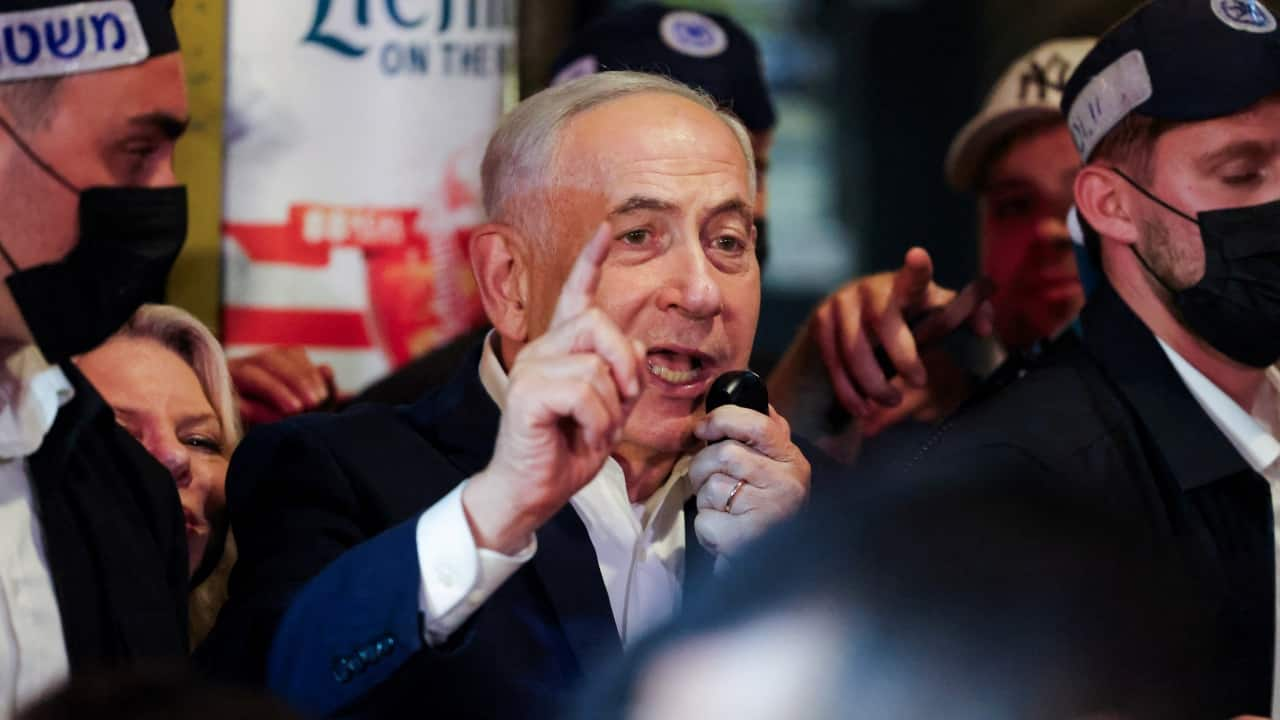
Israeli Prime Minister Benjamin Netanyahu faces a closely contested election on October 27. Opinion polls show neither his ruling bloc nor the opposition may secure the 61 seats needed to form a government. As the nation remains divided, coalition negotiations with smaller parties will likely decide who leads Israel next.
Israeli Prime Minister Benjamin Netanyahu faces a closely contested election on October 27, with opinion polls suggesting that neither his ruling bloc nor the opposition may secure the 61 seats required to form a government. The outcome could determine whether Israel's longest-serving prime minister remains in power after years of war, domestic political divisions and mounting questions over his government's handling of national security. Netanyahu's principal challenger is former military chief Gadi Eisenkot, whose opposition campaign has gained ground in pre-election surveys. With neither side projected to win a clear parliamentary majority, the contest could extend beyond election day, with coalition negotiations and smaller parties potentially deciding who becomes Israel's next prime minister. Netanyahu's political future at stake Netanyahu, leader of the right-wing Likud party, has dominated Israeli politics for decades and served as prime minister for much of the period since 2009. His political future, however, has been shaped by the consequences of the Hamas-led October 7, 2023, attack on Israel and the wars that followed. The attack exposed major security failures and led to sustained scrutiny of the government's preparedness and response. Netanyahu has continued to emphasise national security and military action, while his opponents have called for accountability over the events leading up to the attack. His government has also faced domestic disputes over judicial reforms and exemptions from compulsory military service for ultra-Orthodox Jewish men. The conscription issue has been particularly contentious as Israel's military has faced prolonged operational demands. Netanyahu's political challenges extend beyond security policy. He is also facing a long-running corruption trial in which he denies wrongdoing. The combination of security concerns, domestic divisions and legal proceedings has added to the pressure surrounding his leadership. Gadi Eisenkot emerges as a key challenger Eisenkot, a former chief of staff of the Israel Defense Forces, is seeking to capitalise on dissatisfaction with Netanyahu's leadership and offer voters an alternative after years of conflict and political instability. His military background places national security at the centre of his political profile, while his campaign challenges the prime minister's record in office. The election is therefore not simply a contest between political parties, but also a test of whether Netanyahu can retain public confidence after the security failures of October 2023. Recent opinion polls have placed Eisenkot's political camp in contention, although the fragmented nature of Israel's political system makes it difficult for either side to translate its support into a governing majority. Why a hung parliament is possible Israel elects its 120-member Knesset through a proportional representation system. Voters choose party lists, and parliamentary seats are distributed according to each party's share of the vote, subject to the electoral threshold. A government needs the support of at least 61 lawmakers to command a majority. If neither Netanyahu's bloc nor the opposition reaches that number, the election could produce a hung parliament. In such a scenario, the ability to negotiate with smaller parties would become crucial. Parties that win only a handful of seats could hold the balance of power, determining which bloc has the support required to form a government. Coalition negotiations could consequently become as important as the election results themselves. Even a bloc that emerges with more seats than its rival would not automatically be guaranteed the premiership if it cannot assemble a viable parliamentary majority. Security and domestic divisions shape the contest Israel's security situation remains a major issue for voters, with the October 7 attack and the conflicts that followed continuing to shape political debate. Netanyahu has presented his leadership through the lens of security and military action, while his opponents have questioned the government's handling of the country's most serious security failure in decades. The dispute over military-service exemptions has also exposed tensions within the governing camp. Ultra-Orthodox parties have sought to preserve exemptions for religious seminary students, while other political leaders have argued that military service obligations should be more evenly shared. These disagreements have complicated coalition politics and created competing demands that any incoming government would need to address. What happens after the election? The results will determine the composition of the Knesset, but the identity of the next prime minister could depend on subsequent negotiations. If no bloc secures a majority, political leaders will need to find partners willing to support a government. For Netanyahu, the immediate challenge is to retain enough support among right-wing and religious parties to remain in office. For Eisenkot and the opposition, the task is to assemble a coalition capable of ending Netanyahu's tenure. The election could therefore produce either a new government or an extended period of political bargaining. With the parliamentary arithmetic uncertain, the final outcome will depend not only on how Israelis vote, but also on which parties can agree to govern together.