
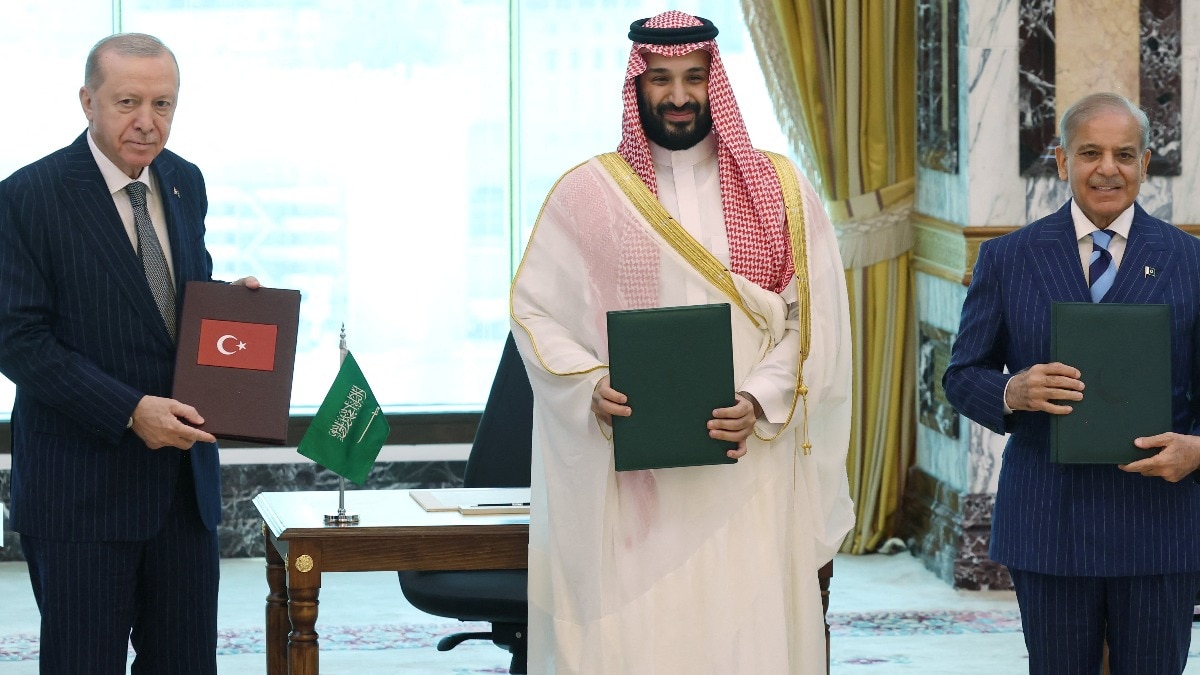
Pakistan, Saudi Arabia, and Turkey can leave the Mecca Joint Defence Agreement only after 10 years from its entry into force. The pact requires members to assist an attacked country. Pakistan’s military spokesperson said Islamabad was providing "whatever support is needed" to protect Saudi Arabia's sovereignty and holy sites.
Pakistan, Saudi Arabia and Turkey can leave the Mecca Joint Defence Agreement only after 10 years from its entry into force, according to the full text of the 16-article pact published by Trkiye Today ahead of its consideration by the Turkish parliament.
While the collective defence pledge was already public, the newly disclosed text spells out the withdrawal restriction and the conditions governing assistance to an attacked member.
"Any 'Party' may withdraw from this Agreement after 10 years have elapsed from its entry into force," Article 16 states. Members must give at least three months' written notice through diplomatic channels, Trkiye Today reported.
The pact has no fixed expiry date. It enters into force when the final instrument of ratification is deposited with the alliance's secretariat. The 10-year period therefore begins from that date rather than its signing.
The details emerged in Turkish media as Ankara submitted the agreement to parliament for ratification on Tuesday, Reuters reported. Parliament's foreign affairs commission must consider it before a vote in the general assembly.
DUTY TO ASSIST, FLEXIBILITY ON RESPONSE
Turkish President Recep Tayyip Erdogan, Saudi Crown Prince Mohammed bin Salman and Pakistani Prime Minister Shehbaz Sharif signed the agreement in Mecca on August 7.
Its central pledge was announced then: an armed attack against one member would be treated as an attack against all. Joint military exercises, intelligence sharing and defence production were also previously outlined.
The text published by Trkiye Today requires members to immediately assist an attacked country. However, the scope and nature of support depend on an assessment of its needs and their available resources.
Members are therefore obliged to help, but the pact does not prescribe a fixed military response or troop contribution.
HOUTHI ATTACKS TEST THE PLEDGE
Missile and drone attacks by Yemen's Iran-backed Houthis on Saudi Arabia are proving to be the alliance's first major test of how that obligation translates into military support.
At an emergency meeting in Riyadh earlier this month, the three members agreed to ensure the rapid deployment of military forces and capabilities in the kingdom.
Pakistan's military spokesperson, Lt Gen Ahmed Sharif Chaudhry, said Islamabad was providing "whatever support is needed" to protect Saudi Arabia's sovereignty, territorial integrity and holy sites.
Speaking to Independent Arabia on Sunday, he described their protection as "paramount" and "non-negotiable" for Pakistan. He did not disclose the nature or extent of the assistance.
A Turkish official told Reuters that Ankara's contribution was expected to be limited to military equipment, intelligence sharing and weapons systems. Foreign Minister Hakan Fidan has described the pact as defensive, saying Turkey would not send troops into another country to carry out attacks.
Egypt is also considering joining the alliance. Foreign Minister Badr Abdelatty said membership was under "serious consideration" and pledged support for Saudi Arabia following the Houthi attacks, Trkiye Today reported.
DIFFERENT ROUTES TO APPROVAL
Domestic approval processes also shape how members can implement the pact. Turkey requires parliamentary ratification of the agreement and separate parliamentary permission for troop deployments abroad.
Saudi Arabia, an absolute monarchy, approves international treaties through royal decree rather than parliamentary ratification.
Pakistan's participation has drawn scrutiny over parliament's role and the risk of involvement in the Yemen conflict. Its Foreign Office has maintained that deployments under the pact do not require parliamentary approval and are covered by existing laws and government procedures.
In 2015, Pakistan's parliament backed Saudi Arabia's territorial integrity but declined to commit Pakistani forces to combat in Yemen.
Islamabad has said troops deployed under the current arrangement would defend Saudi territory and would not cross into Yemen to attack the Houthis.