
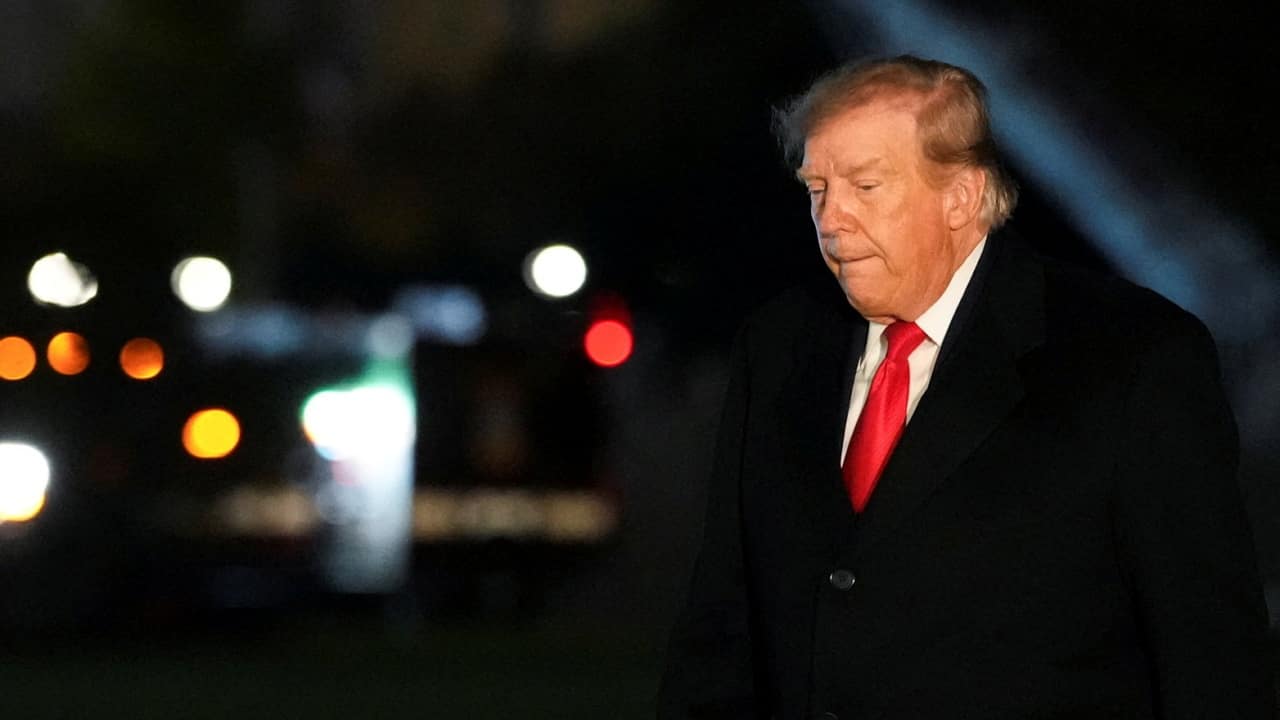
US President Donald Trump said he could order fresh military strikes against Iran following a meeting with his national security advisers on Thursday. "Maybe I will have to," Trump told reporters regarding the potential offensive. The US military is preparing for combat while diplomatic efforts to end conflict continue.
US President Donald Trump has indicated that he could order fresh military strikes against Iran, saying a decision on whether to resume an all-out offensive would be taken soon following a meeting with his national security advisers. The remarks came as the US military finalised preparations for a possible return to major combat operations, even as diplomatic efforts to end the conflict continued. "Now we will make a decision. Do we want to go further" with strikes to ensure Iran's nuclear programme is destroyed and "it will never happen again?" Trump told reporters in the Oval Office on Thursday.
"I would rather not destroy the rest of the country if possible, but maybe I will have to. You'll know soon enough," he added. According to Axios, Trump is weighing three broad options - launching another round of military strikes, maintaining economic pressure on Tehran or pursuing a negotiated settlement that would require significant concessions from Iran. The president's meeting with his top national security advisers on Thursday was the first such discussion on Iran since the November 3 midterm elections, Axios reported, citing two US officials. The election outcome was seen as a turning point for the administration's approach to the conflict, with the political fallout from the war raising questions about the costs of further military escalation.
The US Central Command (CENTCOM) is preparing for the possibility of renewed combat operations but has not received fresh instructions from Washington, according to a US official cited in the Axios report. One possible indication of an impending military escalation would be the deployment of a third US Navy aircraft carrier strike group to the Middle East. The USS Theodore Roosevelt and its accompanying strike group are scheduled to make a port call in Singapore from Friday and are not expected to reach CENTCOM's area of responsibility before mid-November, the official said. Even as Washington considers its military options, regional powers have stepped up efforts to broker an understanding between the two sides.
Iranian Foreign Minister Abbas Araghchi held several telephone conversations on Thursday with regional interlocutors from Qatar, Saudi Arabia, Turkey, the United Arab Emirates, Oman and Egypt. Qatari mediators have also continued discussions with Tehran and the White House on a draft proposal outlining a two-day confidence-building process that could pave the way for broader negotiations, according to regional sources cited by Axios. Under the proposal, Washington would lift its naval blockade of Iran and release some of the country's frozen funds on the first day. Tehran, in return, would formally invite the International Atomic Energy Agency (IAEA) to send inspectors to nuclear sites struck during the conflict, in line with an agreement reached in Cairo a year ago.
On the second day, Iran would reopen the Strait of Hormuz, after which negotiations on its stockpile of highly enriched uranium would resume. However, Tehran has indicated that it is unwilling to make concessions without prior commitments from Washington. Iran's Supreme National Security Council secretary Mohsen Rezaei met Russian President Vladimir Putin at the Kremlin on Thursday, days after the Russian leader offered to mediate in the conflict. Rezaei said he had delivered a message from Iran's Supreme Leader Mojtaba Khamenei to Putin, who reiterated his willingness to help bring the war to an end.
"We told Mr Putin that we announced seven conditions to the Americans regarding diplomacy, and that until the Americans fulfil our seven conditions, neither the Strait of Hormuz will be opened nor will there be any negotiations," Rezaei said after the meeting. The uncertainty over Trump's next move comes amid mounting political pressure on his administration over the conduct of the Iran war, with US Defence Secretary Pete Hegseth facing calls for impeachment and questions over his future at the Pentagon. In a video message posted on social media on Thursday, Hegseth defended his handling of the conflict and vowed to resist efforts to remove him from office.
He described the military campaign against Iran as a "courageous and historic" effort aimed at preventing Tehran from acquiring nuclear weapons. "You see, they attack me, they attack us, because we are effective. It's not going to work. We will not back down," he said. Hegseth dismissed the impeachment campaign as a "sham", drawing a comparison with Trump's two impeachments during his first presidency. "It's all about the politics of personal destruction. It didn't work against President Trump, and it won't work with me. You can rest assured of that," he said. The remarks followed the Democrats' victory in the midterm elections, which gave the party control of Congress and set the stage for investigations into the Pentagon's functioning and Hegseth's decisions.
Hegseth has faced criticism over his handling of the Iran conflict, the dismissal of senior military officials and strained relations with lawmakers as the administration seeks approval for a $1.5 trillion defence spending package. Trump, however, defended his Pentagon chief on Thursday, saying Hegseth had "done a fantastic job". He suggested that opposition to the defence secretary stemmed partly from his decision to remove several senior military officers. "We had so many generals. Everybody was a four-star general. I never saw anything like it. And many of those people were woke. I don't like a woke general.
And so, he probably has opposition," Trump told reporters. The war has also exposed divisions within the Republican leadership over the administration's foreign policy and the political cost of continuing the offensive. Vice President JD Vance had publicly questioned whether the Iran war was worth its cost, arguing that the conflict contributed to Republican losses in the midterm elections. His remarks raised further questions about whether Trump would pursue another round of military operations despite the domestic political backlash. A Trump adviser told Reuters that Hegseth could be "on the chopping block" as the administration assesses the consequences of the election defeat.
Hegseth, meanwhile, has urged lawmakers to approve additional defence funding, arguing that the military needs resources to sustain the Iran campaign and other priorities. "Regardless of how people feel about the war, which I believe is a courageous and historic effort that will ensure Iran never gets nuclear weapons, we need to continue, as President Trump did in his first term, to rebuild our military," he said. Democrats are expected to widen congressional scrutiny beyond Iran to include US policy on Ukraine, military strikes against suspected drug-trafficking vessels in Latin American waters and what they describe as the erosion of the armed forces' traditionally apolitical role.