
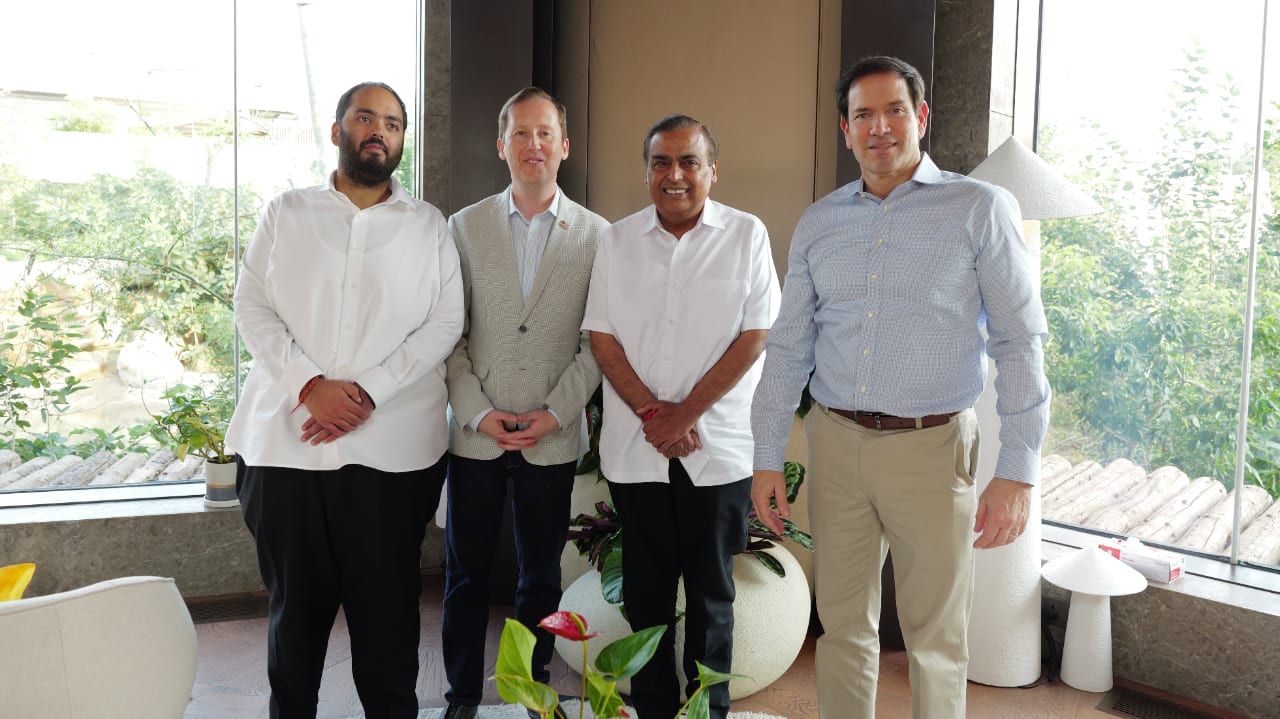
US Secretary of State Marco Rubio visited Reliance Industries’ Jamnagar complex on Wednesday to discuss energy and technology partnerships. Mukesh Ambani and Anant Ambani welcomed the delegation to the facility. They explored opportunities for commercial cooperation in manufacturing and digital infrastructure, focusing on how these sectors can support future global growth.
US Secretary of State Marco Rubio visited Reliance Industries Limited’s (RIL) Jamnagar complex in Gujarat on Wednesday, with discussions focusing on energy cooperation, advanced manufacturing and potential commercial partnerships between RIL and US companies.
Rubio and US Ambassador to India Sergio Gor, were welcomed by Reliance Industries Chairman and Managing Director Mukesh Ambani and Executive Director Anant Ambani, the company said in a statement.
The delegation toured the world’s largest single-site oil-refining complex, where it was briefed on the facility’s scale, advanced technology and integrated operations.
Rubio and Gor were also briefed on Reliance’s new energy giga-factories, which are being commissioned in phases, and data centres under construction. The tour highlighted the company’s investments in energy and digital infrastructure, drawing on its advanced manufacturing and deep-tech capabilities, Reliance said.
Mukesh Ambani and Anant Ambani outlined the company’s long-term vision for the Jamnagar complex and its development as a centre for deep technology, innovation and advanced manufacturing.
The visit included discussions on the global energy landscape and opportunities for commercial partnerships across conventional and new energy. The discussions covered reliable and affordable energy supplies, technological advances, resilient supply chains and the investment required to meet growing demand.
The visiting delegation also discussed the growing intersection of energy and digital infrastructure, including the role of dependable power in supporting data centres and the expansion of the digital economy.
The Ambanis shared their views on potential collaboration with US companies, citing complementary strengths in technology, engineering and advanced manufacturing.