
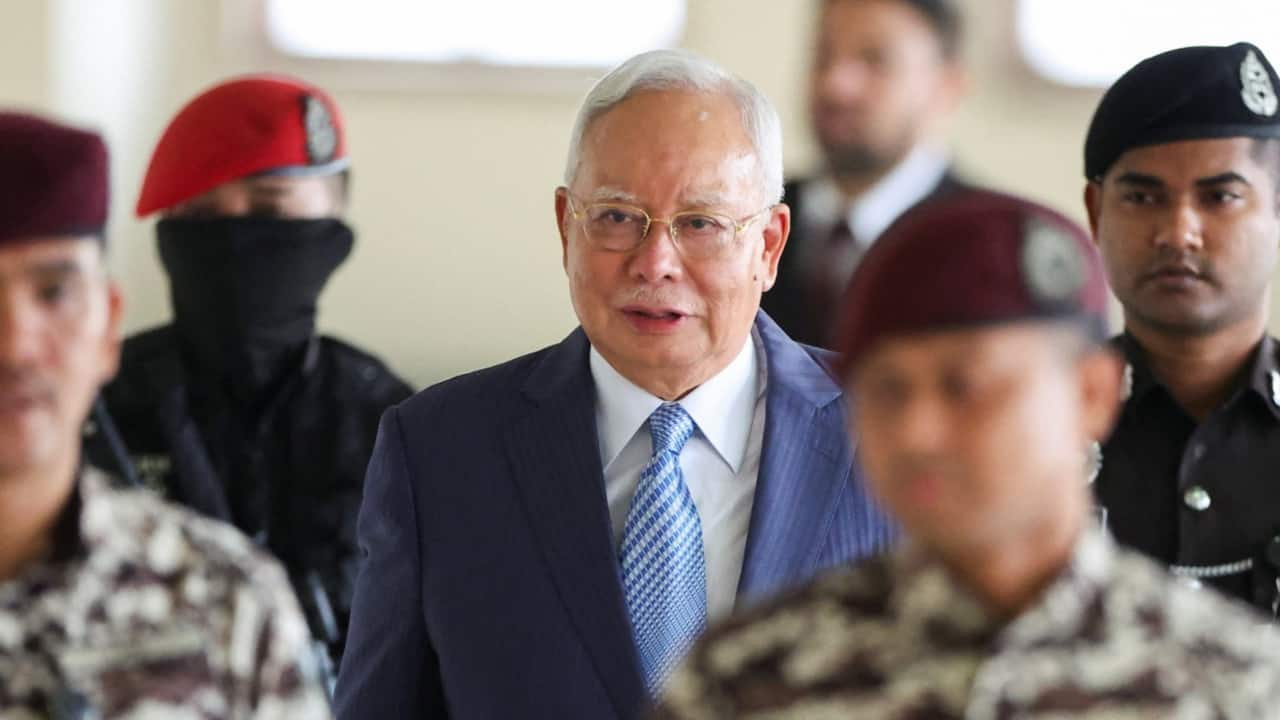
Malaysia's former Prime Minister Najib Razak is set for house arrest after his party paid a $12.3 million fine on Friday. The United Malays National Organisation raised the money through crowdfunding. Lawyer Farhan Shafee said, "We have that order, and we will be delivering that order to the prison."
Malaysia's former Prime Minister Najib Razak is set to be transferred from prison to house arrest after his political party paid a 50 million ringgit ($12.3 million) fine required under the terms of a conditional royal pardon. The United Malays National Organisation (UMNO) raised the money through a crowdfunding campaign and completed the payment at the High Court on Friday, the party's secretary-general, Asyraf Wajid Dusuki, said in a statement. Najib's lawyer, Farhan Shafee, said the court had issued an order allowing his transfer to house arrest and that the document would be delivered to Kajang prison, where the former prime minister has been held since August 2022.
"We have that order, and we will be delivering that order to the Kajang prison right now," Shafee told reporters. Najib, 73, could return home on Friday if the transfer process proceeds as planned, his lawyer said. However, the precise timing of his transfer was not immediately clear. Police were stationed outside his Kuala Lumpur residence early Friday, and the road leading to the house was blocked. Royal pardon allows Najib to serve reduced sentence at home Malaysia's King Sultan Ibrahim Iskandar granted Najib a conditional pardon, allowing him to serve the remainder of his reduced six-year prison sentence under house arrest until August 23, 2028, subject to payment of the fine and other conditions.
Najib was originally sentenced to 12 years in prison and fined 210 million ringgit ($51.5 million) in 2020. He was convicted on charges of abuse of power, criminal breach of trust and money laundering involving 42 million ringgit ($10.3 million) transferred from SRC International, a former unit of state investment fund 1Malaysia Development Berhad (1MDB), into his bank accounts. In January 2024, Malaysia's Pardons Board halved his prison term to six years and reduced the fine to 50 million ringgit. UMNO used a donation drive to raise the money after Najib's lawyers said he could not pay the fine himself because his bank accounts had been frozen.
Separate 1MDB conviction could send Najib back to prison The house arrest arrangement applies only to Najib's sentence in the SRC International case. It does not cover a separate 15-year prison term imposed in December 2025 in another case linked to the 1MDB scandal. Najib was convicted of corruption and money laundering in that case and fined 11.4 billion ringgit ($2.8 billion). He has appealed the conviction and sentence. The 15-year sentence is scheduled to begin after he completes the six-year term covered by the house arrest arrangement. If he fails to overturn the second conviction on appeal, he could return to prison after August 23, 2028.
His lawyers had sought to suspend the prison term and fine pending the appeal, citing his declining health and inability to pay the penalty. A judge rejected the request last month, saying there were no special circumstances to justify the suspension and that "the gravity of the offence is a more important public interest consideration". Najib's role in 1MDB scandal and political influence Najib set up 1MDB shortly after taking office as prime minister in 2009. The state investment fund became the centre of a multibillion-dollar corruption scandal that triggered investigations across several countries.
US investigators estimate that at least $4.5 billion was stolen from 1MDB and laundered through bank accounts in the United States and other countries. More than $1 billion allegedly flowed into accounts linked to Najib. The money was also allegedly used to finance Hollywood films and purchase luxury assets, including hotels, a yacht, artwork and jewellery. Najib has consistently denied wrongdoing and has described himself as a scapegoat for a complex international scheme. Public anger over the scandal contributed to the historic defeat of Malaysia's ruling coalition in the 2018 general election.
The coalition had governed the country since independence from Britain in 1957. Despite his convictions, Najib remains influential within UMNO, which is now part of Prime Minister Anwar Ibrahim's multi-party government. Anwar's Pakatan Harapan alliance has opposed leniency towards Najib, and his transfer to house arrest could add to tensions within the coalition. Malaysia's next general election is not due until early 2028, although Anwar has said he could call an early poll if divisions deepen. Tony Pua, a former lawmaker from the Democratic Action Party (DAP) who helped draw attention to the 1MDB scandal, criticised UMNO for raising money to pay Najib's fine.
"Instead of using such a large sum of money to help ordinary Malaysians, they chose to 'free' Malaysia's most corrupt," Pua said in a Facebook post.