
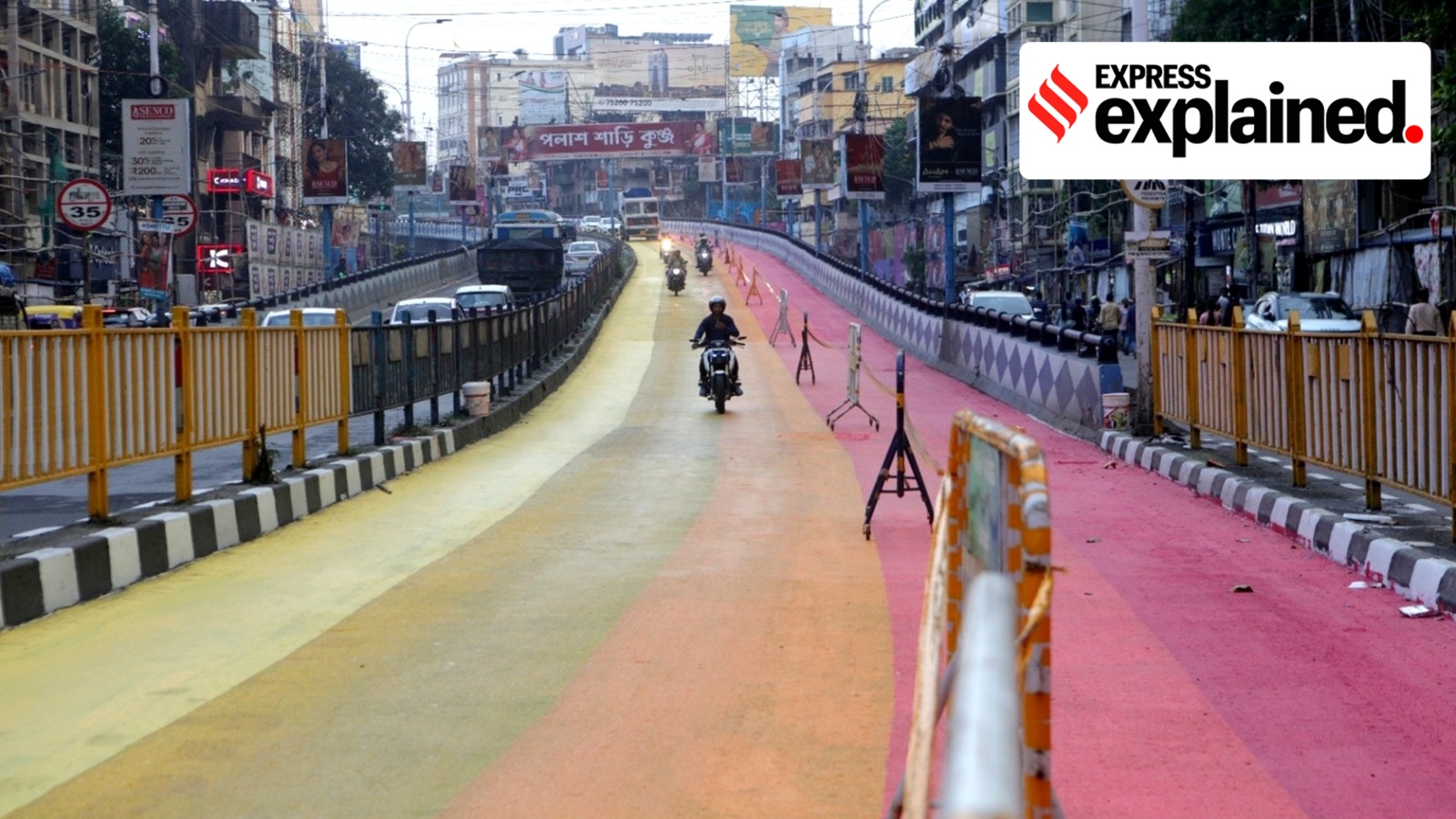
The West Bengal government ordered an enquiry after bikers slipped on Kolkata’s new rainbow flyover. Urban Development Minister Agnimitra Paul said anti-skid paint was used for the Durga Puja beautification. Experts note that black asphalt provides better friction, while glossy paint can reduce grip, making roads dangerous for many motorists.
The West Bengal government has ordered an enquiry after videos of bikers slipping purportedly on the newly painted "rainbow" flyover in Kolkata went viral.
The Opposition Congress and TMC slammed the BJP government, saying the paint had made the road unsafe. Urban Development Minister Agnimitra Paul, however, said anti-skid paint had been used for the Durga Puja beautification drive.
The incident raises a basic question: why are most roads black, and what determines whether a road surface is safe?
Why are roads black?
Most conventional black roads are made of asphalt, a mixture of mineral aggregates such as crushed stone, gravel and sand, held together by bitumen. Bitumen is the dark, sticky binder, derived from petroleum, that gives asphalt much of its characteristic colour.
To make roads, the aggregate of various granular materials is bound together with hot, viscous asphalt, which cools and hardens quickly to make a firm surface.
Asphalt is widely used because it combines strength with flexibility and can be laid and repaired relatively quickly. The aggregate provides the road's structure, while the binder holds the particles together.
The other popular type of roads are concrete roads, which are more expensive and take longer to build, but can take heavy loads better and last longer.
While asphalt roads happen to be black because of bitumen, their colour serves other useful purposes. Black absorbs light, whereas a brightly coloured road, like in Kolkata, would reflect light and create more glare for motorists. Also, lane markings stand out prominently against black.
What makes a road safe to drive on?
A tyre needs friction with the road to brake, accelerate and change direction without slipping. A glossy coat over the road can reduce the available friction, making wet roads particularly challenging.
The US Federal Highway Administration (FHWA), in its technical advisory on pavement surface texture, identifies two important characteristics: microtexture and macrotexture.
Microtexture refers to the tiny irregularities on the surface of the stones in the road. These help the tyre maintain friction. Macrotexture refers to larger variations in the surface, which help water escape from beneath the tyre, particularly at higher speeds.
The FHWA says: "Both microtexture and macrotexture are necessary to provide wet pavement friction at low and high speed conditions."
A surface may appear rough but still offer poor grip if its stones have become polished by traffic. Conversely, a properly designed surface can provide adequate friction without looking visibly coarse.
The FHWA also notes that both asphalt and concrete can provide safe, durable and relatively quiet surfaces when properly designed and constructed. The material alone does not guarantee safety; the surface finish matters, too.
Can roads be coloured safely?
Yes. One option is to incorporate colour into the asphalt mix itself, rather than apply a coating over an existing road.
UK-based construction materials company Holcim, in its explanation of coloured asphalt, describes how pigments can be blended with the hot asphalt binder and aggregates during production. Coloured aggregates can also help produce different shades. The resulting mixture is then laid as a road surface.
The advantage of this approach is that colour is incorporated into the material rather than supplied solely by a separate layer on top.
Coloured asphalt can help distinguish cycle lanes, pedestrian areas and other designated spaces. But using colour across a busy carriageway, where vehicles travel at speed, would involve different engineering requirements from colouring a pedestrian path or a residential area.
What about the Kolkata flyover case?
The Kolkata enquiry will need to establish what material was applied and whether it contributed to the skidding.
Minister Agnimitra Paul told mediapersons, "Officials have been directed to investigate the cause of the accident. Some people are saying that the colours are straining the eyes while driving. If that is the case, an alternative arrangement will be made. Whatever is convenient for the people's needs will be done."
On Wednesday (October 15), reflectors were installed on the coloured roads, and some of the pain was scraped off. "As precaution, we have installed cat's eye (reflectors) on Chingrighata bridge and on Gariahat flyover the paint has been slightly scraped so that the friction increases," Paul added.
Meanwhile, MLA Kunal Ghosh from the Mamata Banerjee Trinamool Congress faction posted a video on Facebook on Thursday of paint being washed away from the flyover at Gariahat. "If the scientifically unsound and dangerous paint had to be removed, why was it applied in the first place in such a reckless manner? Who will take responsibility for the accidents? Whose money has gone to waste? Let the images of the paint being removed from Gariahat remain a reminder of what happened after the Chingrighata accident," he said.