
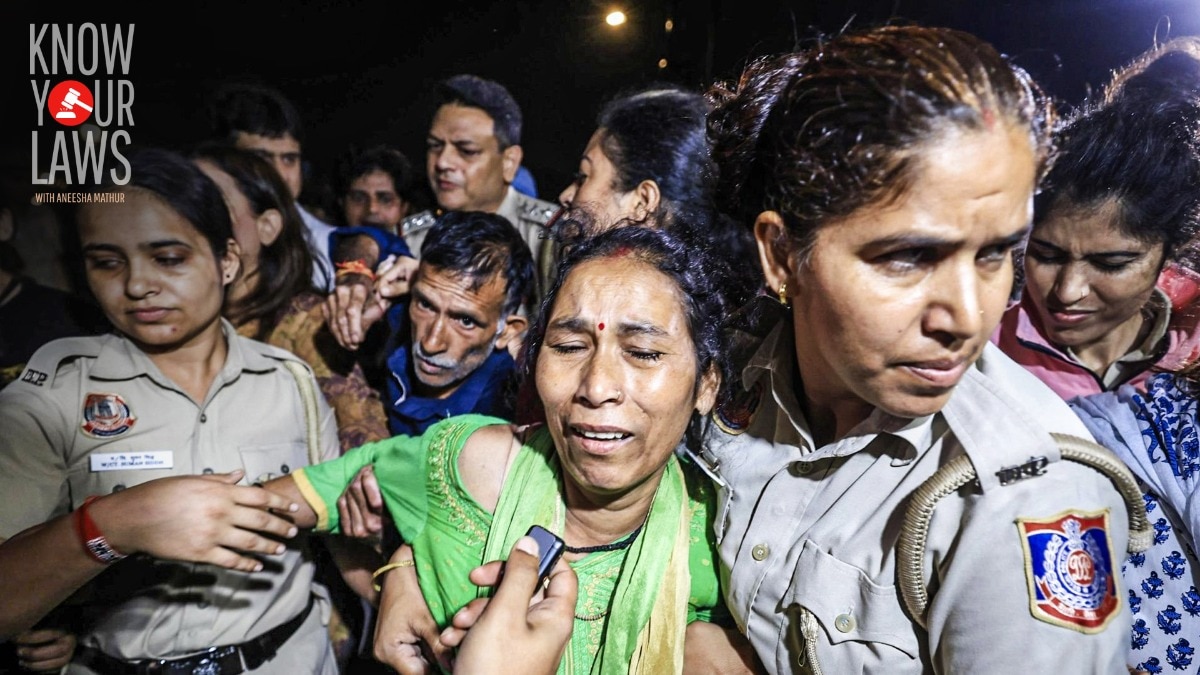
Delhi Police removed Ankita Bhandari's parents from their silent protest at Rajghat on Wednesday evening. The couple claimed they got stuck in a police van for two hours. Virendra Bhandari said, "They made us sit in the van for close to two hours without any water." This incident sparked legal questions.
Delhi Police removed Ankita Bhandari's parents from their silent protest at Rajghat. The incident has renewed scrutiny of legal safeguards governing detention and police force.
The visual is shocking: the mother of a rape victim being dragged away from a dharna demanding justice for her child.
On Wednesday evening, the parents of Ankita Bhandari were removed by the Delhi Police from a 'maun vrat' (silent protest) at Rajghat. The parents were staging a demonstration to demand a comprehensive CBI investigation into their daughter's 2022 murder and the revocation of Dushyant Kumar Gautam's appointment as the Governor of Sikkim.
The couple has claimed that they were kept in a police van for close to two hours.
Speaking to the media after being released, Virendra Bhandari claimed, "They made us sit in the van for close to two hours without any water. My wife was feeling weak, and they provided no emergency assistance, but kept on making rounds around markets and roads in that area."
There is politics, there are protests, and there are competing claims about law and order.
But amid all the arguments, one fundamental question must be asked: What does the law actually permit the police to do when dealing with protesters?
When can the police detain and remove people from a protest site? Does the size of the gathering matter? Can citizens be stopped from protesting at a location that is not a notified protest site? And, most importantly, how much force can the police legally use?
On Thursday, the Supreme Court delivered an important ruling clarifying that the mandatory 24-hour period within which a detained person must be produced before a magistrate begins from the moment of detention, and not merely from the time of formal arrest.
This distinction is significant because police action against protesters does not always take the form of a formal arrest.
Under provisions of the Bharatiya Nagarik Suraksha Sanhita (BNSS) and the Delhi Police Act, protesters are often detained, removed from protest sites, taken away and subsequently released after a few hours.
But what are the legal powers behind such an action?
DO CITIZENS HAVE THE RIGHT TO PROTEST ANYWHERE
Earlier, India Today spoke to senior advocate and former High Court Justice Mukta Gupta on whether citizens can be prevented from protesting at a location simply because it is not a notified protest site.
According to Justice Gupta, roads and footpaths are not private property unless they are owned by an individual. Every citizen therefore has access to them.
As long as an individual's activity does not create an apprehension of breach of peace, cause a disturbance or obstruct anyone's ingress or egress, the person enjoys the fundamental rights to freedom of speech and expression under Article 19(1)(a) and peaceful assembly under Article 19(1)(b) of the Constitution.
She emphasised that it is not necessary for every individual wishing to protest to go to a notified protest site. Protests may be directed not only against the government but also against an employer, neighbour or another third party. In such circumstances, requiring an individual to travel to a designated protest location would make little sense.
However, Justice Gupta also pointed to the Supreme Court's decision in Amit Sahni v. Commissioner of Police, where the court recognised that when large numbers of people assemble to protest, the competing rights under Article 19 must be regulated to protect public order and other constitutional interests.
In such cases, protests may be required to take place at notified locations.
She also referred to the Supreme Court's decision in the Ramlila Maidan Incident case, which held that requiring police permission for protests in public places does not, by itself, violate fundamental rights. However, permission cannot be refused or withdrawn arbitrarily. Such refusal must be based on exceptional circumstances and supported by valid reasons.
Authorities cannot use the requirement of permission as a tool to stifle dissent.
WHAT POWERS DO THE POLICE HAVE TO REMOVE PROTESTERS
Under Section 172 of the BNSS, police officers have powers to detain persons who cause a nuisance, pose a threat to public order or fail to comply with lawful directions issued by them.
Similarly, Section 163 of the BNSS empowers an Executive Magistrate to issue prohibitory orders to prevent public nuisance or danger to human life, health or safety. Importantly, such orders are not restricted to gatherings of more than five people.
Even a solitary protester can be removed if a valid prohibitory order applies to the situation.
Another relevant provision is Section 65 of the Delhi Police Act. It requires people to comply with reasonable directions issued by police officers in the discharge of their duties. Where a person resists or refuses to comply, the police may remove that individual. They must either produce the person before a Metropolitan Magistrate or release them.
In either case, the person must be released or produced before a magistrate within 24 hours.
However, the existence of these powers does not give the police an unrestricted licence to use force.
The BNSS also empowers the officer in charge to command an unlawful assembly to disperse. Where a crowd remains violent or refuses to disperse, the police may resort to graded measures, beginning with warnings and persuasion, followed by physical restraint, lathi-charge, water cannons and tear gas.
Any escalation must remain within the limits of the law and the force necessary in the circumstances.
The underlying principle is that the force used must be proportionate to the threat or resistance encountered. Police officers cannot use more force than is reasonably necessary to control a situation.
The Ministry of Home Affairs' Code of Conduct for Police Personnel reinforces this principle. It states that police must, as far as practicable, use persuasion, advice and warning. Where the application of force becomes inevitable, only the irreducible minimum force required in the circumstances should be used.
There are also specific safeguards concerning women protesters. As far as possible, women should be detained or restrained by women police officers. Women cannot ordinarily be arrested after sunset and before sunrise, except in exceptional circumstances and subject to the prescribed legal safeguards.
Further, any person who is detained and suffers an injury or illness must receive appropriate medical attention. Police officers have a duty of care towards people in their custody and must take reasonable steps to protect their health and well-being.
The Supreme Court, in the Ramlila Maidan case, underscored the principle that restrictions must be enforced with the least possible invasion of individual rights. The court also laid down detailed guidelines emphasising the importance of warnings and persuasion before resorting to physical force.
WHAT HAPPENS WHEN PROTESTERS ARE PEACEFUL
India Today spoke to senior advocate Nandita Rao to understand the legal limits on police action, particularly when a small group of people is peacefully sitting on a dharna.
Rao emphasised that the right to assemble peacefully and without arms, and the right to freely express one's views, are fundamental rights guaranteed under Article 19 of the Constitution.
"The duty of the police is to ensure that peaceful citizens are able to exercise this right without any hindrance," she said, adding that fundamental rights are not gifts from the state but obligations that the State must enable citizens to exercise.
In her view, family members of a rape victim peacefully protesting and demanding justice, without obstructing traffic, cannot reasonably be characterised as causing a nuisance or threatening public order in a democratic country. Rao stated that their forceful removal in such circumstances would be seen as "a disproportionate interference with their fundamental rights under Article 19."
Even regarding the imposition of Section 163 BNSS, Rao opined that prohibitory orders should not be imposed indefinitely or used as a means to silence citizens demanding justice.
But can the police intervene even when fewer than five people are protesting?
Rao clarified that the answer is yes, but only where they are causing a public nuisance or their removal is necessary to maintain public order. The number of protesters, by itself, does not determine whether police intervention is justified.
She also emphasised the police's obligation when a protester faints or sustains injuries during removal from a protest site. Such a person must receive immediate medical attention at a hospital of their choice.
WHEN DOES USE OF FORCE BECOME EXCESSIVE
Ultimately, the legality of police action cannot be judged merely by whether the police had the power to remove protesters. The more important question is whether that power was exercised reasonably and proportionately.
Was a warning issued? Did the protesters continue to violate lawful police directions? Was there violence or any threat to public order? Were police personnel injured? Could the situation have been controlled without physical force? Was the force used necessary, or was it excessive?
These are not peripheral questions. They go to the heart of whether police action was legally justified.
The right to protest is not absolute, and the police do have powers to maintain public order. But neither can the power to maintain law and order become a justification for suppressing peaceful dissent.
When protesters are dragged away, detained or injured, the question must therefore go beyond whether the police had the authority to intervene.
The real question is whether they followed the rules while doing so.