
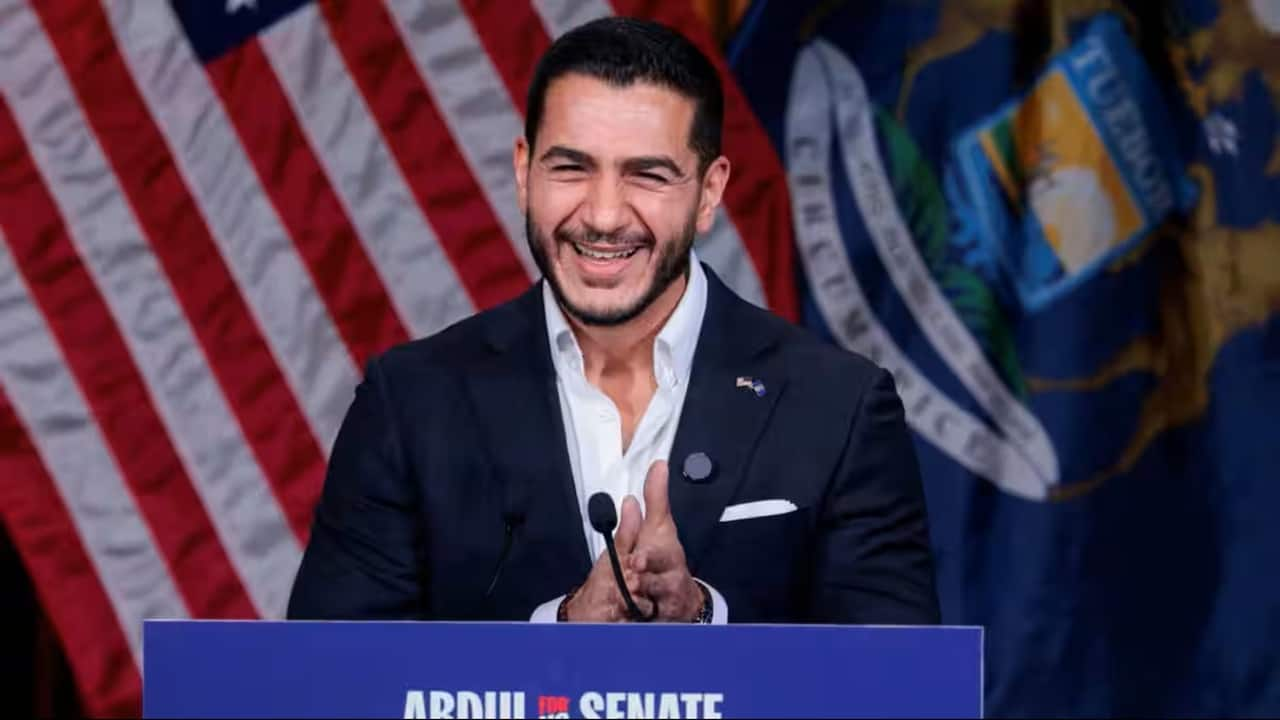
Abdul El-Sayed used the term "habibi" to address JD Vance during his Senate victory speech. The Egyptian-American politician’s Arabic reference sparked celebrations across the Arab world. He also used "inshallah" and "alhamdulillah" to embrace his heritage. "There is this delicious irony in the fact that you're constitutionally obligated to swear me in."
Abdul El-Sayed's pointed reference to US Vice President JD Vance as "habibi" during his Senate victory speech has sparked celebrations across the Arab world, with social media users embracing the Arabic expression and applauding the Egyptian-American politician's response to months of attacks over his faith and heritage. "JD, habibi," El-Sayed said while addressing Vance, who had criticised him during the campaign and suggested that he would support violent demonstrations in American cities. The newly elected senator then highlighted what he called the irony of Vance being constitutionally required to swear him into office in January.
"There is this delicious irony in the fact that you're constitutionally obligated to swear me in in January," he said. The remark resonated with Arab audiences, with users sharing music videos, memes and clips featuring the word "habibi" across social media. The Arabic term literally translates to "my beloved" but is commonly used in everyday conversation to mean "buddy", "pal" or "bro". Supporters of El-Sayed had also worn T-shirts bearing the slogan "Habibi for Abdul" during his campaign. His victory speech gave the expression a wider political resonance, with many in the Arab world celebrating the use of their language in a prominent American political moment.
One social media user shared a video of Egyptian singer Shireen Abd El-Wahab dancing to one of her popular songs, joking that El-Sayed would make it the new US national anthem. Others drew on Egypt's well-known tradition of political humour, sharing a meme from an Egyptian film featuring a man laughing uncontrollably at a funeral. The caption, quoting a line from the movie, read: "I came here to crack jokes." Egyptian academic Khalil al-Anani also welcomed the moment in a post on X, describing "habibi" as "the sweetest word" and thanking El-Sayed for bringing joy to Egyptians. The celebrations extended beyond the reference to Vance.
El-Sayed, the son of Egyptian immigrants, also used the Arabic expressions "inshallah" and "alhamdulillah" to mark the transition from campaigning to victory. "Inshallah", meaning "God willing", had been a recurring phrase in his campaign speeches whenever he was asked about the election outcome. After his win, he told supporters that they could now turn it into "alhamdulillah", or "thank God". The expressions became a prominent feature of his campaign, reflecting his decision to openly embrace his Muslim faith and Egyptian heritage despite repeated attempts by political opponents to make them an electoral liability.
El-Sayed's victory speech also included a direct response to President Donald Trump, who had repeatedly mocked his name and questioned his suitability for the Senate. "Donald, look, I know you've struggled with my name. So after JD swears me in in January, you can just go on and call me senator," he said. He also addressed parents who had struggled to explain why the president publicly mocked someone's name or religious practices. "To all the parents who struggled to explain why the president openly mocks someone for their name or how they pray, let them know tomorrow that the bad guys lost," El-Sayed said.
The remarks followed a campaign marked by Islamophobic rhetoric and attacks on his Muslim identity. Trump had referred to him as a "jihadist", invoked the September 11 attacks and deliberately misstated his name during campaign appearances. Vance had also intensified his criticism of the Democrat at a rally in Howell, Michigan, on October 27. Referring to demonstrations in Paris, the vice president alleged that El-Sayed and left-wing political commentator Hasan Piker would support similar unrest in American cities. "I guarantee you, if those rioters were burning down New York, or Detroit, the Hasan Pikers and El-Sayeds would be right there leading them and cheering them on,"
Vance told the crowd. He also accused El-Sayed of being influenced by hatred and a desire to destroy rather than build. The candidate rejected the allegations, arguing that policies depriving working people of healthcare and affordable essentials were a greater threat to Americans. The 42-year-old physician and former Wayne County health director defeated Republican Mike Rogers in Michigan's closely watched Senate race. His win makes him the first Muslim American elected to the US Senate and allows Democrats to retain the seat being vacated by retiring Senator Gary Peters. El-Sayed campaigned on healthcare affordability, Medicare for All, reducing corporate influence in politics and ending US military assistance to Israel.
He has described Israel's actions in Gaza as genocide, a characterisation rejected by Israel. His victory was particularly significant in Michigan, a state narrowly won by Trump in the 2024 presidential election. El-Sayed also faced allegations of links to the Muslim Brotherhood during the campaign, which he denied. In his victory speech, he described the result as a triumph of ordinary voters over powerful financial interests. "We showed that in a battle between the money and the many that the many can win," he said. For many across the Arab world, however, the celebrations went beyond the electoral outcome.
El-Sayed's unapologetic use of Arabic expressions and his humour in responding to political attacks offered a rare moment of public affirmation amid years of conflict, displacement and prejudice faced by Arab and Muslim communities.