
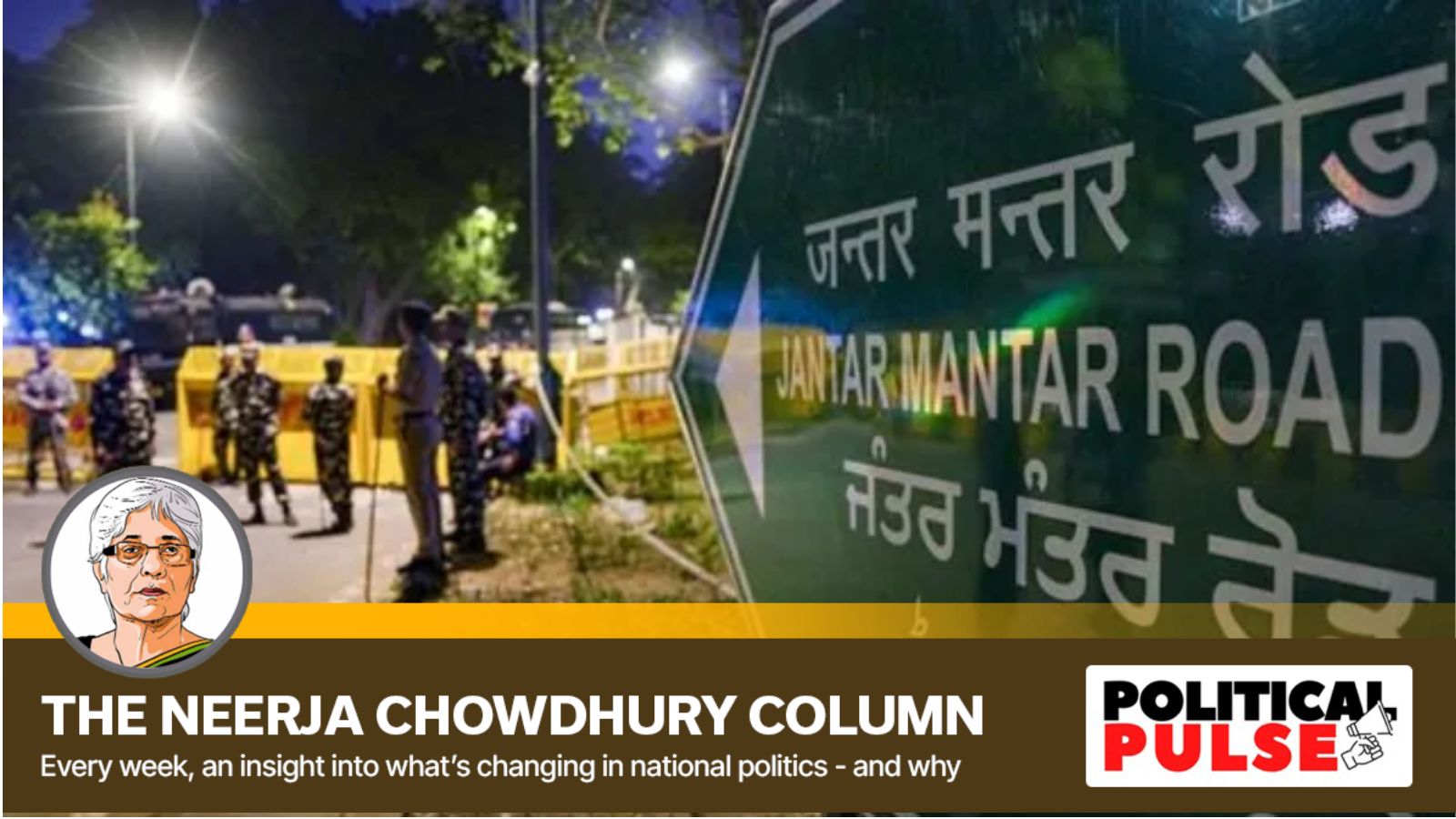
Jantar Mantar served as a vital protest site for 33 years in Delhi. On Friday, police imposed restrictions to stop the Cockroach Janta Party’s Tricolour march at Connaught Place. They detained founder Abhijeet Dipke and student leader Neha Bora. This move makes it harder for citizens to reach those in power.
For 33 years, Jantar Mantar was not just a designated protest site in the heart of Delhi, but one of those soft symbols of democracy almost as important as Constitutional guarantees.
Be it the 18th-century astronomical observatory whose status as a protest site now stands cancelled, or the Central Hall of the old Parliament, which was also done away with in the new building, these were spaces where people across the political divide freely exchanged views. Even the Holi Milans and Iftar parties that leaders across the political spectrum once hosted helped make hard political discord a shade softer.
However, these are now almost relics of the past and the de-notification of Jantar Mantar as a protest site pushes citizens further out to the peripheries, making it more difficult for their voices to be heard by those in power. The nature of power being what it is, those who get to the top have to be constantly reminded of the promises they made to those who put them there.
On Friday, the police imposed restrictions to stop the Cockroach Janta Party's (CJP) Tricolour march at Connaught Place, not far from Jantar Mantar. They detained its founder Abhijeet Dipke as well as Left student leader Neha Bora, the faces of the next generation of protesters.
Over the last three decades, Jantar Mantar enabled people to try and hold people in power accountable. Groups would gravitate to the observatory from across the country, set themselves up on the pavements -- often for days -- holding their placards and banners aloft, raising slogans, and venting their grievances in the hope that the media would amplify their voice and it would reach those in power. Sometimes parliamentarians would come and speak to them. They felt they were heard, if not always heeded.
Protests in the past
Jantar Mantar, and before it the Boat Club, also not far from Parliament, represented a safety valve by which the citizens let off steam and did so peacefully. The idea was to ensure that differences in a democracy did not come to a head or explode. The wise amongst the rulers managed to defuse the situation before the pressure started to build.
It is not surprising that most democratic countries have their designated protest sites -- there is the Hyde Park Corner and Parliament Square near Whitehall in London and Lafayette Square opposite the White House in Washington, DC.
Protest sites have shaped politics and that is how it should be in any vibrant democracy, provided it is done peacefully. When the Anna Hazare movement for public accountability was at its peak in 2011, senior BJP leaders quietly visited Jantar Mantar -- the protest later moved to Ramlila Maidan -- and returned convinced that the moment "to strike" had arrived. In 2014, Narendra Modi went on to dislodge the Congress-led United Progressive Alliance (UPA) from power.
Decades ago, Charan Singh held a mammoth meeting at Boat Club in December 1978. It was a show of strength by the Jat leader who had been thrown out of the Janata government and it compelled the then PM, Morarji Desai, to take him back and make him Deputy PM.
In 1988, kisan leader Mahendra Singh Tikait organised a huge rally of 5 lakh farmers at the Boat Club. They came with their tractors and even charpoys to camp in Delhi. The meeting reinforced the pressure on the then PM, Rajiv Gandhi, whose own Finance Minister, V P Singh, had challenged him with allegations of corruption in defence deals. V P Singh went on to replace Rajiv as PM in 1989.
A rally at the Boat Club also influenced VP's decision to go in for the far-reaching decision to implement the Mandal Commission's report to give reservation to Other Backward Classes (OBCs) in government jobs. VP expected his estranged Deputy PM Devi Lal to demand the implementation of "Mandal", lure away the OBC MPs, and bring down the government. He announced the decision two days before a rally Lal had called, irreversibly changing politics.
How Jantar Mantar was designated
Similar apprehensions of a threat to his government led P V Narasimha Rao to ban the BJP's Boat Club rally on February 25, 1993. The party had planned to call for the PM's resignation, demand a mid-term poll, and push for the construction of a Ram temple at the site where the Babri Masjid had been demolished only weeks earlier in December 1992. Rao had an estimated 1 lakh security personnel out to prevent the protesters from entering Delhi.
It was then that Rao decided to designate the much smaller Jantar Mantar as the new protest site, thinking that the confined space with limited exit and entry points would be easier to manage.
But even in 1993, the government did not think of pushing the dissent venue to the city's outskirts. Governments over the decades accepted the premise that no matter how inconvenient, protesters should neither be invisible nor (politically) inaudible.
Given this history, Burari and the CBD Ground in East Delhi are really non-starters, being so far from central Delhi. Ramlila Maidan, the third designated protest site, could work, but it is so heavily booked that it may take months to get access to it.
The need to maintain public order versus the citizens' right to protest is the quintessential dilemma faced by successive governments. Ultimately, the answer, as suggested by many, may lie in walking the middle path. That is only possible when dialogue takes place between the executive and the aggrieved and when the search is for a political, and not a law-and-order, solution.
How Indira handled protests
When Indira Gandhi politically dealt with protests, she managed to defuse an ugly situation. In 1966, soon after she took over as PM, Jan Sangh and RSS-backed protesters marched to Parliament to demand a ban on cow slaughter. It resulted in clashes with the police, leading to the death and injury of many. Mrs Gandhi sacked her Home Minister and set up a high-level committee, which included then RSS chief M S Golwalkar, to examine the constitutional feasibility of the demand. The issue slowly fizzled out.
In contrast, she took a strident position against the JP Movement of the Bihar youth in 1974 demanding a "total revolution". Instead of engaging with them, she imposed the Emergency, jailed opponents, and censored the press. When she held elections in 1977, she was wiped out all over North india.
you may like
At present, as protests against Chief Election Commissioner (CEC) Gyanesh Kumar continue, could the entire country become a Jantar Mantar, as Abijeet Dipke has declared? Or can the government find another way out that addresses the basic question of the protestors: how to restore the sanctity of the electoral rolls and the credibility of the electoral process? And to do it before the state elections next year.
All eyes are now on the Supreme Court, whose institutional response will be closely watched. But, clearly, something has to give way somewhere.
(Neerja Chowdhury, Contributing Editor, The Indian Express, has covered the last 11 Lok Sabha elections. She is the author of How Prime Ministers Decide.)