
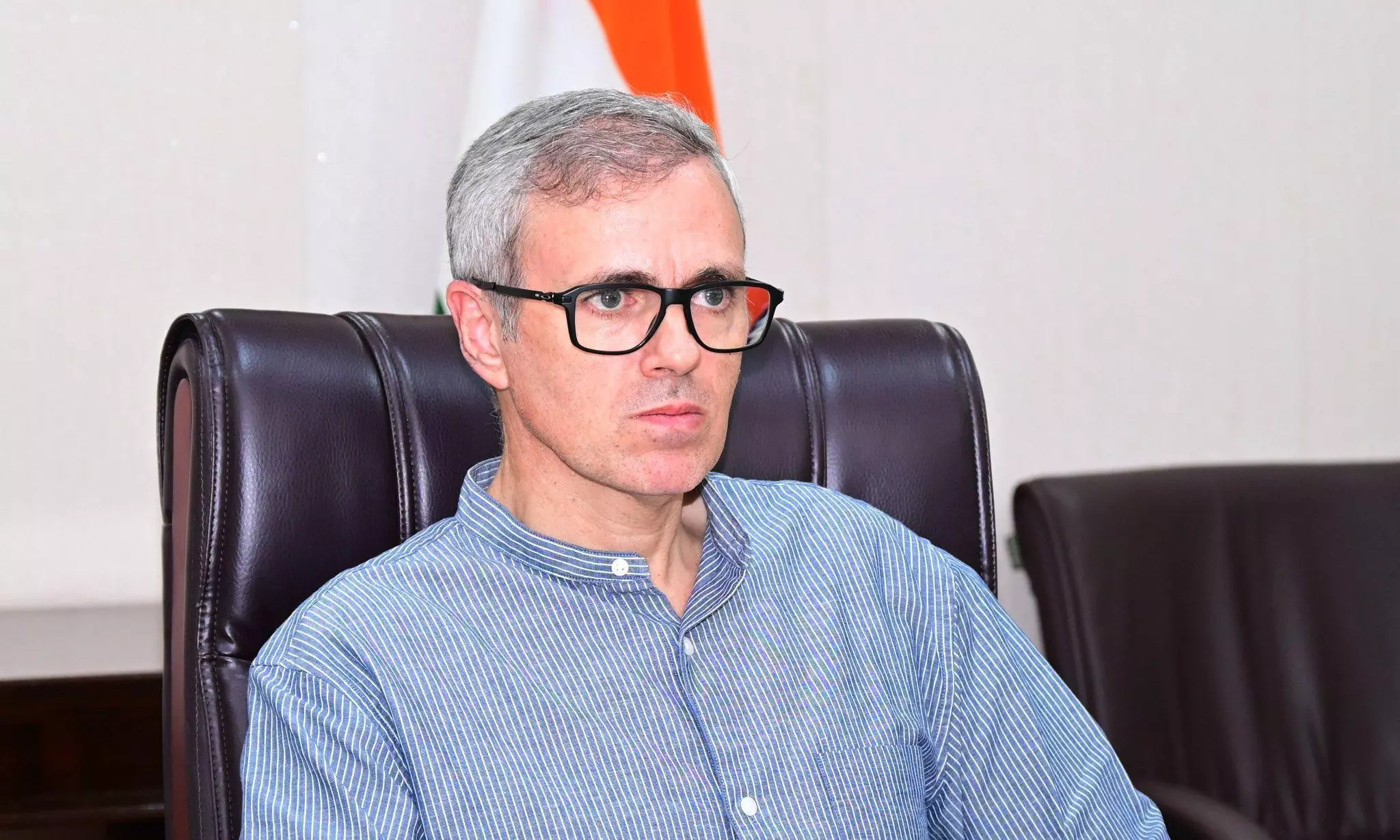
Jammu and Kashmir Chief Minister Omar Abdullah’s nine-member Council of Ministers has sparked a debate over regional representation. With only two ministers from Jammu, critics say the cabinet lacks balance. Leader of Opposition Sunil Sharma said, "This is the first time that there appears to be such a regional and cultural imbalance."
Concerns grow over regional balance in Jammu and Kashmir's Council of Ministers, with Jammu's reduced presence raising questions about political representation.
SRINAGAR: The composition of the nine-member Council of Ministers headed by Jammu and Kashmir Chief Minister Omar Abdullah has triggered a sharp political debate, with critics alleging that the new government suffers from a pronounced regional and cultural imbalance.
While the Union Territory is broadly divided between the Jammu region and the Kashmir Valley, Jammu has found representation through only two ministers in the new dispensation, one of whom is Deputy Chief Minister Surinder Choudhary, a Hindu leader from the region. The other is a Muslim minister from Jammu Chowdhary Javed Rana. The remaining seven members of the Cabinet, including the Chief Minister, belong to the Kashmir Valley and are Muslims.
Opposition parties have seized upon the issue, arguing that the Cabinet's composition does not adequately reflect the geographical and social diversity of J&K. Leader of Opposition in the J&K Assembly, Sunil Sharma, described the Council of Ministers as suffering from an unprecedented "regional and cultural imbalance."
"This is the first time that there appears to be such a regional and cultural imbalance," Sharma said, emphasising that governments are expected to carry all sections of society together. "Governments have to carry every community along. They have to take every region and every area along. You have to maintain religious, regional and cultural balance. Today, that was nowhere to be seen," he said.
According to Sharma and other critics, a Cabinet in a region as diverse as J&K should reflect not only electoral outcomes but also broader regional aspirations and sensitivities. They argue that Jammu, with its distinct cultural identity and substantial population, deserved significantly greater representation in the Council of Ministers.
However, political analysts and constitutional observers have countered these assertions by pointing to the electoral verdict delivered in the 2024 Assembly elections. Their argument is that cabinet representation in parliamentary democracies is inevitably shaped by the strength of political parties in the legislature.
The National Conference (NC) emerged as the dominant force in the Kashmir Valley, winning 35 of the Valley's 47 Assembly seats. Its ally, the Congress, secured five seats, while the Communist Party of India (Marxist) won one. Later, Omar Abdullah's decision to vacate the Budgam seat led to a by-election in which the People's Democratic Party (PDP) won the constituency, reducing the NC's tally in the Assembly by one seat. The PDP's representation consequently increased from three to four seats. The Peoples Conference and the Aam Aadmi Party won one seat each, the former in the Valley and the latter in the Jammu region.
In contrast, the electoral picture in Jammu was markedly different. The Bharatiya Janata Party (BJ) emerged as the dominant political force, winning 29 seats in the region. Congress managed just one seat, while the remaining seats were shared by independents and other candidates. Since the NC's legislative strength is overwhelmingly concentrated in the Kashmir Valley, many political commentators argue that the party naturally looked to its own legislators while distributing ministerial portfolios.
NC leaders privately and publicly maintain that the criticism ignores the electoral arithmetic. They contend that a party which secured an overwhelming majority of its seats in the Valley cannot be expected to distribute ministerial positions on a purely regional basis. According to this view, cabinet berths are a reflection of legislative numbers, and the Valley's dominance in the ministry mirrors the NC's dominance in the Assembly.
The party's supporters also point out that Omar Abdullah consciously attempted to strike a balance by appointing a Deputy Chief Minister from Jammu. They argue that the choice of Surinder Choudhary, a Hindu leader from the Jammu region, addresses both regional and religious concerns. In their assessment, the presence of a senior Jammu-based leader in the number two position of the government sends a message of inclusiveness and ensures that Jammu's interests are represented at the highest levels of decision-making.
Yet the controversy has revived a longstanding debate in J&K politics: whether cabinet formation should be guided primarily by electoral strength or by principles of regional representation. Historically, governments in the erstwhile state often sought to maintain a visible balance between Jammu, Kashmir Valley and Ladakh (which is now a separate Union territory), even when electoral outcomes heavily favoured one region.
In fact, when Omar Abdullah first assumed office as Chief Minister in October 2024, his Council of Ministers reflected a more balanced regional arrangement. He inducted Satish Sharma, son of veteran Congress leader and former Member of Parliament Madan Lal Sharma. Satish Sharma had won the Chhamb Assembly constituency in Jammu as an Independent after being denied a Congress ticket. His inclusion ensured that Jammu had three representatives in the ministry, while Kashmir was represented by three ministers including the Chief Minister, creating a rough regional parity within the six-member council then in place.
That arrangement, however, generated considerable discontent within sections of the NC. Many party leaders questioned why an Independent legislator had been accommodated when the NC had secured an overwhelming mandate in the Valley. They argued that a party which had won 35 of Kashmir's 47 seats had every right to claim the lion's share of ministerial positions. Several within the party maintained that the combination of a Jammu-based Deputy Chief Minister and representation for the region in the Cabinet was sufficient to address concerns relating to both regional and religious balance.
The latest expansion of the Council of Ministers appears to reflect that line of thinking. While the government has prioritised rewarding legislators from within the ruling party's ranks, critics maintain that the resulting composition has widened perceptions of regional disparity. Supporters, meanwhile, insist that the Cabinet merely reflects the democratic verdict and the NC's overwhelming legislative strength in the Kashmir Valley.
The debate, therefore, goes beyond the number of ministers from either region. It touches the core question of governance in J&K: whether political representation in the executive should mirror electoral mandates alone, or whether special efforts are required to ensure visible regional, cultural and religious balance in a territory marked by deep diversity. The answer to that question is likely to remain at the centre of political discourse as the Omar Abdullah government settles into office.