
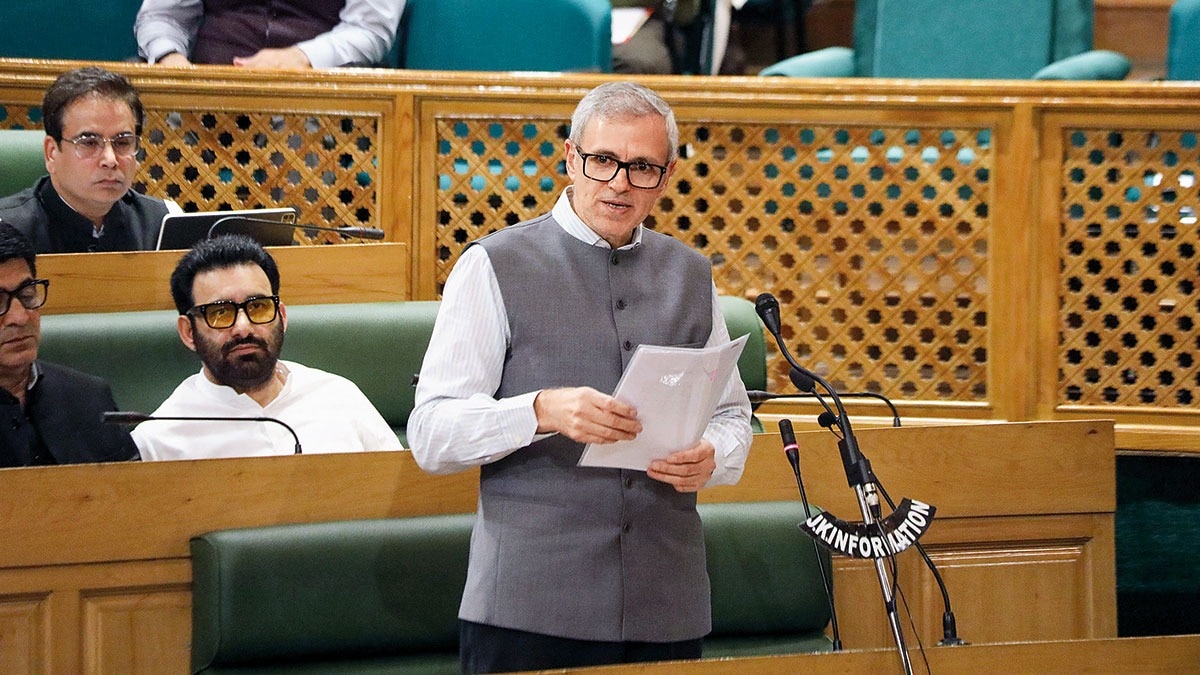
On September 28, the Jammu and Kashmir assembly adopted a resolution seeking the immediate restoration of full statehood. CM Omar Abdullah steered this move to remind New Delhi of its promise. Prof. Sheikh Showkat Hussain said, "The NC is under tremendous pressure from the people as also from vocal dissenters."
Omar steers a statehood resolution, the second one in two years. It's a reminder as well as renewal of oath
It was a small set piece of legislative theatre, meant as much for the acoustics in the hall as the desire for the voice to carry to New Delhi. No one would object if it does, of course. Overcoming its status diminution is an idea that carries broad consensus in Jammu and Kashmir. So, on September 28, when the assembly adopted a resolution seeking the "immediate and urgent restoration of full statehood", it wasn't chafing against anyone's politics. Ever since 2019, when J&K was stripped of its special status and bifurcated into Union territories, even the Centre has repeatedly called its UT status temporary and return of statehood a solemn promise -- to be fulfilled at an "appropriate time".
Why, then, did the chief secretary and law secretary hasten to write to the Speaker before the debate, advising against taking up the resolution proposed to be moved by CM Omar Abdullah? Well, its historical references carried weight, even if the wording was restrained. The text did not explicitly demand restoration of special status, but it recalled two prior resolutions: a precursor from November 2024, from right after Omar's government came in; and more significantly, the autonomy resolution adopted on June 26, 2000, under Farooq Abdullah's National Conference government.That 2000 resolution had endorsed a 1999 State Autonomy Committee report seeking a return to J&K's pre-1953 position. That meant returning all subjects of governance except defence, foreign affairs, currency and communication. Drawing on the 1952 Delhi Agreement, it also proposed redesignating the Governor as Sadr-e-Riyasat and the CM as Wazir-e-Azam. Delicate territory, and the Atal Bihari Vajpayee cabinet had duly met it with a rejection. So, Omar tiptoed across it, merely appending references to them, not calling for a fresh vote on those demands. Just for a subtle echo to hang in the air.Chance of autonomy being sub-zero now, why even bother? "The NC is under tremendous pressure from the people as also from vocal dissenters, like MP Ruhullah Mehdi," says Prof. Sheikh Showkat Hussain, former head, School of Legal Studies, Central University of Kashmir. The wait for statehood has been frustratingly long. New Delhi's open-ended timetable leaves an electoral promise unfulfilled, and curbs the NC dispensation's capacity to govern by vesting powers in the Lieutenant Governor. He feels the resolution is a symbolic protest against that "helplessness" -- having pro forma power "without any capacity to exert it". COMPROMISE TEXTOmar played it with dead hands, dropping proposed amendments by at least six NC legislators who sought to explicitly insert Articles 370 and 35A in the text. "The careful wording and relatively soft reference to autonomy was probably a compromise to secure the support of non-BJP parties," says political scientist Noor Ahmad Baba. Silencing critics who accused them of reneging on promises was, in Hussain's view, a primary objective. But Omar's two resolutions, in his view, also negate New Delhi's claim of having the legislature's "concurrence" for revoking special status.The chief secretary's preventive dash, which Baba calls "bureaucratic overreach", also offered Omar a chance to dial up the resistance a notch. Hussain felt it "reflected the real worth of the UT legislature" -- implying it was "too small a body" to take up such issues. Thus, he says, "The passing of the resolution itself became a process of reassertion."- Ends