
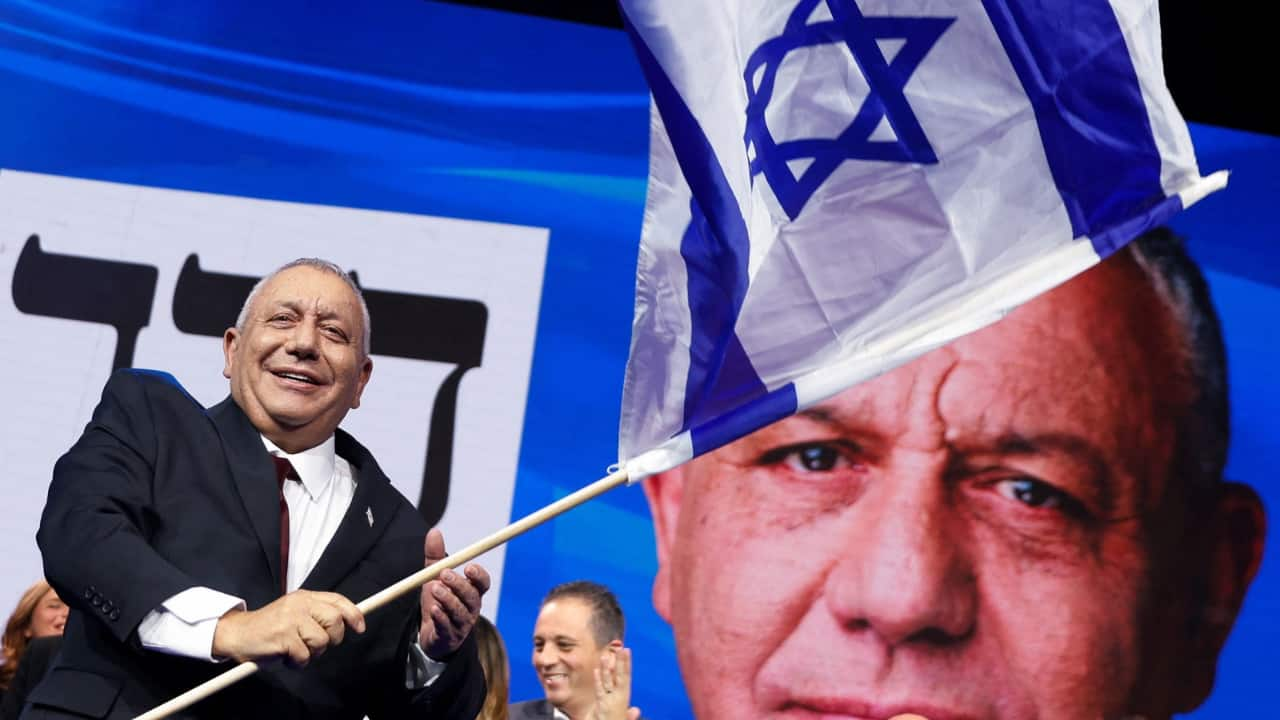
Israeli President Isaac Herzog chose Gadi Eisenkot to form a government after the October 27 election left no clear majority. Eisenkot got 67 recommendations from lawmakers, while Benjamin Netanyahu received 46. Eisenkot now has 28 days to build a coalition, though he faces many challenges to secure enough parliamentary support.
Israeli President Isaac Herzog has chosen Gadi Eisenkot, Prime Minister Benjamin Netanyahu's main political rival, to try to form the country's next government after the October 27 election left neither political camp with a parliamentary majority. Herzog announced his decision late on Saturday, following consultations with political parties elected to the Knesset. Eisenkot, leader of the Yashar Party and a former military chief, will formally receive the mandate at a ceremony at the President's Residence on Sunday at 5 pm local time (8:30 pm IST). Eisenkot received recommendations from 67 lawmakers, compared with 46 who backed Netanyahu.
The seven-member United Torah Judaism party did not recommend either candidate. However, these recommendations do not mean Eisenkot has secured a majority in Parliament. A government needs the support of at least 61 of the Knesset's 120 members, and Eisenkot now faces weeks of negotiations to assemble a coalition. Netanyahu, Israel's longest-serving prime minister, is seeking to remain in office after his religious-nationalist coalition lost its parliamentary majority in the election, although it remained the largest bloc. How did the election leave Israel divided? The October 27 election failed to produce a clear majority for either political camp in a country sharply divided after the Hamas-led attacks of October 7, 2023, and the subsequent wars in Gaza and across the region.
Netanyahu's coalition won 53 seats, down from 68, while the four-party alliance led by Eisenkot secured 48 seats. The two Arab-led parties won a combined 19 seats, an unprecedented result. Likud emerged as the largest single party, with 27 seats, while Eisenkot's Yashar won 21. Although Eisenkot's bloc does not have enough seats to govern on its own, Arab-led parties recommended him to Herzog as their preferred candidate to form the government. Their support gave him the highest number of recommendations during the presidential consultations. Eisenkot, however, has ruled out forming an alliance with Arab parties.
Some members of his political bloc are also opposed to relying on their support, making the question of how to secure a parliamentary majority one of his biggest challenges. What are Eisenkot's options to form a government? Eisenkot has 28 days to form a government after receiving the mandate. He can seek an additional 14 days from the president, giving him a maximum of six weeks to complete the process. He has three broad options: form a minority government with Arab parties supporting him on key votes, negotiate an agreement with ultra-Orthodox parties, or explore a national unity arrangement with Netanyahu.
The Arab-led parties offer a potential route to the numbers Eisenkot needs. Ra'am has said it is prepared to support Eisenkot, while the Joint List has indicated it would back him from outside the coalition. Together, the two parties hold 19 seats, which could help Eisenkot secure the parliamentary majority he needs if their lawmakers back his government. However, cooperation would be politically difficult. Eisenkot has set conditions for any Arab party seeking to join his coalition, including recognition of Israel as a Jewish state and declaring Hamas a terrorist organisation. His more conservative ally, Yisrael Beytenu, has already ruled out joining a government that includes Arab-led parties.
The ultra-Orthodox parties could offer another route, but negotiations would involve a major disagreement over military service. Eisenkot and his allies campaigned for an end to the long-standing military exemptions enjoyed by the ultra-Orthodox community, while religious parties want to preserve them. The exemptions have become especially controversial among the broader public during the three years of war. United Torah Judaism, which did not endorse either candidate during Herzog's consultations, has left open the possibility of cooperating with Eisenkot. A unity government with Netanyahu is another possibility, although Eisenkot has repeatedly said he would not join a government led by the prime minister.
Netanyahu, meanwhile, has called for a national unity arrangement. Netanyahu seeks to block rival's path to power Netanyahu has sought to prevent Eisenkot from relying on Arab-led parties to form a government. He has accused the parties of having "stolen" the election, without providing evidence to support the claim. In a video message shortly before Herzog announced his decision, Netanyahu called for a "national unity government" but cautioned against "hastily swearing in a government with terrorist supporters", referring to Arab-led political groups. Israel's Shin Bet security agency has launched an investigation into possible foreign interference in the election.
The Central Elections Commission and Herzog have maintained that the vote was valid and that any wrongdoing, if established, would not have significantly affected the result. On Saturday night, Yashar said that Likud and its allies could join a coalition led by Eisenkot, but did not extend the offer to Netanyahu. Eisenkot has repeatedly ruled out serving in a government with the prime minister, according to The Times of Israel. Eisenkot, 66, entered politics in 2022 after serving as Israel's military chief. He briefly joined Netanyahu's wartime Cabinet following the October 7 attacks before returning to the opposition.
He has since criticised Netanyahu's leadership and handling of the war in Gaza. What happens if Eisenkot fails to form a government? If Eisenkot cannot put together a coalition within the allotted period, another candidate, potentially Netanyahu, can be given an opportunity to form a government. If that attempt also fails, the Knesset can nominate another candidate. The process has an overall deadline of around 100 days, according to the supplied reports. If no candidate succeeds within that period, Israel will have to hold fresh elections, extending a period of political deadlock that has previously seen the country vote five times between 2019 and 2022.
Four opposition parties have also called for the Knesset to elect a new speaker at its first sitting on Tuesday, November 10. Such a move could lead to the removal of incumbent Likud speaker Amir Ohana. Ohana has said he will not permit a vote on the matter during the first session, but would schedule a debate on choosing his successor within the following week if a majority of lawmakers formally requested one. Meanwhile, the new members of the Knesset are due to be sworn in on Tuesday. Netanyahu and his Cabinet will remain in office in a caretaker capacity, with limited powers, until a successor coalition takes office.