
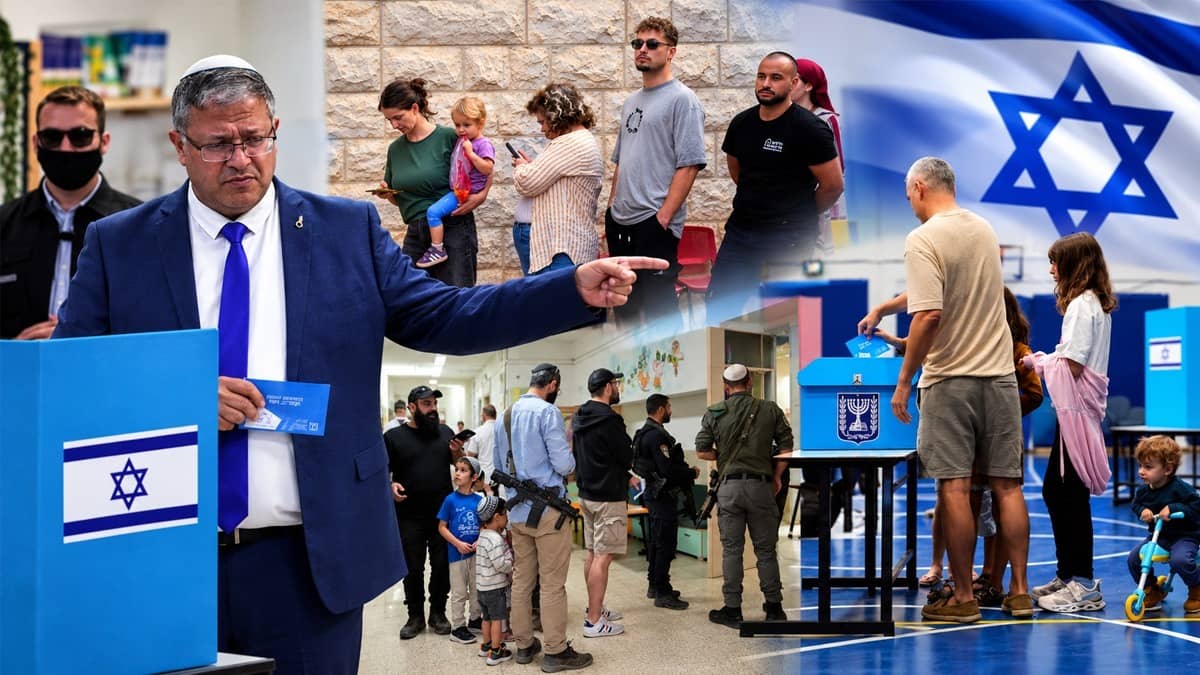
Israelis were voting Tuesday in a tense national election seen as a referendum on Prime Minister Benjamin Netanyahu. Voters turned out in high numbers despite bad weather. With no party expected to win a majority, the results depend on Arab turnout and complex coalition talks that could last for months.
Israelis were voting Tuesday in a tense national election widely seen as a referendum on Prime Minister Benjamin Netanyahu's leadership since the Hamas-led Oct. 7, 2023, attack on Israel and the wars that have since shaken the Middle East.
Israelis vote for parties, which then form alliances to create a majority coalition. No single party has ever won a 61-seat majority in the 120-member parliament, or Knesset.
Opinion polls suggest a tight race, with no clear winner expected, setting the stage for weeks or even months of negotiations among around a dozen parties expected to win seats in the Knesset.
Winter weather hits Israel on election day
Israelis are turning out to vote in high numbers despite rainfall and blustery weather in parts of the country. The meteorological service said at midday that thunderstorms were developing in several parts of central and southern Israel, with a risk of flash floods.
Police reported several road closures in the south.
High turnout in Arab communities could shape the result
Palestinian citizens, whose families remained in Israel after the 1948 war surrounding the country's creation, make up 20% of the population but have historically turned out to vote at lower rates than Jewish citizens. In Israel's most recent election in 2022, roughly 53% voted.
Leaders of the two Arab-led slates running are hoping that frustration with Prime Minister Benjamin Netanyahu will motivate voters to turn out.
Turnout could have multiple effects on the election result and whether Netanyahu retains power.
The higher the turnout in Arab communities, the more seats their parties could win. It could also raise the number of votes required to clear the 3.25% threshold that parties must surpass to enter the Knesset, making it harder for smaller parties to win seats. That could prove decisive for smaller parties at risk of not qualifying, including Yoav Hendel's center-right Reservists-Economic Party and Ofer Winter's far-right Amcha Yisrael party.
Israel's Arab-led parties could decide the election
If anyone would partner with them.
Netanyahu and his chief rivals have said they won't form a coalition with any other Arab-led party after the election - even if that means months of gridlock and another round of voting.
It's a measure of where Israel's long-marginalized Arab minority finds itself three years after the Oct. 7 attack. Their speech is heavily policed, their leaders have been branded as traitors, and at one point their parties were outlawed before a court lifted the ban. Yet in a tight race, Arab politicians are poised to play a potentially decisive role in choosing the next prime minister -- a rare opportunity to wield their influence.
Voting for better healthcare and schools
Lotem Beiden Ben Aharon, 42, said she voted for Yair Golan and the Democrats because of healthcare and education. She said that under Netanyahu's government, doctors' appointments have become harder to come by, as more and more physicians "run away from Israel." She moved with her daughter Geffen, 4, from the city of Rehovot to Tel Aviv for better schools, but she said teachers are being poorly paid.
"Golan seems like the best option for a change here in Israel," she said, "I'm probably going to be disappointed."
Rights group files complaint about delays in Arab towns
An Israeli rights group has filed a complaint with the country's election commission, warning that widespread delays could be suppressing the vote among Palestinian citizens of Israel.
Though delays could be a result of high voter turnout, the Association for Civil Rights in Israel, or ACRI, said in its complaint to Israel's Central Elections Committee that delays had been reported in at least 18 communities. It asked the committee to investigate "whether these delays are deliberate."
ACRI also reported "a large presence of Israel Police and National Guard" officers at a polling station in the Negev Desert, raising concerns that officers were using crowd control as a pretext to prevent people from entering to vote.
Most Palestinians in annexed east Jerusalem can't vote
Tareq Ahram, 36, a Palestinian lawyer in Jerusalem, lives under Israeli rule but cannot vote.
Sitting in front of his grandfather's bakery just outside the Old City, he said that if he could vote he would vote for peace.
Israel captured east Jerusalem, along with Gaza and the West Bank, in the 1967 Mideast war. Israel annexed east Jerusalem in a move not recognized internationally and views the entire city as its capital. The Palestinians want east Jerusalem to be the capital of their future state.
Palestinians in east Jerusalem, unlike those in Gaza and the West Bank, can apply for Israeli citizenship. But most choose not to because it would recognize Israeli claims to the city. Those who do face a long and uncertain bureaucratic process.
"We Palestinian Jerusalemites are a huge bloc of people," Ahram said. "If we could vote, it could change things."
There are over 350,000 Palestinians in east Jerusalem.
Election committee data shows voter turnout is high in rural areas
By midday, rural areas in Israel's south and north showed exceptionally high voter turnout in comparison with previous years, according to data released by Israel's Central Election Committee.
Small villages around Beer Sheba, including many Bedouin villages, had already reached 40 to 50 percent voter turnout, compared with the national average of 31 percent. While the total number of votes in these villages is small, it could point towards higher-than-usual voter participation among Palestinians with Israeli citizenship. Palestinians who remained within Israel after the 1948 war surrounding its creation, and their descendants, today make up about 20% of the population, but have traditionally had low voter turnouts and sometimes boycotted national elections.
Itamar Ben-Gvir played into this fear. "Voter turnout in the Arab sector is off the charts - unprecedented!" he warned his supporters from outside the Arab town of Kfar Kassem in central Israel, encouraging them to vote for his party if they want the country to remain Zionist and Jewish.
It could be weeks or months before the winner is known
It might even require another election.
Shortly after polls close at 10 p.m. local time (2000 GMT), Israel's three main television broadcasters will release exit polls estimating how many seats were won by each party.
The exit polls usually provide a good indication of how people have voted. But they also could vary and may not be borne out by the official results, which will be released in the coming days.
If, as expected, neither coalition pulls off a clear victory, then the coming weeks will see intense negotiations and bargaining among party leaders as they try to get to 61 seats.
The Associated Press calls thousands of elections in the United States, but doesn't declare winners in foreign elections.
Eisenkot speaks to crowd after voting
People chanted "Our next prime minister!" after Eisenkot voted in Herziliya, a city north of Tel Aviv.
After voting, Eisenkot called on all Israelis to vote to get rid of the "the worst government Israel has known." He said victory wasn't certain, adding that "we are on perhaps the most critical day since the founding of the state."'
Gadi Eisenkot's name tells a story of his parents' North African heritage
Eisenkot grew up in southern Israel with parents who were among the more than 100,000 Jews who emigrated from Morocco in the 1950s.
If elected prime minister, he would be the first Israeli of Middle Eastern or North African descent to lead the country. The demographic, known as Mizrahim, now accounts for more than half of Israel's Jewish population and is, on average, poorer and more conservative than Israelis of European ancestry. Mizrahim have affectionately called Eisenkot "dialna" -- or "ours" in North African Arabic dialect.
Eisenkot's last name comes from a word in Amazigh, an indigenous North African language widely spoken in Morocco, and means "antelope," said Amazigh scholar and Williams College professor Brahim El Guabli.
He said the spellings of many Moroccan Jewish names like Eisenkot were altered upon their arrival to sound more European and help them assimilate in Israel.
Netanyahu returns to warnings about Arab voter turnout to rally supporters
The prime minister urged supporters to forget about the beach or the barbecue and go vote, because what's at stake is "securing the Jewish state, ensuring our security and safeguarding our future."
Arab-led parties have repeatedly predicted that motivated voters will turn out in record numbers and AP journalists observed busy polling places in multiple Arab towns in northern Israel on Tuesday.
But Netanyahu has a history of using anti-Arab sentiment to energize supporters. In 2015, he warned that Arabs were heading to the polls "in droves" in an effort to scare complacent right-wing supporters into voting. In this election, he has claimed Hamas militants have called on Palestinian citizens of Israel to vote to oust him and has used campaign posters placing leaders of Arab-led parties alongside Iranian and Palestinian Authority figures, depicting them as enemies.
A different campaign unfolds in Israel's Arab towns
In Jewish-majority cities and towns, billboards promoting mainstream parties like Benjamin Netanyahu's Likud and Gadi Eisenkot's Yashar are hard to miss. But they're few and far between in predominantly Palestinian Arab cities. In Nazareth and the surrounding northern Israeli towns, posters promoting the two Arab-led slates -- Ra'am and the Joint List -- line the streets, reflecting the parties' hopes for strong voter turnout in Arab communities.
Netanyahu's face appears along highways or on rare billboards urging voters to turn out and vote against him. The stark contrast illustrates the growing isolation of Palestinian citizens of Israel, even as Arab-led parties could win enough seats to help determine the next government. Apart from Yair Golan and his left-leaning Democratic party, candidates from mainstream Jewish parties have barely campaigned in these communities.
Turnout by noon climbs above 31%, election commission says
Israel's Central Elections Committee says that more than 31% of Israelis -- more than 2.3 million people -- had voted by noon, the highest midday voter turnout since 1977.
If the trend continues, it could put Israel on track for the highest voter turnout in decades by the end of the day.
Voter turnout among soldiers also stood at around 30%, according to the Israeli military. This was higher than in the previous election in November 2022, when voter turnout by midday stood at around 25% for soldiers.
Netanyahu casts his ballot as supporters cheer
The Israeli prime minister cast his vote at a Jerusalem school where his supporters sang and cheered him on. The area of Gonenim is a strong Netanyahu base.
Some of his supporters stood on tables, trying to look over a makeshift security barrier separating them from the voting area.
Earlier, while waiting for Netanyahu, they chanted in Hebrew: "Bibi king of Israel."
In his final campaign stretch, Netanyahu was busy on social media, from posting a fake image of a nuclear attack on Tel Aviv -- underlining the perceived threat from Iran -- to claiming that liberals were coming out in droves to vote against him.
He has also embraced the endorsements of U.S. President Donald Trump.
"This is a very moving and fateful moment. My wife and I are truly overwhelmed," Netanyahu said after voting. "We know what is at stake, and since I am not allowed to say things explicitly, I will say: Vote correctly."
The party of Netanyahu's rival alleges attempts to sabotage voting
The party of Gadi Eisenkot, Netanyahu's key rival and former army chief, filed a complaint with the Central Elections Committee, saying it has noted several incidents in which the party's ballot slips were missing, damaged or turned over inside voting booths.
The party Yashar said this suggests a "systematic and deliberate" sabotage attempt rather than accidental errors.
The party called on the election commission to restore the ballots and carry out frequent inspections at polling stations.
Israel's election commission moves to dispel claims of voting irregularities
The commission overseeing the elections said in a statement that it has so far found no indication of systematic attempts to sabotage the voting.
It followed online reports and complaints by several parties about missing ballot slips and other irregularities at polling stations.
The committee said it was addressing every isolated incident brought to its attention.
A crowd at a polling station in northern Israel raises hopes of high Arab turnout
Voters swarmed around Maha Karkabi-Sabbah, a candidate on the Joint List, outside a polling place in the northern Arab town of Shefa-Amr. She said this gives her some optimism that turnout among Palestinian citizens of Israel could be high.
"Our issues are the worst they've ever been under this government," she said, citing high crime, personal safety and Israel's conduct toward Palestinians in the West Bank and Gaza.
"People feel ... that they should do whatever it takes to change reality here," she added.
Anger toward Netanyahu drives young Arab voters
Mahmoud Aidi, a 35-year-old nurse from the Galilee, drove up to his polling station in the town of Maghar with a car full of signs for the Arab-led Ra'am party and its leader, Mansour Abbas.
A Palestinian citizen of Israel, Aidi said the growing challenges facing his community made him a fan of any candidate who could help get Netanyahu out of power. He mentioned crime, housing, jobs and education as key issues.
"Not much is needed to encourage people to vote this time," he said.
Head of Israel's election commission says fewer irregularities are being reported
According to Dean Livne, acting director-general of the Elections Committee, the overall number of reports about irregularities or issues at polling stations by mid-morning was much lower than in previous elections.
Police believe the arrest of three people in southern Israel who are suspected of being involved in voting bribe attempts was a single incident and not part of a larger campaign, Livne added.
Israeli voters say they are casting ballots for a better future
At a polling station in Jaffa, a mixed Jewish-Arab area of Tel Aviv, voters said the elections were pivotal for the kind of country they want Israel to be.
"I believe we deserve a country with a good quality of life, where we can raise our children and grandchildren in peace and security," said Haim Ron, 69, who said he was voting for Netanyahu's leading rival, Eisenkot.
The election is "about the last three years, and about the future we want for our children here," said voter Noa Sabban.
Israelis can choose from a multitude of parties
Ahead of the vote, 38 parties were registered for the election but some later dropped out. Parties must reach a minimum threshold of 3.25% of the popular vote to get seats in the Knesset, and only around a dozen parties are expected to cross this threshold.
Israelis vote by placing a slip of paper for their party in a blue envelope. Ballots are counted by hand at each polling station by both showing and reading aloud the slip in each envelope.
More than 15,000 cameras have been set up at polling stations to document possible irregularities, along with thousands of volunteer monitors and those associated with the major parties.
Emotions are running high as Israelis vote
"This is critical. And it's never been as critical," said Noga Mizrahi, a voter in Jerusalem, speaking of the elections. She said she had come from kibbutz Nirim, which was attacked on Oct. 7.
In Kiryat Shmona, a Netanyahu stronghold near the border with Lebanon, a man kicked and tore down a poster of Eisenkot, the prime minister's chief rival.
In Tel Aviv, some families of those killed in the Hamas-led 2023 attack and families of former hostages held a moment of silence.
"Remember all those whose voices are no more," said Yona Adam, the mother of Mapal Adam, who was killed.
At a polling station set up in a Jerusalem school, some said they were voting for change while others said they only trusted Netanyahu to keep them secure.
"He's not responsible for Oct. 7," said Nisim Cohen, a reservist.
He said he wants Netanyahu to win the election and continue the wars in Gaza, Lebanon and with Iran until Israelis can sleep peacefully.
Politicians and officials begin to vote
Mansour Abbas, the soft-spoken 52-year-old leader of the Islamist party Ra'am, voted in his mountainside hometown in the Galilee.
Ra'am is expected to win at most a handful of seats in the Knesset, but Abbas could emerge as an unlikely kingmaker if neither Netanyahu nor the bloc of parties opposing him win enough seats to form a majority.
Abbas said he was hoping record turnout in Arab communities could help unseat Netanyahu's right-wing government. "Our vote will change the government," he said.
Israel's far-right national security minister, Itamar Ben-Gvir, also voted. He's perhaps the most visible of Netanyahu's allies, with his public taunting of Palestinian detainees.
"God willing I will become defense minister, it will be good for the soldiers and good for the people of Israel," Ben-Gvir said.
Leading Arab party says some of its activists have been arrested
Ra'am, a leading Arab political party, says at least three of its activists were arrested overnight. It filed a complaint with Israel's election commission on Tuesday and said the arrests were carried out "without justification" in Bedouin towns in the Negev Desert.
Israel's police said three people were arrested overnight on suspicion of planning to bribe citizens to vote for Ra'am and denied attempting to interfere with the election.
Mansour Abbas, the Ra'am party leader, said after he voted that the arrests were undemocratic and "an attempt to influence the election results." He also said that some polling places had reported shortages of Arabic language ballots and encouraged supporters to vote regardless of unforeseen challenges.
Rising crime is motivating Palestinian citizens of Israel to vote
The spokesperson of the Abraham Initiatives, an organization that promotes coexistence and equality in Israel, says that rising crime is prompting more Palestinian citizens of Israel -- roughly 20% of the population -- to vote.
The organization has tallied 186 crime-related killings in Arab communities so far in 2026. Last year, 252 Palestinian citizens were killed in violent crimes, making 2025 the deadliest year on record.
Lama Yassin said voters linked the unchecked violence to "years of government neglect and a failure to protect our communities."
"We are demanding the most basic responsibility of any government: to protect the lives of its citizens," she said.
Netanyahu's rival meets with voters in a southern community attacked in 2023
Eisenkot, Netanyahu's top rival, was up and meeting voters as polls opened in Ofakim, one of the communities in southern Israel that was attacked by Hamas-led militants on Oct. 7, 2023.
He said that if those in "the government had a shred of responsibility, they would start the morning here," near Gaza.
The visit was likely aimed at reminding voters of the security failures ahead of the deadliest militant attack on Israel in its history, and of Netanyahu's refusal of a state commission of inquiry into them.
Eisenkot lost his son and two nephews to combat in Gaza. Speaking to the residents, he also repeated his vow to dismantle or destroy the militant Hamas group's "governing force" within 18 months of forming the next government.
"This is a commitment I will uphold," he said.
Polls open across Israel in a tense election
Thousands of volunteer Israeli election observers were in place at polling stations across the country to monitor the election.
Eyal Sher said he volunteered with a civil society group called Elections Guards because he wanted to play a role in such a critical vote.
"We have a corrupt government that will do anything to stay in power," he said. "Every vote counts and we want to make sure the procedures are kept intact."
According to Israel's Central Election Committee, more than 7.3 million Israelis are eligible to vote, including around 330,000 young Israelis who spent their high school years in the shadow of war.
The polling stations -- around 12,000 of them -- will close in most places at 10 pm. Ballots are manually counted at each polling station immediately after voting ends.
Netanyahu's legacy is on the line in the vote
Netanyahu has been Israel's most dominant politician for nearly two decades, and a poor showing could end the 77-year-old's lengthy career on a bitter note and open the door to a new era in Israeli politics.
A victory would cement his image as the ultimate political survivor. Earlier this month, Trump backed Netanyahu's reelection, but the late endorsement still marked a setback for the Likud politician who had billed his tight ties to the Republican president as a selling point for staying in power.
Netanyahu has been a master at forming coalitions with religious and nationalist partners. But opinion polls now suggest a tight race between his bloc and the one led by Eisenkot, which says Netanyahu should be held accountable for Oct. 7 and the failure to turn battlefield victories into diplomatic achievements.
Scars of Oct. 7 weigh heavily on Israelis
The deadliest day in Israel's history has featured prominently in the campaign, but there has been almost no debate over Israel's wartime conduct in Gaza, which led to an international arrest warrant against Netanyahu.
Israel's occupation of much of southern Lebanon and parts of Syria, as well as its two wars launched against Iran, also has broad support among Israelis.
The candidates have instead focused on Netanyahu's role in the security breakdown on Oct. 7; his efforts to exempt ultra-Orthodox Jews from military service and a 2023 judicial overhaul seen by critics as an assault on Israel's democratic institutions.