
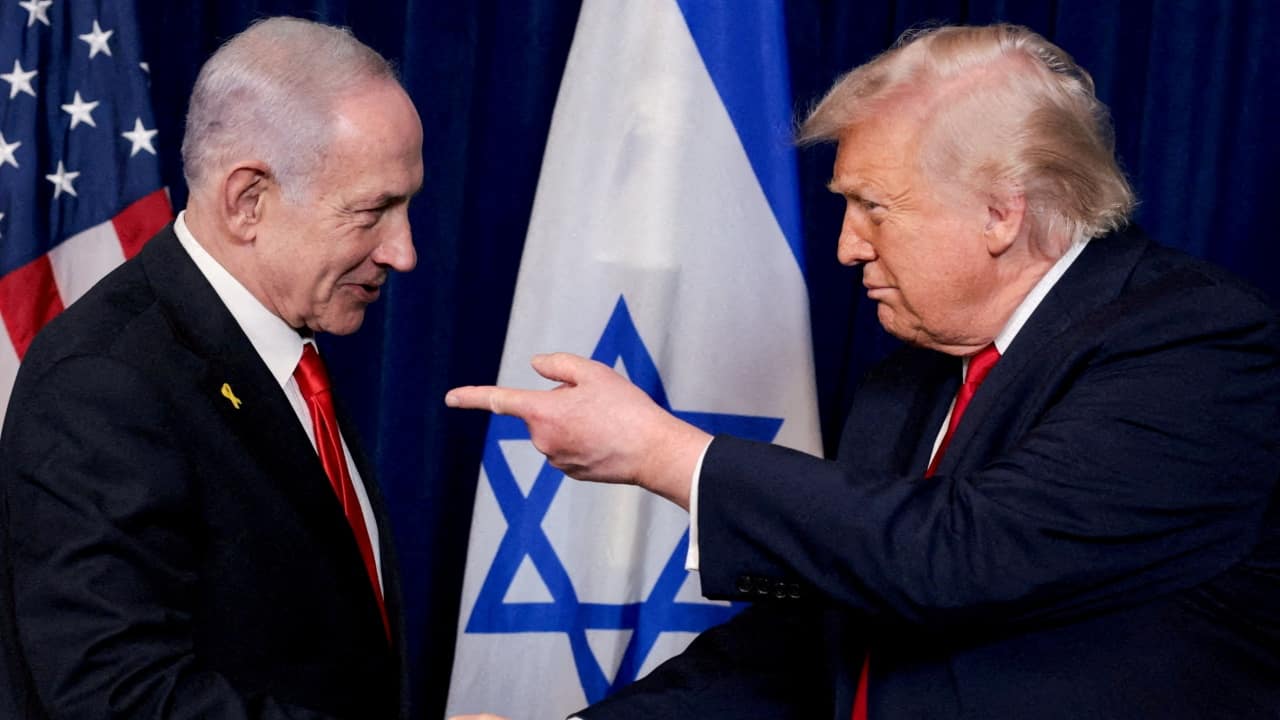
Israel’s intelligence chief Roman Gofman travelled to Washington on Friday to meet senior US officials. Prime Minister Benjamin Netanyahu wants the US to resume military action against Iran. While Netanyahu pushes for strikes, President Donald Trump currently prefers keeping economic pressure and a naval blockade on Tehran instead of war.
Israel's intelligence chief Roman Gofman travelled to Washington on Friday for talks with senior officials in US President Donald Trump's administration, as Prime Minister Benjamin Netanyahu seeks to persuade Washington to resume military action against Iran, Axios reported. Gofman, the director of Israel's Mossad intelligence agency and one of Netanyahu's closest confidants, met CIA Director John Ratcliffe, the report said, citing three sources familiar with the matter. He was also expected to travel to Miami for talks with White House envoy Steve Witkoff, one of the sources said. The visit comes amid differences between Washington and Tel Aviv over the next course of action against Iran.
Netanyahu is pressing for renewed military strikes, while Trump has so far favoured maintaining the naval blockade and economic pressure on Tehran rather than immediately resuming large-scale military operations. Mossad, the CIA and the White House declined to comment on Gofman's visit, Axios reported. Netanyahu denies reports of heated call with Trump The visit comes after Netanyahu's office on Thursday denied reports of a heated telephone conversation between the Israeli prime minister and Trump over whether to resume military action against Iran. Israeli media outlet Ynet had reported that a weekend phone call between the two leaders, which largely focused on Iran, involved an unusually heated exchange.
One source cited by the publication described it as a "shouting match from hell". A senior Israeli official reportedly confirmed that the conversation took place but disputed the account of tensions, saying it was "very much not a difficult conversation". Netanyahu's office dismissed the reports as "fake news" and "complete nonsense". The reported weekend conversation was separate from a November 5 call between the two leaders about the Iran conflict, which was confirmed by a US official to Axios. The Financial Times has also reported that Netanyahu has been calling Trump "every day" to push for renewed military action against Tehran.
Trump rules out need for Iran deal as Netanyahu pushes for regime change Trump's position on negotiations with Iran has shifted in recent days. After meeting Qatari Prime Minister Sheikh Mohammed bin Abdulrahman Al Thani earlier in the week, he said there was "positive momentum" in negotiations and indicated that he was prepared to hold off on further attacks. On Thursday, however, Trump said the United States did not need a deal with Iran and redirected Vice-President JD Vance, who had been leading diplomatic efforts, towards domestic issues. "I have asked Vice President Vance to focus his complete and total attention" on alleged corruption and crime in Democratic-run cities and states, Trump wrote on Truth Social.
"We don't need a deal with Iran. Those days have long since passed," he added. Trump also claimed that Washington had leverage over Tehran, writing: "We've got their money, Hundreds of Billions of Dollars, and we've got their Strait!" Earlier in the week, Trump said Saudi Arabia had asked him to maintain the existing situation, while Qatar, Kuwait, the UAE and Bahrain preferred that he wait before taking further military action. These remarks came before his latest statement ruling out the need for a deal. Trump's remarks have raised questions over the future of diplomatic efforts led by Vance.
The White House has not confirmed whether negotiations with Iran have ended, while the administration continues to rely on the naval blockade and economic pressure on Tehran. Netanyahu, however, has argued that the threat posed by Iran cannot be permanently eliminated without a change of regime. Speaking in the Knesset on Tuesday, he said: "Iran isn't giving up on its plan to destroy Israel." "The only way to permanently remove this existential threat is to overthrow the ayatollah's rule," he added. Netanyahu faces political uncertainty at home The diplomatic developments over Iran are unfolding amid political uncertainty in Israel.
Netanyahu's Likud-led bloc won 53 seats in the 120-member Knesset in the October 27 election, falling short of the 61 needed for a majority. Israeli President Isaac Herzog tasked Netanyahu's political rival Gadi Eisenkot with forming the next government. Eisenkot has 28 days to secure a parliamentary majority, with the possibility of a 14-day extension. It remains unclear whether he can gather enough support. Netanyahu remains prime minister while coalition negotiations continue. Sources cited by Axios said Israeli opposition leaders feared Netanyahu could launch an attack on Iran or provoke Tehran into striking Israel to undermine Eisenkot's efforts to form a government.
Netanyahu held a two-hour meeting with Eisenkot on Thursday and briefed him on the situation involving Iran. A source close to Eisenkot said he did not believe the prevailing circumstances required immediate military action against Tehran. In a statement on Friday, Eisenkot said he had met Netanyahu and the prime minister's military secretary earlier in the week and made clear that he would not allow a lack of oversight over the prime minister's actions during the transition between governments. "For me, Israel's security takes precedence over every other consideration and must never be used as a means of political capital.
This is also what I expect of all officeholders," Eisenkot said. Iran conflict remains in a stalemate The latest diplomatic manoeuvring comes as the conflict between Iran, the United States and Israel remains deadlocked. The US and Israel launched strikes against Iran in February, triggering retaliatory attacks by Tehran on American military bases and interests in Gulf countries. Iran also effectively blocked shipping through the Strait of Hormuz, a critical route for global oil and gas supplies. Washington responded with a naval blockade of Iranian ports. Although both sides agreed to a ceasefire framework in June, it quickly unravelled over unresolved issues, including restrictions on shipping through the Strait of Hormuz and Iran's nuclear programme.
The standoff has exposed a widening difference between Washington and Tel Aviv: Trump is relying on economic and maritime pressure, while Netanyahu is pushing for renewed military action and the overthrow of the ayatollah's rule.