
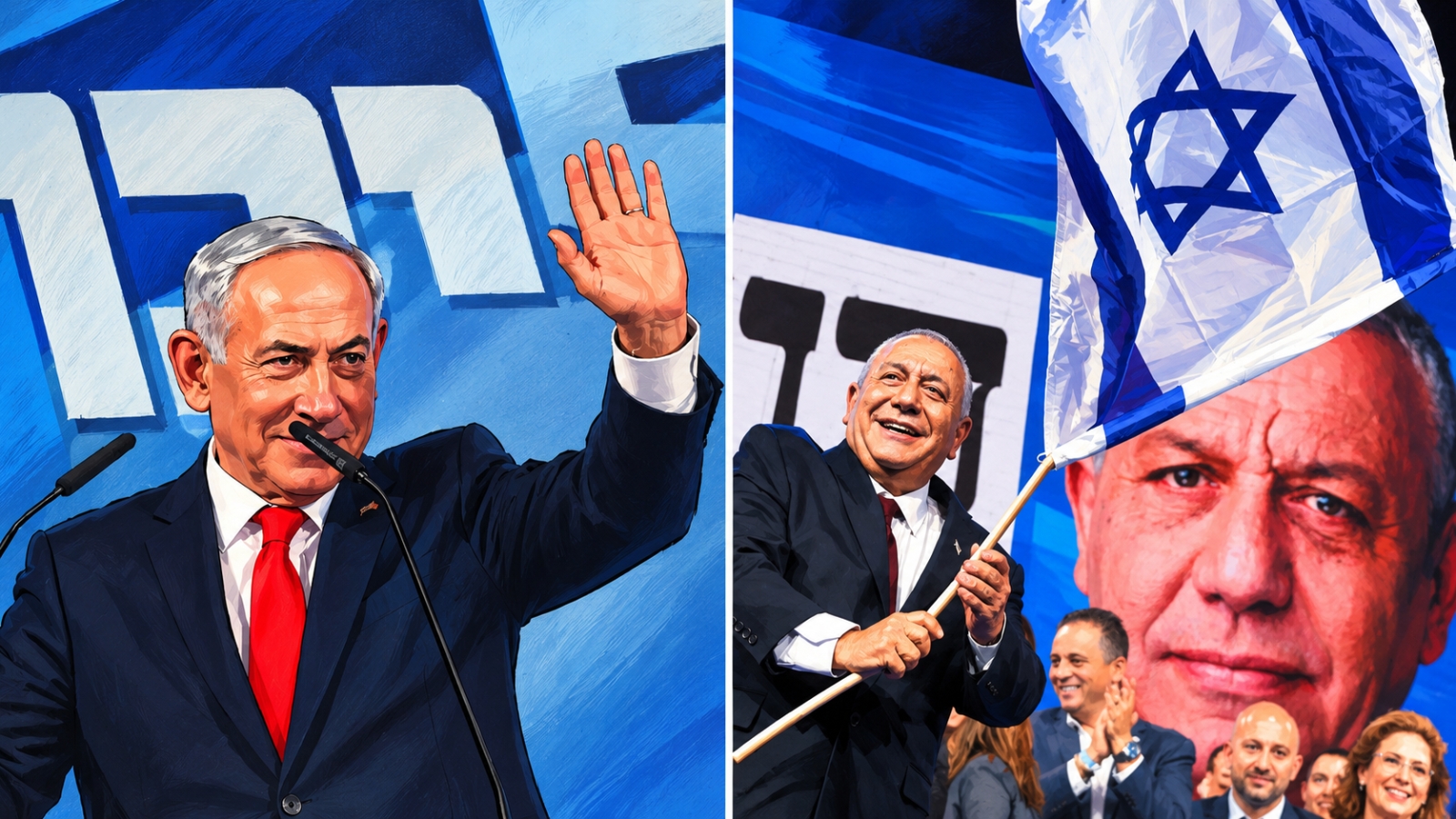
Israel’s 2026 election remains deadlocked as neither Benjamin Netanyahu nor Gadi Eisenkot reached the 61 seats needed for a majority. Officials are now counting hundreds of thousands of double-envelope ballots from soldiers and displaced residents. These votes could change the final seat tally and influence upcoming, difficult coalition negotiations.
Israel's election remains deadlocked, with neither Prime Minister Benjamin Netanyahu's bloc nor the opposition alliance led by Gadi Eisenkot reaching the 61 seats needed for a majority. The counting of hundreds of thousands of double-envelope ballots could alter the seat tally and shape coalition negotiations.
The Israel election 2026 has left Prime Minister Benjamin Netanyahu's bloc short of a parliamentary majority, with hundreds of thousands of special ballots still awaiting verification and counting. According to The Times of Israel, the count of regular ballots put Netanyahu's bloc at 53 seats, the opposition bloc led by Gadi Eisenkot at 48, and Arab-led parties at 19, all short of the 61 seats needed to form a government.
The remaining double-envelope votes could alter the final distribution of seats and influence coalition negotiations. The Times of Israel reported that around 600,000 such ballots were awaiting counting, while Ynet put the expected number at more than 650,000. These ballots include votes cast by soldiers, reservists, displaced residents and other eligible voters unable to vote at their designated polling stations. The Central Elections Committee must verify that voters have not cast ballots more than once before the votes are added to the national tally.
Israel Elections 2026
What happens next? Israel's coalition scenarios
Neither bloc has the 61 seats needed for a majority. Three ways it could go, and the president's role in deciding who gets the first shot.
Partial count: 85.6% of votes 53 19 48 Netanyahu-led bloc Arab parties Eisenkot-led bloc Dashed line: 61 seats. About 600,000 double-envelope votes, including soldiers', had yet to be counted. Source: Central Elections Committee figures via The Times of Israel, Oct 28. Pick a scenario to trace its path SCENARIO 1Netanyahu gets to 61SCENARIO 2Eisenkot's bloc forms a governmentSCENARIO 3Neither side: new election +8seats Netanyahu's bloc needs beyond its 53 in the partial count
He would need to bring in parties from outside his bloc.
He has called a government relying on anti-Zionist Arab parties "unthinkable".
He says the right has a "decisive majority" among the Zionist public.
Path shown assumes Netanyahu gets the first mandate. Source: The Times of Israel +13seats Gadi Eisenkot's bloc needs beyond its 48 in the partial count
Arab-led parties hold 19 seats, but Eisenkot has ruled out partnering with them.
Analysts say they could back a government from outside the cabinet, without ministries.
A confidence vote needs only more yes than no votes, so a minority government is legally possible.
Path shown assumes Netanyahu fails first; Herzog could instead give Eisenkot the first mandate. Sources: Al Jazeera; Israel Policy Forum 90days: the window for a new election if every attempt fails
The Knesset dissolves and Netanyahu's government stays on as a caretaker.
Israel held three elections in 2019-2020 before a power-sharing deal ended a similar deadlock.
Analyst Asaf Ronel says another election within months is the most likely outcome if rivals keep refusing to work with Arab-led parties.
Al Jazeera; Israel Policy Forum How a government gets formed Official resultsThe Central Elections Committee must publish them within eight days of the vote: by November 4. PRESIDENT'S ROLEPresident consults every partyWithin seven days, Isaac Herzog hears each party's recommendation, then picks the lawmaker he thinks is most likely to win a confidence vote, not necessarily the leader of the largest party. First mandate: 28 daysThe nominee negotiates a coalition. The president can extend the deadline by up to 14 days. ✓ Coalition formed → confidence vote ✗ Fails PRESIDENT'S ROLESecond mandate: 28 daysIf the first nominee fails, the president has three days to choose another lawmaker.
No extension. ✓ Coalition formed → confidence vote ✗ Fails PRESIDENT'S ROLEKnesset majority steps inOver 21 days, 61 lawmakers can ask the president to assign a candidate of their choice, who gets 14 days. ✓ Coalition formed → confidence vote ✗ Fails ✓ GovernmentKnesset confidence voteHeld within seven days; needs a simple majority of votes cast. The government is then sworn in. ✗ DeadlockKnesset dissolvesA new election within 90 days; the outgoing government stays on as caretaker.
Times are maximums set by law. The mandate goes to whoever the president judges most likely to win a confidence vote. In 2009, Shimon Peres picked Benjamin Netanyahu (Likud, 27 seats) over Tzipi Livni (Kadima, 28 seats).
Sources: Israel Democracy Institute; Israel Policy Forum; Al Jazeera; The Times of Israel.
Express InfoGenIECreated by Aniruddha Dhar
Here is how the double-envelope system works and why the count matters:
What are double-envelope votes in Israel's elections?
Double-envelope votes are special ballots cast by eligible voters who cannot vote at their designated polling stations. The system allows their votes to be verified and counted separately after polling day. These ballots could influence the final distribution of seats in Israel's 120-member Knesset.
How does Israel's double-envelope voting system work?
According to the Israel Democracy Institute, voters place their ballot paper inside an anonymous inner envelope, which is then sealed inside an outer envelope carrying their identifying details. Election officials check the outer envelope to ensure that the voter has not already cast a ballot at their designated polling station. The inner envelope is then separated from the identifying information before the vote is counted, preserving ballot secrecy.
Who can vote through the double-envelope system?
The system covers several categories of eligible voters, including soldiers and reservists, police personnel, prisoners, hospital patients, certain medical and election workers, voters with limited mobility, evacuees using designated polling stations, and eligible Israeli representatives serving abroad. The Israel Democracy Institute explains that the arrangement enables voters who cannot reach their regular polling stations to participate in the election.
How many double-envelope votes are expected in Israel's 2026 election?
The number is estimated at around 600,000 to 650,000 or more. The Times of Israel reported that approximately 600,000 double-envelope votes were awaiting counting, while Ynet reported that more than 650,000 such ballots were expected. IsraelFM, citing the TPS-IL news agency, reported an estimate of 650,000 to 700,000. The final number may therefore differ from the initial estimates.
When will the double-envelope votes be counted?
The Central Elections Committee said the counting would begin after the regular ballots were processed. The Times of Israel reported that the special ballots might not be fully counted until Friday, while Ynet reported that the process could extend into Friday morning. The schedule depends on the verification process and the final volume of ballots.
Why could double-envelope votes change the election result?
Israel uses proportional representation, with seats allocated according to parties' shares of the national vote, subject to the electoral threshold and seat-allocation rules. The additional ballots are added to the national totals and can change the number of seats awarded to individual parties. The Times of Israel reported that the special ballots could have a significant impact because the leading blocs are short of the 61 seats needed for a majority.
How many seats does Netanyahu need to form a government?
A majority in the 120-member Knesset requires 61 seats. With his bloc at 53 seats in the reported count, Netanyahu remained eight seats short of a majority. He would need support from additional parties to form a government.
Could the double-envelope votes help Netanyahu?
They could affect the seat distribution, but the direction and scale of the change cannot be established in advance. The Times of Israel reported that special ballots have traditionally tended to favour Zionist parties over Arab and ultra-Orthodox parties, although the large number of reservists serving in 2026 makes this year's outcome harder to predict. The final impact will depend on how the ballots are distributed among parties.
Could the double-envelope votes help the opposition?
Yes. The additional ballots could change the number of seats won by parties in either bloc. However, the effect is not guaranteed to favour the opposition. The final seat allocation will depend on the vote totals of individual parties, including those close to the 3.25% electoral threshold.
Why are the Arab-led parties important in the election?
The Arab-led parties were projected to hold 19 seats in the reported count, a historically high total, according to The Times of Israel. Their representation could change as the remaining votes are counted. Their potential role in coalition negotiations is significant because neither main bloc has secured a majority, although Netanyahu has opposed relying on Arab-led parties to form a government.
When will Israel announce the final election results?
The Times of Israel reported that the official results were scheduled to be announced by November 4. Until the special ballots are verified and counted, the published seat distribution remains provisional. Even after the final tally, forming a government could take weeks because a candidate must secure sufficient parliamentary support.
Can the double-envelope count alone determine who becomes prime minister?
No. The count determines the final distribution of seats, but it does not directly elect the prime minister. After the official results are published, President Isaac Herzog will consult representatives of the elected parties and assign a lawmaker he believes has the best chance of forming a government. That candidate must secure the support needed for a parliamentary majority.