
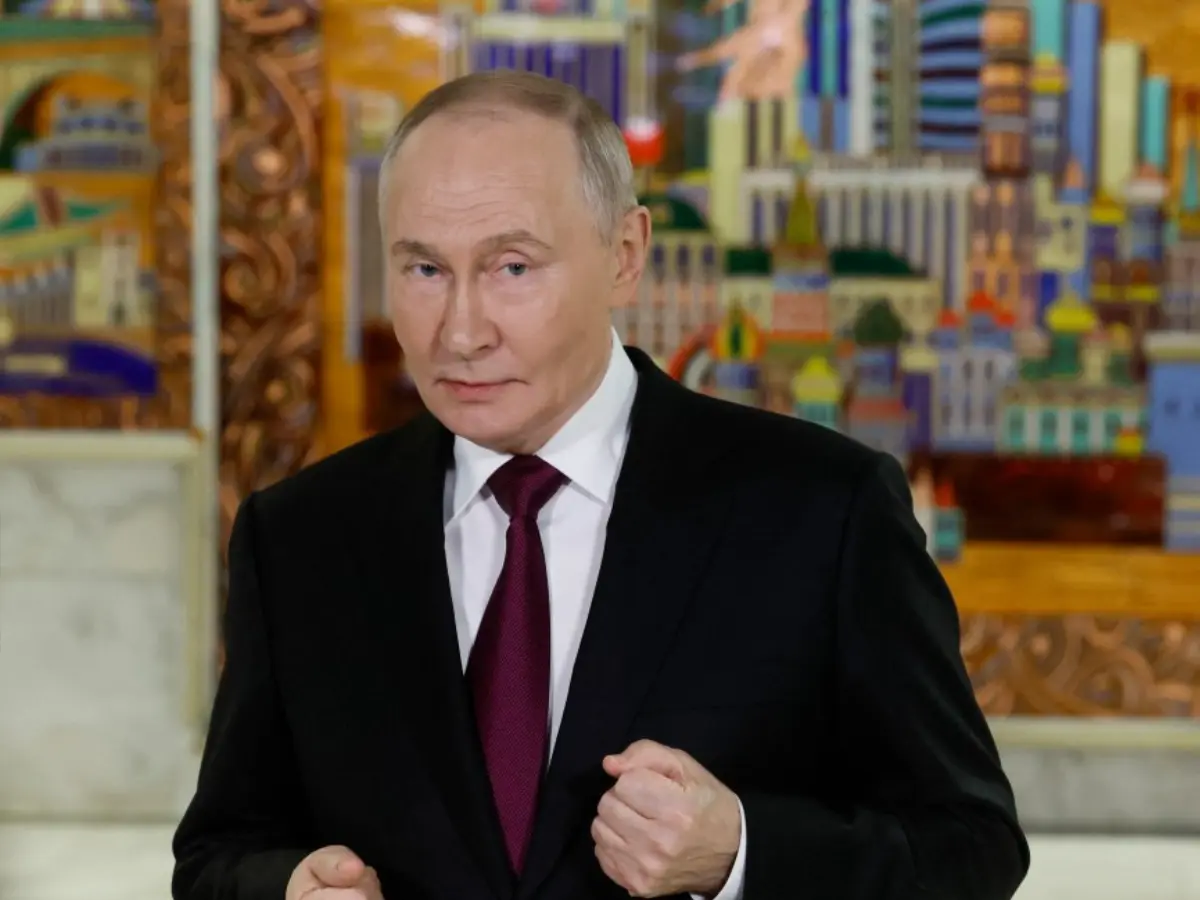
Russian state TV aired footage showing a Kremlin aide carrying what it described as Vladimir Putin's nuclear briefcase at the APEC summit in China. A naval officer confirmed it was the device when asked by a reporter. This claim remains unverified, though it surfaced before key nuclear talks in Shenzhen.
Russian state TV claims Putin's nuclear briefcase was spotted at the APEC summit in China, raising questions ahead of sensitive nuclear talks
Russian state television has aired footage showing what it described as Vladimir Putin's nuclear briefcase being carried by a Kremlin aide at the APEC summit in China. A correspondent from the Kremlin-controlled Russia-1 channel approached a Russian naval officer in uniform and asked whether the briefcase he was carrying to a meeting was the nuclear briefcase used to issue orders for a nuclear strike. The naval officer responded 'yes' in the footage, which has since been widely circulated. However, the claims made by Russian state television have not been independently verified.
Putin's visit to APEC
Russian President Vladimir Putin arrived in Shenzhen on Tuesday for the summit involving 21 member countries. The gathering is expected to include a much-anticipated trilateral meeting with Chinese President Xi Jinping and US President Donald Trump. The White House has said that nuclear proliferation will be among the subjects discussed by the leaders.
The United States has expressed concern over China's expanding nuclear arsenal. Washington is also concerned about Russia's nuclear posture since the beginning of the Ukraine war. Putin placed Russian nuclear forces on special alert, suspended participation in the New START non-proliferation treaty and updated the country's nuclear deterrence guidelines. Yevgeny Popov, a presenter with Russia-1 and co-host of the current affairs programme 60 Minutes alongside his wife Olga Skabaeeva, was filmed reporting outside the summit venue in Shenzhen, where several cars were parked.
"Look, the very nuclear briefcase is right behind our backs," he said as a naval officer was seen walking with a briefcase.
Popov then approached the officer and asked, "hello, is this the nuclear briefcase," to which the officer replied, "yes." The presenter followed up by asking "that very one?" The officer again responded, "this very one." Popov could then be heard saying 'unbelievable' off camera.
The possibility that the interaction was staged as part of Kremlin psy-ops ahead of sensitive nuclear discussions cannot be ruled out. A similar incident was recorded in October 2023, when Putin met Chinese President Xi Jinping in Beijing. Following the meeting, Putin was filmed walking towards another engagement while being followed by two Russian naval officers carrying briefcases.
What is the nuclear briefcase?
Russia's nuclear briefcase is a system developed during the 1980s. It entered service in 1985, when Mikhail Gorbachev became the final president of the Soviet Union. Known as the 'Cheget', after Mount Cheget in the Caucasus, the briefcase is generally carried by a Russian naval officer who accompanies the president. However, it is rarely seen in public footage.
Russia also has two other such briefcases, held by the country's defense minister and chief of the general staff. Valentin Golubkov, who was involved in developing the briefcase, said its primary purpose was to provide a secure communication system connecting the president with the country's senior military leadership. "The goal is to unite our entire vast missile and nuclear arsenal," he told the tabloid Komsomolskaya Pravda in 2014.
At the time, the United States was deploying missiles in Europe whose flight time to the USSR was only five minute. Russia's General Staff was also conducting exercises and simulating retaliatory strikes. "There was another reason, it was necessary to ensure against unauthorized nuclear missile launches," Golubkov said. "In these few minutes, the sanction for a retaliatory strike must be obtained," he added. The president issued the order, which was coordinated through the corresponding nuclear briefcases held by the defense minister and chief of the general staff.
Who actually carries the cases?
In December 2025, independent Russian investigative outlet the Dossier Center reported that its investigation had identified officers from the secretive Special Service for Strategic Communications, internally known as Service 'K', as the people responsible for carrying the briefcases.
According to the outlet, at least 53 individuals had been linked to Service 'K' between 2021 and 2025. The group reportedly included a general, dozens of colonels and several navy captains whose salaries were comparable to those of other contract officers. "Despite the sensitivity of their work, many of the officers live relatively modest lives, mostly in a closed town outside Moscow," the Dossier Center report said.