
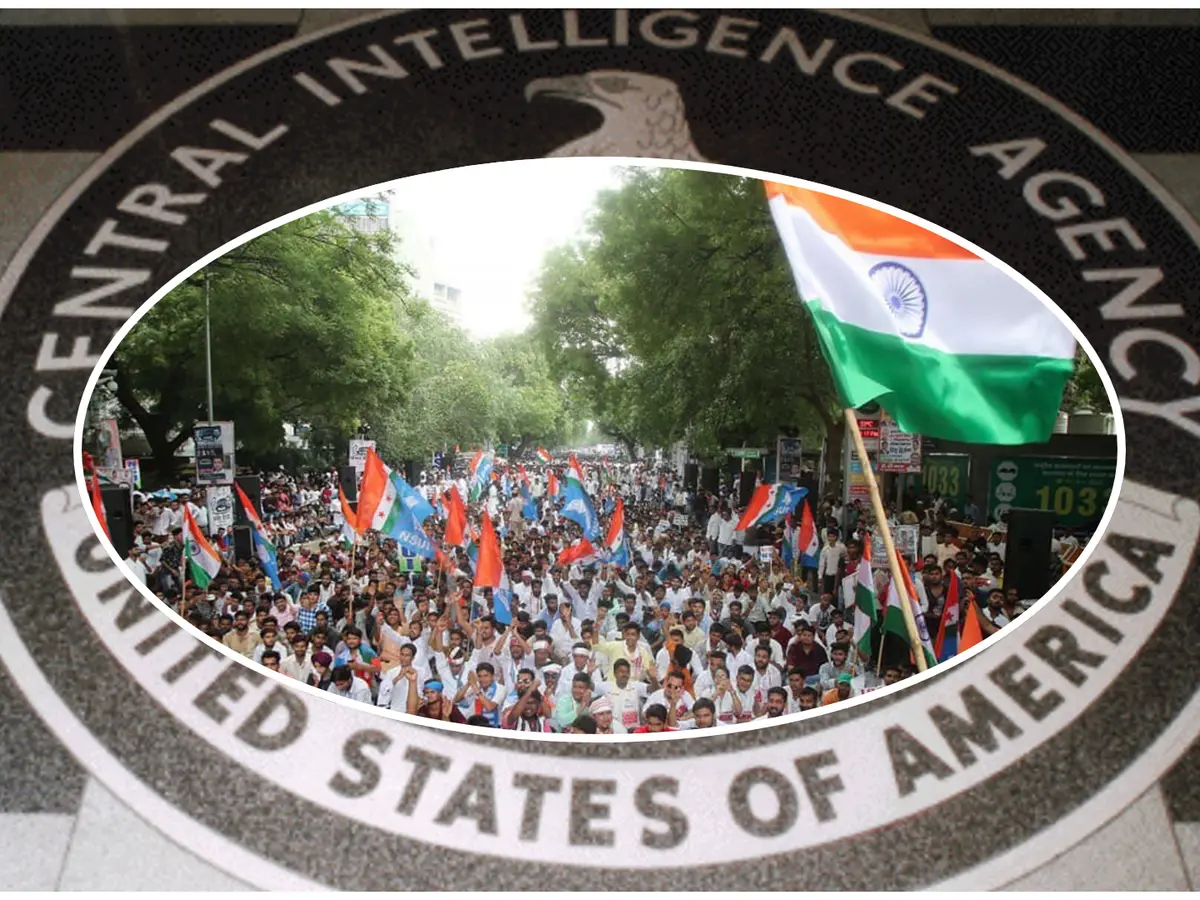
Allegations of US interference in Indian politics have resurfaced amid protests against the Modi government over the actions of top election official Gyanesh Kumar. BJP leaders claim foreign forces want to "destabilise the country." Security agencies are now checking social media and funding links, though no official findings exist yet.
Allegations of US interference in Indian politics have resurfaced amid protests against the Modi government over the actions of top election official Gyanesh Kumar. This is nothing new. Foreign funding and influence claims are part of historical political discourse in India
Amid protests against India's top election officer Gyanesh Kumar, led by the youth movement Cockroach Janta Party (CJP) and joined by opposition political parties, some sections of the media and government-aligned observers allege foreign attempts to destabilise the government of Prime Minister Narendra Modi. Much of this speculation has focused on the US. While the merits of these allegations are up for debate, analysts and historians point to the US record of engineering or attempting regime change in several countries, including democracies. Such operations involved various agencies and organisations such as the Central Intelligence Agency (CIA), aid agencies that channel funds through non-governmental organisations (NGOs), and arms suppliers that equipped different sides of the political divide in countries across continents.
A recurring theme in the ruling Bharatiya Janata Party's (BJP) allegations is that foreign forces are backing the protests. Sukanta Majumdar, a Union minister, described the movement as an attempt to "destabilise the country", while BJP president Nitin Nabin accused it of acting "at the behest of foreign forces".
Security agencies are examining social media posts and profiles allegedly linked to foreign countries, including Pakistan, as well as claims about financial and material support for the CJP and other groups. Questions have also been raised about whether some protest organisers were in contact with personnel linked to the US Embassy, whether workshops involved American consultants, and whether money transfers from US-based foundations to Indian NGOs were connected to the protests.
At the time of writing, no official findings confirming these allegations had been made public.
What is often described as the US "deep state", the official American aid agency, the United States Agency for International Development (USAID), and the National Endowment for Democracy (NED) and its affiliated institutes are frequently mentioned in these allegations. These include the National Democratic Institute (NDI) and the International Republican Institute (IRI).
The Open Society Foundations, established by billionaire philanthropist George Soros, and related entities have also been accused of funding NGOs, media outlets, activists and investigative projects to criticise or destabilise the Modi government, amplify protests and influence electoral narratives. These claims remain contested and should be distinguished from established evidence.
Such funding is often linked in political debates to civil society organisations, human rights groups and media outlets critical of the government on issues such as minority rights, farmers' protests and democratic backsliding. Over the past 12 years, the Indian government has tightened enforcement of the Foreign Contribution (Regulation) Act (FCRA), cancelling the registrations of dozens of NGOs over alleged violations and concerns about foreign interference in India's internal affairs.
In 2025, the BJP cited reports that the Organised Crime and Corruption Reporting Project (OCCRP), an investigative journalism network, receives funding from the US government. The party accused the organisation of producing material targeting Modi and his associates, describing this as part of a "deep state" agenda to destabilise India. Some of these allegations have also been linked politically to Congress leader Rahul Gandhi.
Former US State Department official Mike Benz has made unverified claims about American interference in Indian elections, including the 2019 general election, through USAID, think tanks, technology platforms and efforts to influence public narratives.
In 2025, US Director of National Intelligence Tulsi Gabbard said American intelligence agencies were not involved in regime-change efforts in India.
USAID has spent hundreds of millions of dollars on development and governance programmes in India over successive administrations, often working through local organisations. In 2016, India placed the NED, which provides grants to civil society and related groups, under scrutiny in connection with FCRA-related restrictions.
India's political discourse has repeatedly featured allegations that the US has tried to influence political outcomes in the country to advance its own interests.
In his 1978 memoir, A Dangerous Place, former US ambassador to India Daniel Patrick Moynihan wrote that the US had provided financial assistance to the Indian National Congress on two occasions to help it counter communist influence, once in Kerala and once in West Bengal. One payment was reportedly made to Indira Gandhi, who later became prime minister, when she was a Congress party official.
Another US diplomat, Ellsworth Bunker, also claimed financial assistance to the Congress, citing concerns about Soviet funding for the Communist Party of India during the Cold War. Indira Gandhi publicly rejected the allegations as "malicious, motivated and absolutely baseless".
There have also been allegations that the CIA, operating through aid channels, supported the anti-communist Vimochana Samaram, or Liberation Struggle, in Kerala. The movement contributed to the political campaign against the south Indian state's Communist government, which was dismissed by the central government in 1959. Led by EMS Namboodiripad, it was the first democratically elected Communist government in India. However, claims of direct CIA involvement in the movement remain disputed.
Opposition parties and protest movements in India have frequently faced allegations of receiving foreign backing. From the Cold War to the present, such claims of foreign interference in Indian politics have placed the US at the centre.
However, allegations of foreign influence, evidence of foreign funding and proof of an organised regime-change operation are distinct matters. Many claims about links between foreign organisations and Indian opposition movements remain unsubstantiated.