
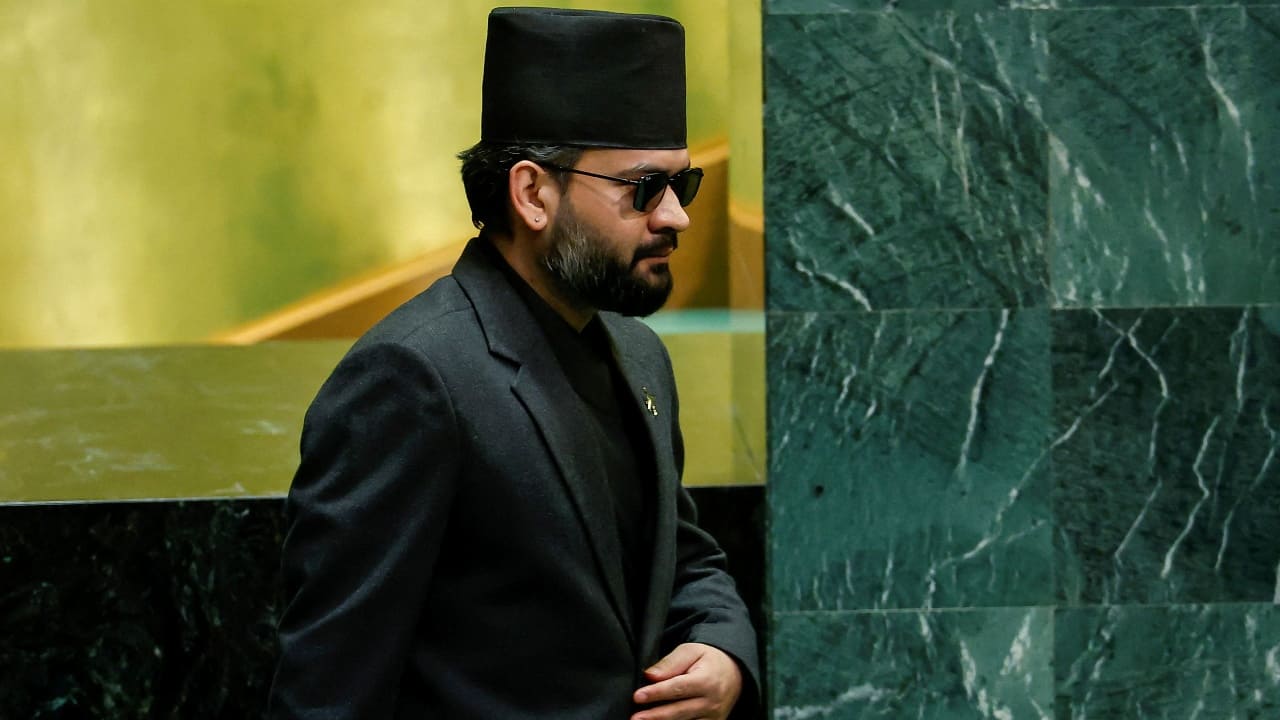
Nepal Prime Minister Balendra "Balen" Shah arrived in New Delhi on Sunday for his first foreign visit. He met Prime Minister Narendra Modi on Monday, securing a $1.6 billion development package. This trip signals a shift in priorities, as Shah chose India over China to strengthen ties and boost economic cooperation.
Nepal Prime Minister Balendra "Balen" Shah's first bilateral foreign visit since taking office in March took him to New Delhi, breaking the uncertainty over which of the country's two powerful neighbours would get the first opportunity to engage with his new government. Shah arrived in India on Sunday evening for a visit lasting around 25 hours. He met External Affairs Minister S Jaishankar before holding talks with Prime Minister Narendra Modi on Monday. The visit resulted in a $1.6 billion Development Cooperation Package for Nepal, eight memorandums of understanding and progress on six cross-border infrastructure and energy projects.
But beyond the announcements, the choice of destination carried diplomatic significance. A new Nepali prime minister's first foreign visit has traditionally been viewed as an indication of Kathmandu's priorities in its relations with India and China. Shah's decision to travel to Delhi first comes at a time when Beijing has expanded its engagement in South Asia and Nepal's ties with India have experienced periods of strain. Several factors appear to have shaped the decision, including Nepal's economic dependence on India, the urgent need for flood reconstruction assistance and the importance of maintaining a working relationship with New Delhi.
An important diplomatic signal to New Delhi For decades, India's position as the first foreign destination for a newly appointed Nepali prime minister has been an established diplomatic convention. There have been exceptions, including Pushpa Kamal Dahal "Prachanda", who travelled to China in 2008 in connection with the Beijing Olympics before visiting India weeks later, and KP Sharma Oli, who chose China in December 2024. Shah's decision to visit India first therefore signalled an effort to avoid an early diplomatic disagreement with New Delhi. The choice is particularly significant given the concerns surrounding his government's initial engagement with India.
Shah, a rapper-turned-politician and former Kathmandu mayor, had cultivated an image built around assertive nationalism and sovereignty. As mayor, he displayed a "Greater Nepal" map, a gesture that resonated with nationalist sentiment. After becoming prime minister, Shah was initially reluctant to hold one-on-one meetings with foreign envoys, including India's. The delay in establishing regular working-level engagement contributed to perceptions that relations needed attention. PM Modi had congratulated Shah on becoming prime minister on March 27 and invited him to India. The Indian prime minister subsequently referred to the "historic mandate"
Shah received, saying it reflected the aspirations of Nepal's new generation. Travelling to Delhi first offered Shah an opportunity to establish direct engagement with the Modi government and prevent the relationship from being overshadowed by disagreements. Nepal's urgent need for reconstruction assistance The immediate economic requirement was another important consideration. Nepal suffered extensive damage from floods in August, including the Bhotekoshi flood on August 26, which affected homes and hydropower projects. India responded with more than 130 tonnes of relief supplies and 54 rescue specialists.
Shah thanked India in Parliament on September 2 for its assistance. Nepal's Finance Minister Swarnim Wagle also reached out to New Delhi on reconstruction financing. With Kathmandu facing a substantial recovery bill, India was an important source of financial and logistical support. During the joint statement, PM Modi announced a Development Cooperation Package worth 24,000 crore Nepali rupees, equivalent to $1.6 billion. He said the assistance would help affected families rebuild their lives, create new opportunities and strengthen Nepal's ability to deal with future disasters. The package was the biggest financial announcement of Shah's visit and placed development cooperation at the centre of the bilateral engagement.
Economic dependence makes India difficult to bypass Nepal's economic relationship with India is another major factor behind Shah's choice. India is Nepal's largest trade, transit and investment partner. It accounts for around 80 per cent of Nepal's goods exports and nearly a third of its foreign direct investment. Nepal also depends heavily on India for fuel supplies and access to the sea. The challenges facing alternative trade routes have reinforced this dependence. The closure of the Tatopani and Rasuwagadhi border points has reportedly increased the cost of Nepal's trade with China, highlighting the difficulties of replacing its southern trade routes with northern alternatives.
Energy cooperation is an especially important part of the relationship. India currently imports around 1,200 MW of electricity from Nepal under a long-term arrangement that envisages purchases of up to 10,000 MW over ten years. Nepal earned approximately 1,800 crore Nepali rupees from net electricity exports to India in 2025-26. Indian companies are also involved in major hydropower projects in Nepal, including the 900 MW Arun-3 project. The two countries used Shah's visit to advance cooperation in the sector, including the foundation stone for the 669 MW Lower Arun Hydroelectric Project. Months of diplomatic groundwork The visit was preceded by several high-level exchanges between the two countries.
Rastriya Swatantra Party chairman Rabi Lamichhane travelled to Delhi in June and met Modi, Home Minister Amit Shah and Jaishankar. Nepal's Foreign Minister Khanal also visited India. In early November, Indian Foreign Secretary Vikram Misri travelled to Kathmandu, met Shah and helped finalise the agenda for the prime minister's visit. He also delivered Modi's formal invitation. The groundwork helped establish the diplomatic framework for Shah's first bilateral trip and provided an opportunity to move beyond the initial uncertainty surrounding his government's engagement with India. Delhi first does not mean Beijing is out Shah's visit to India does not mean Nepal intends to distance itself from China.
Beijing had also invited him soon after he assumed office, although preparations for the trip were reportedly put on hold. China has continued to maintain diplomatic engagement with Kathmandu. Nepal's new ambassador to China, Dr Kalyan Raj Sharma, assumed office in Beijing on November 19, shortly before Shah's India visit. Shah has also sought to keep both neighbours involved in regional issues. In his September address to the United Nations General Assembly, he proposed a Himalayan Climate Resilience Mechanism involving Nepal, India and China, and thanked both countries for their assistance during the floods.
However, the new government's approach has been widely perceived as moving away from Beijing, even as it seeks to maintain relations with both neighbours. What remains unresolved with India Despite the agreements and financial announcements, several longstanding issues remain unresolved. The border dispute involving Lipulekh, Limpiyadhura and Kalapani was not included in the formal agenda, according to reports in Nepali media ahead of the visit. The disagreement has persisted since 2019, when both countries published maps incorporating the disputed territory. Nepal also continues to seek additional air-entry routes through Indian airspace to improve international connectivity for its airports at Bhairahawa and Pokhara.
India has cited security concerns but has reportedly been positive about a possible Mahendranagar route. Kathmandu has also sought changes to trade arrangements to improve market access for Nepali goods and address provisions of the 1950 treaty. Nepal's widening trade deficit with India remains another concern. Shah's visit has produced tangible agreements on development, connectivity, energy and institutional cooperation. But the border, air routes and trade issues underline that the broader relationship still has difficult questions to address. His decision to make India his first bilateral destination reflects the immediate importance of New Delhi to Nepal's economy, reconstruction needs and regional diplomacy.
The visit has opened a channel for closer engagement, although the larger task of rebuilding trust between the neighbours remains.