
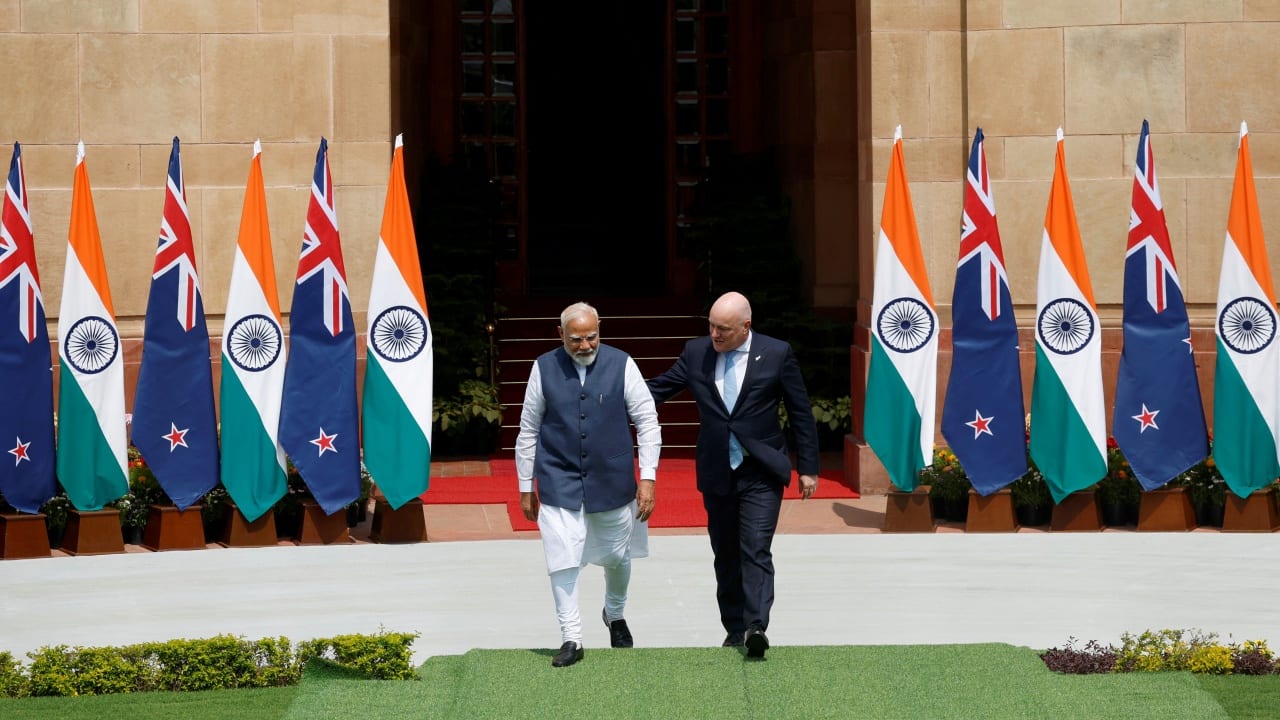
The India-New Zealand free trade agreement starts on October 20, opening a $6-billion export opportunity for Indian businesses. Key sectors like pharmaceuticals, jewellery, and machinery stand to gain as tariffs get removed. This deal helps Indian exporters reach new markets and diversify trade routes amid global disruptions in West Asia.
Market Mastery
Webinar by Vishal Malkan
Find the weak links
in your portfolio by Vishal Malkan
The India-New Zealand free trade agreement (FTA), set to come into force on October 20, could open up a $6-billion market for Indian exporters, with pharmaceuticals, gems and jewellery, machinery and manufactured goods among the biggest potential beneficiaries, according to a Moneycontrol analysis of trade data.
The opportunity lies primarily in product categories where New Zealand already imports substantial quantities from the rest of the world but sources little or nothing from India, despite Indian exporters having an established global presence.
Of the 2,871 product categories in which New Zealand imported goods worth $47.5 billion in 2024, India had negligible exports in 1,144 categories, representing a combined import market of around $6 billion. In another 506 categories worth $2.3 billion, Indian shipments were below $1,000.
India exported just $742 million worth of goods to New Zealand in 2024.
Pharmaceuticals, machinery offer substantial headroom
Pharmaceuticals represent one of the largest opportunities. India exported nearly $20 billion worth of pharmaceutical products globally in 2024, but shipments to New Zealand amounted to just $69 million, against the country's total pharmaceutical imports of $763 million.
In immunological products, where New Zealand imported nearly $140 million worth of goods, it sourced virtually nothing from India, even though Indian exporters shipped around $300 million globally.
New Zealand imported nearly $60 million worth of forklifts, while India's global exports stood at $141 million, with negligible shipments to New Zealand. In grapes, New Zealand imported $48.3 million, with India accounting for only a marginal share.
Jewellery, textiles and plastics could gain
Significant headroom also remains in categories where Indian exporters already have a presence but account for a relatively small share of New Zealand’s purchases.
Indian jewellery exports account for less than a quarter of New Zealand's $108-million precious jewellery import market.
Similarly, India supplies only around 10 percent of New Zealand's $95-million T-shirt import market and about 7 percent of its nearly $50-million imports of plastic plates, sheets and films.
Under the agreement, New Zealand will eliminate tariffs on all qualifying Indian exports from the first day, potentially improving their competitiveness against suppliers from other countries.
Diversification amid Gulf disruptions
The FTA also assumes significance amid disruptions to trade routes in West Asia.
An earlier Moneycontrol analysis found that New Zealand’s import demand could provide an alternative market for at least 12 percent of India’s exports currently exposed to the Strait of Hormuz, assuming prolonged disruptions and a weak demand recovery in affected Gulf economies.
Products with potential demand include food preparations, machinery, medical instruments, electrical equipment, cosmetics and plastics.