
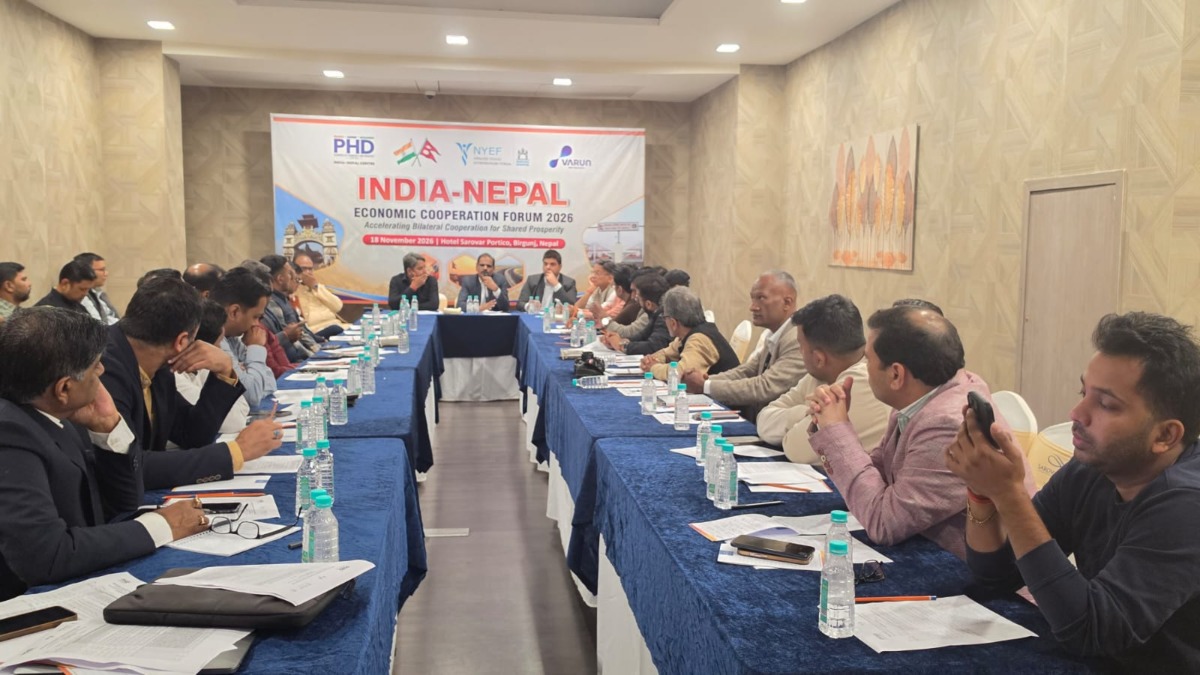
The India-Nepal Economic Cooperation Forum 2026 took place on 18 November in Birgunj. Over forty participants gathered to discuss trade barriers before Nepal PM Balen Shah’s India visit. Devi Sahai Meena said, "bilateral trade between the two countries is increasing with multi-sectoral cooperation." The event aimed to boost economic ties.
For ideating on a forward looking bilateral economic partnership agenda with further accelerating the economic cooperation between India and Nepal, the NYEF Birgunj Chapter and PHDCCI India-Nepal Centre organising "India-Nepal Economic Cooperation Forum 2026" on 18 November 2026 at Birgunj, Nepal.
The interactive forum brought together over forty participants, including leaders of industry chambers and trade bodies, representatives of industry, banking, logistics and hospitality and members of NYEF Birgunj Chapter. Crucially well-timed before Nepal PM Balen Shah's imminent India visit this month that is expected to result in some major announcements on physical infrastructure and connectivity fronts (including new air spaces and a direct train between Janakpur and Ayodhya) besides post-Bhotekoshi floods reconstruction/development cooperation from India, the India-Nepal Economic Cooperation Forum" was designed to gather ground-level feedback on the state of India-Nepal trade, understand the challenges and barriers faced in cross-border business, and identify the support expected from the Government of India to facilitate a closer partnership between the two nations.
Devi Sahai Meena, Consul General of India, Birgunj, Nepal was the "Chief Guest & Keynote Speaker" of "India-Nepal Economic Cooperation Forum 2026" wherein the other speakers' were the leading voices of industry. The Chief Guest and Keynote Speaker, Devi Sahai Meena, Consul General of India, Birgunj (Nepal), noted that bilateral trade between the two countries is increasing with multi-sectoral cooperation. He spoke in favour of closer ties between the two nations and encouraged such dialogues to be held in the future as well for keeping people-to-people connect as the key bilateral strong fundamentals.
The session was moderated by Mohit Agrawal of NYEF Birgunj Chapter. The programme commenced with a welcome address by Chandan Singh, President, NYEF Birgunj Chapter, who welcomed the guests and participants to the Forum. In his "Theme Address", Atul K Thakur, Senior Secretary, India-Nepal Centre, PHDCCI, outlined the objectives of the session besides broadly reflecting on the bilateral economic relations between India and Nepal-with an aim to shape a forward looking economic cooperation agenda. He added how the "Economic Reforms" combined with "Good Governance" can transform the Nepalese economy, for this to happen, citing 'level playing field' as an important enabler that the policy regime in Nepal should consider on high priority.
The leading industry representatives' of Nepal's business community addressed the session. Ashok Temani, Immediate Past President, Federation of Nepalese Chambers of Commerce and Industry (FNCCI) Madhesh Pradesh, called for a more systematic and better-organised border to facilitate smoother trade. Citing the development of 'border economy' as a decisive factor for the Nepalese economy, he advocated for deeper bilateral engagements on this. Madhav Rajpal, Senior Vice President, Birgunj Chamber of Commerce and Industry (BiCCI), raised concerns about non-tariff measures affecting Nepalese exports and about the cross-border movement of illegal migrants. He also called for the regulation of grey channels of trade. Prabhat Roongta, Senior Vice President, Association of Pharmaceutical Producers of Nepal (APPON), highlighted how restrictions such as a ban on sugar exports from India can cripple Nepal's pharmaceutical industry. He also called for uniformity in Harmonised System (HS) codes. Ganesh Lath, Past President, FNCCI Madhesh Pradesh, spoke on the importance of connectivity, productivity and trust in strengthening trade relations between the two countries. Anup Agrawal, Past President, NYEF Birgunj Chapter, called for investment in the next generation and for bringing premier Indian educational institutions to Nepal to provide better education opportunities.
In the open discussion, the speakers' shared their perspectives on the practical challenges of cross-border business. Participants also underlined the importance of digitalisation of trade processes. The deliberations reaffirmed the value of direct dialogue between industry and policymakers, and the importance of turning ground-level feedback into practical outcomes for stronger India-Nepal economic ties. Maneesh Dudpuri, Commercial Representative, Consulate General of India, Birgunj (Nepal) addressed the trade-related queries of industry representatives and briefed on new developments that are further easing the doing business through India-Nepal borders.
The initiative shall help in opening new avenues of business engagements in the key sectors of economy besides giving a much needed boost to the trade from the Birgunj industry cluster, near crucially important India-Nepal border.