
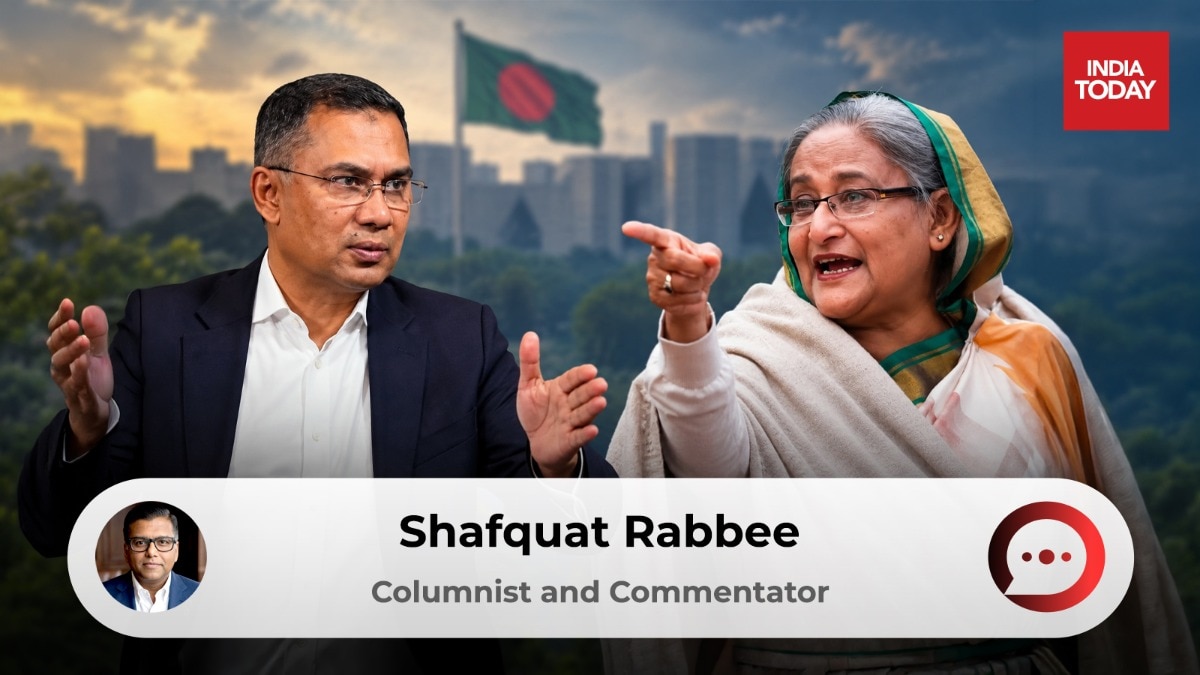
Bangladesh faces rising violence ahead of a November 19 shutdown call by the Awami League. Arson attacks and petrol bombs have gripped the nation, causing several deaths, including a bus helper. Many now worry that the unrest is being directed from outside, as India continues to shelter former leader Sheikh Hasina.
Ahead of Sheikh Hasina's proclaimed return to Bangladesh, Bangladeshi-American commentator Shafquat Rabbee argues that India risks allowing its long-term relationship with 170 million Bangladeshis to become entangled with the political fate of one former leader.
For more than two years, New Delhi has attempted a delicate diplomatic balancing act: sheltering deposed Bangladeshi Prime Minister Sheikh Hasina while insisting on stable, productive ties with Dhaka after the July-August uprising in 2024. That tightrope is snapping. As a fresh wave of coordinated arson, petrol-bomb attacks, and political violence gripped Bangladesh ahead of a November 19 shutdown call by Hasina's Awami League, India's continued hosting of the former leader and several of her senior associates is becoming an increasingly difficult diplomatic challenge.
The human cost of the escalating street violence is already mounting with several unfortunate deaths. In the early hours of November 18, for example, a 25-year-old bus helper named Mohammad Siam was burned alive while sleeping inside a parked bus after arsonists torched two passenger coaches at the Bhandaria bus stand in Pirojpur. The same night, suspected activists from Awami League affiliated outfits torched roadside shops and hurled petrol bombs in nearby Nazirpur.
That fatal attack follows a week-long campaign in which arsonists and vandals targeted 72 branches of Grameen Bank across 40 districts, torched a police station, set fire to the home of several ruling-party Members of Parliament in Gopalganj, and staged disruptive attacks targeting political rivals both at home and abroad, including an attack on a National Citizen Party event in London, which initiated an investigation by the British police.
A leaked audio recording circulating in Dhaka ahead of the November 19 lockdown added fuel to the crisis. In it, former Bangladesh Liberation War Affairs Minister AKM Mozammel Huq appeared to instruct party operatives to "set fire to one or two houses" in every area to oust Prime Minister Tarique Rahman's government by the end of the month.
While the audio's authenticity has not been independently verified, its circulation alongside coordinated arson across the country has reinforced widespread accusations in Dhaka that a violent destabilisation campaign is being directed from outside Bangladesh. By November 19, social media was flooded with targeted arson attack footage, where Hasina's men are openly celebrating, some even openly self-identifying for whom they are carrying out such attacks.
With a large contingent of absconding Awami League senior leaders currently residing in India, Dhaka now has the ammunition to turn New Delhi's long-held belief on its head. For fifteen years, India and Hasina justified mutual backing on the grounds that only her rule prevented Bangladeshi soil from being used by anti-Indian insurgents to destabilise the northeastern region.
Yet over the past 27 months -- spanning roughly 18 months under Muhammad Yunus's interim administration and nine months under Tarique Rahman's elected government -- Bangladesh's territory has not been used against India's core security interests. Today, Dhaka can argue that the presence of senior Awami League figures in India has given it grounds to question whether Indian territory is being used as a base for political activity directed at Bangladesh.
This predicament begins with the contradictory accounts surrounding Hasina's arrival in India. On August 6, 2024, External Affairs Minister S Jaishankar explicitly told the Lok Sabha that before embarking on the helicopter that she used to flee from her state residence, Hasina had requested approval "at very short notice" to come to India, arriving in Delhi only after Bangladeshi authorities requested flight clearance.
Yet in subsequent accounts from exile, Hasina's camp has sought to portray her departure as an abrupt, disorienting evacuation in which she was pushed onto an aircraft without clarity on her destination, as though she came to India against her will -- a narrative that appears difficult to reconcile with New Delhi's own parliamentary record.
Since then, Hasina has repeatedly tested the boundaries of Indian hospitality. Despite India's Ministry of External Affairs periodically distancing itself from her remarks, Hasina's live press appearances and audio addresses have systematically undermined diplomatic thaws. Most notably, after she addressed a high-profile press event in August, Dhaka sharply protested the platform afforded to a fugitive convicted in absentia of crimes against humanity, abruptly derailing a planned visit to India by Prime Minister Tarique Rahman and stalling what had been billed as a bilateral reset.
Now, Hasina has further complicated New Delhi's position by publicly declaring her intention to return to Bangladesh in December "even if death is the price," while offering almost no concrete details on the exact modality of her travel or how she plans to cross the border without an active Bangladeshi passport. Just as tellingly, she has said nothing about what will happen to the large contingent of absconding Awami League leaders and former ministers who fled with her and remain in India.
Behind the scenes, however, there are signs that South Block is increasingly eager to find a way out of the impasse. According to a BBC Bangla report, New Delhi quietly floated two conditions for Hasina's return: that the Bangladesh Army receive her via military aircraft, mirroring her August 2024 flight, and that Dhaka guarantee her the right to appeal her death sentence and receive a fresh trial. Predictably, Dhaka rejected any external conditions on its domestic legal process, with Rahman's advisers insisting neither India nor any other country can dictate terms over her extradition.
What makes New Delhi's predicament particularly consequential is the sheer scale of what is at stake. Official Bangladeshi parliamentary disclosures place formal bilateral trade at $11.39 billion in financial year 2024-25 and roughly $12.8 billion in financial year 2025-26, though actual commerce -- once informal border trade and unrecorded flows are accounted for -- could be substantially larger.
Even by conservative official counts, the asymmetry is staggering: Bangladesh imported $11 billion in Indian goods in 2025-26 while exporting just $1.8 billion, leaving India with a massive $9.2 billion trade surplus and making Bangladesh one of India's top export markets globally. Moreover, India's landlocked northeastern states depend heavily on Bangladeshi transit corridors and border commerce. Sacrificing 27 months of strategic and commercial momentum with South Asia's second-largest economy for a single deposed politician defies basic realism.
Sheikh Hasina is now 79 years old, leading a banned, fractured party with no credible succession plan. By every political and biological measure, her era is drawing to a close. Yet by allowing her and her exiled circle to be in India and prepare ground for a last-ditch street campaign, New Delhi risks allowing its long-term relationship with 170 million neighbours to become entangled with the political fate of one former leader. If India does not draw a hard line now, it risks permanent estrangement from Dhaka long after Hasina leaves the stage.