
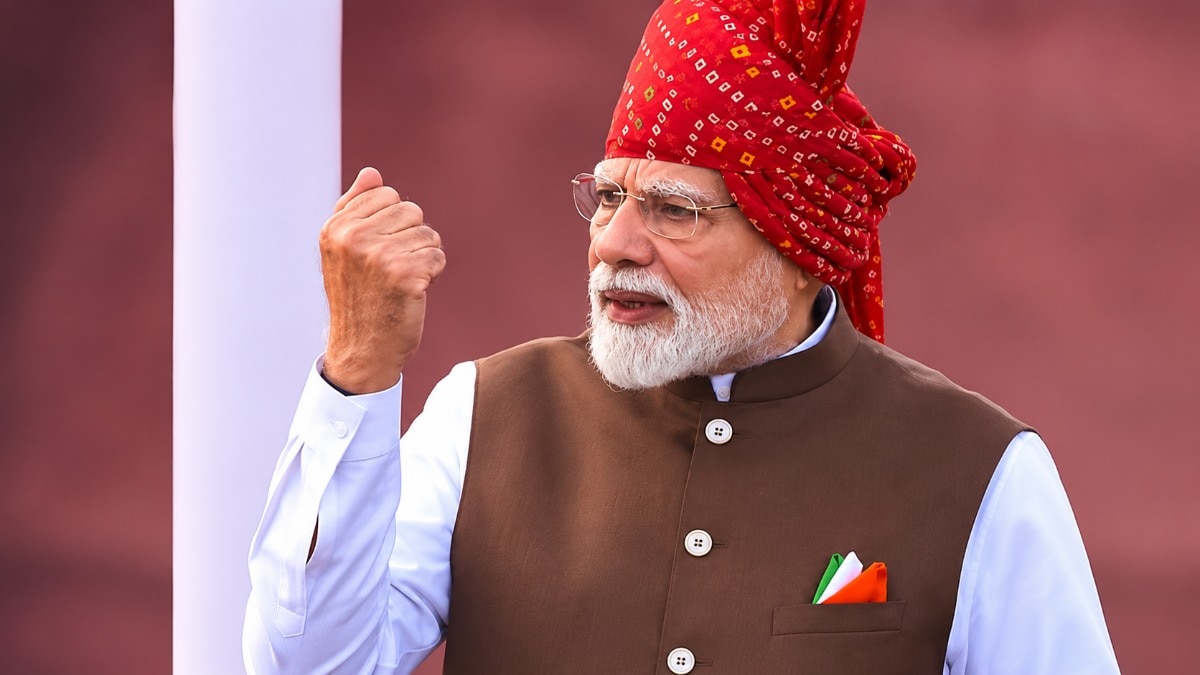
The power gap between India and China reached its lowest level in eight years, the Lowy Institute said on November 22. Prime Minister Narendra Modi ranked as Asia's second-most effective leader. Syed Akbaruddin noted, "India grows more influential in Asia. The only upward arrow in the top ten."
The power gap between India and China has narrowed to its lowest level in eight years, said Australian think tank Lowy Institute, even as it assessed Prime Minister Narendra Modi as the second-most "effective" leader in Asia. In its 'India Gains Influence' report, Lowy said the country had consolidated its position as a major Asian power despite a challenging year.
The Asia Power Index 2026, which has placed PM Modi only behind Chinese President Xi Jinping, said India had "consolidated its position as a major power" in 2026, although China's overall power remained 80% higher. The report also noted that expert assessments of PM Modi's regional leadership had "improved markedly".
The findings are part of the 2026 Asia Power Index, released by the Sydney-based Lowy Institute on Sunday (November 22). India retained its position as Asia's third-most powerful country, behind the United States and China, with its overall score rising to 40.5 points. The US is included in the rankings because the index measures power and influence in the Indo-Pacific region, not just Asia.
Reacting to the findings, former Indian diplomat Syed Akbaruddin, now Dean of the Kautilya School of Public Policy, highlighted India's improved standing. "India grows more influential in Asia. The only upward arrow in the top ten of the Lowy Institute's 2026 Asia Power Index," he wrote on X.
The Lowy Institute is an independent Australian think tank specialising in international affairs and foreign policy. Its annual Asia Power Index, first published in 2018, assesses countries' resources and influence across eight measures, including economic capability, military strength, diplomatic influence and defence networks.
INDIA NARROWS POWER GAP WITH CHINA: LOWY
The Lowy Institute's report, titled "India gains influence", said India's comprehensive power score rose by 0.5 points to 40.5 in 2026, consolidating its position as a major Asian power.
The difference between India and China's overall power scores narrowed to its smallest since the index began in 2018. However, the report added that China remained substantially more powerful.
India's improved standing came despite a difficult economic year and domestic challenges. Its economic capability score declined to 26.4 points, although the country retained third place in the category.
The institute attributed the decline partly to a weakening rupee, changes in the International Monetary Fund's methodology for measuring economies, and a nearly $20-billion reduction in India's outbound investment, said that report.
India's future resources score, however, rose to 56.2 points, supported by an improved economic outlook.
DECLINE IN PERCEPTION DUE TO STANCE ON IRAN WAR: LOWY
One of the report's most significant findings concerned Prime Minister Narendra Modi's regional leadership.
Expert assessments of Modi improved enough to lift India three places on the regional leadership indicator. The improvement came even as the institute recorded weaker perceptions of his global leadership and strategic ambition.
"Expert appraisals of Prime Minister Narendra Modi’s regional leadership improved markedly, lifting India three places. He is now judged to be the second-most effective regional leader, behind Chinese President Xi Jinping," the report noted.
The Lowy Institute linked the decline in perceptions of Modi's global leadership and strategic ambition to India's "lower diplomatic profile" during the war in the Middle East. It particularly flagged India's "muted response" to the sinking of an Iranian naval vessel by a US submarine. The warship was returning from a military exercise hosted by India.
IMPROVEMENT IN PM MODI'S ASSESSMENT DUE TO STABILITY, CONTINUITY: LOWY
Speaking to Australia's ABC News on Sunday, Lowy Institute analyst Jack Sato attributed the improvement in Modi's regional assessment largely to stability and continuity.
"For the assessment of Modi's regional leadership, it's largely stability at a time of upheaval," Sato said.
The analyst said India's Minister of External Affairs, S Jaishankar, had also established himself in the role.
"A key factor we've found is continuity. Both Prime Minister Modi and External Affairs Minister S Jaishankar have established themselves in their roles," Sato told ABC News.
Meanwhile, Pakistan climbed to 16th place in the Lowy Institute's 2026 Asia Power Index. It said that Pakistan's diplomatic influence was boosted by its role in US-Iran ceasefire talks. However, the report added that Pakistan would "unlikely... sustain this score in future editions."
The report also highlighted India's growing defence engagement in Southeast Asia. India's defence networks score increased to 18.6 points, helping it climb two places to ninth. The institute credited stronger regional defence cooperation and BrahMos missile sales to Southeast Asian countries for the improvement.
Overall, the report pointed to India's growing regional influence, even as China continued to hold a substantial lead in power and PM Modi's improving regional leadership assessment.