
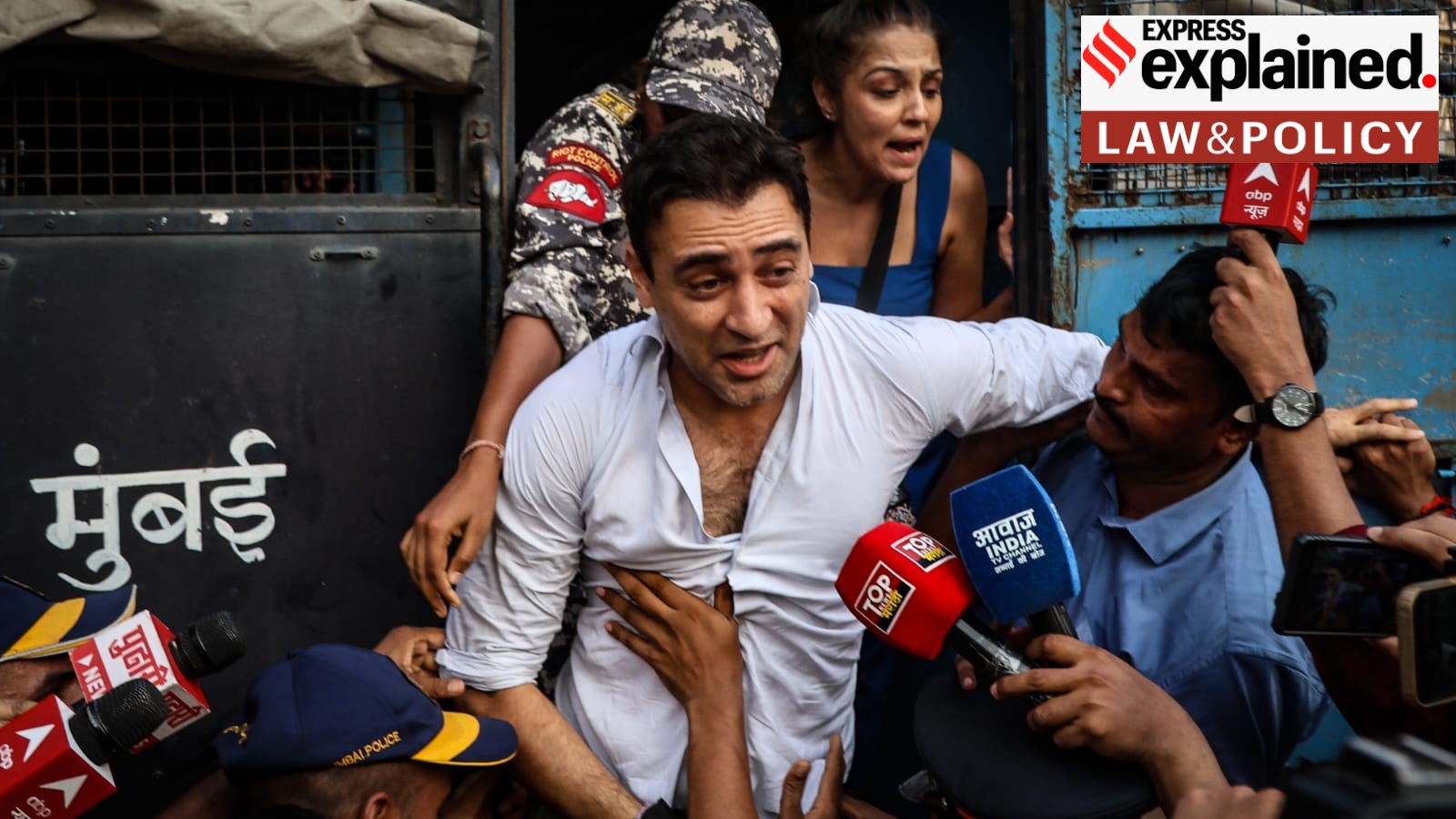
The Foreigners Regional Registration Office asked actor Imran Khan to leave India by October 28. Khan, a US citizen and OCI cardholder, got this notice after he joined a protest on October 10. The government used its broad powers under the Immigration and Foreigners Act, 2025, to issue this order.
Actor Imran Khan, a US citizen and Overseas Citizen of India (OCI) cardholder, has been asked by the Foreigners Regional Registration Office (FRRO) to leave India by October 28, days after he joined a protest in Mumbai demanding the resignation of Chief Election Commissioner Gyanesh Kumar.
Khan was detained along with other protesters at August Kranti Maidan on October 10. Subsequently, BJP leader Kirit Somaiya complained to police that Khan, being a foreign national, had violated the law by participating in the demonstration. The complaint was forwarded to the FRRO, which issued the Leave India notice. According to the police, the notice says Khan is a US citizen and had violated immigration law by joining the protest.
Who is an OCI, and what rights does the status carry?
The OCI scheme was introduced in 2005 for certain categories of foreign nationals of Indian origin. India does not permit dual citizenship, and an OCI remains a foreign national holding the passport of another country.
The status nevertheless gives privileges unavailable to ordinary foreign nationals, most importantly a multiple-entry lifelong visa and exemption from registration with the FRRO irrespective of the duration of stay. OCI cardholders also receive parity with Indian citizens or NRIs in certain areas, including some property, educational and professional rights.
But there are restrictions. A March 2021 government notification requires OCI cardholders to obtain special permission before undertaking research; missionary or Tabligh work; mountaineering; journalistic activity; certain employment or internships in foreign diplomatic establishments; or entering protected, restricted or prohibited areas.
Significantly in Khan's case, the notification does not expressly list participation in political protests or demonstrations as an activity requiring prior permission.
OCIs also do not possess the political rights of Indian citizens. Under Section 7B of the Citizenship Act, they cannot vote or contest elections, and Article 19 rights -- including the constitutional guarantees of freedom of speech and peaceful assembly -- are guaranteed specifically to citizens.
Can an OCI be asked to leave India for joining a protest?
The Immigration and Foreigners Act, 2025, which came into force in September 2025 and replaced the Foreigners Act, 1946, gives the government wide powers over foreign nationals -- and an OCI remains a foreign national for this purpose.
There is no provision in the Act that expressly says that a foreign national cannot attend a political rally or demonstration.
Instead, Section 7 gives the government broad powers to regulate a foreigner's presence and conduct in India. The Centre can issue orders concerning all foreigners, a class of foreigners or an individual foreigner. Such an order can direct that a foreigner "shall not remain in India". It can also impose restrictions on movement or association, prohibit the person from engaging in "activities of a specified description", or regulate his conduct "in any such particular as may be specified".
The significance is that the statute itself does not designate "political protest" as prohibited conduct. But it gives the executive latitude to prohibit particular categories of activity through an order or direction.
There is an even broader provision. Section 29 empowers the government to remove a foreigner from India for contravention of the Act, or of any rule or order made under it, or on the basis of an "adverse security report".
And these are not powers exercisable only by the Union Home Ministry. A September 2025 notification delegated powers under Section 7(2) and Section 29 to FRROs and Foreigners Registration Officers.
In 2020, the Calcutta High Court quashed a Leave India Notice issued to Polish student Kamil Siedczynski, who had participated in an anti-CAA rally in Kolkata. The government had invoked the then Foreigners Act. The court found the notice deficient and held, on the law then before it, that mere participation in a political rally was not by itself sufficient to sustain the action.
The 2025 Act has since replaced that law, although it retains similarly broad executive powers over foreigners.
When can OCI registration itself be cancelled?
This is a different process governed by Section 7D of the Citizenship Act.
The government may cancel OCI registration if it was obtained through fraud, false representation or concealment of a material fact; if the person has shown "disaffection" towards the Constitution; helped an enemy during war; or, in specified circumstances, has been convicted of serious crime.
The widest ground is Section 7D(e), which permits cancellation where the government considers it necessary in the interests of the sovereignty and integrity of India, security of India, friendly relations with foreign countries, or "the general public".
The law has subsequently been expanded to cover specified legal violations as well as certain cases involving OCI status obtained through marriage.
But unlike a straightforward immigration direction, cancellation now carries an express procedural safeguard: an OCI must be given a reasonable opportunity of being heard. Courts have repeatedly examined how much latitude the broad cancellation provisions give the government.
What has happened in previous OCI cases?
Aatish Taseer: The writer had been a persistent critic of the Modi government and, during the 2019 Lok Sabha election, wrote the TIME cover article describing Modi as India's "Divider in Chief". The article triggered a political controversy. Months later, the government cancelled his OCI, saying he had concealed when applying for his status that his father, Salmaan Taseer, had been a Pakistani national. Taseer disputed the concealment allegation and linked the action to his writing; the Home Ministry denied that connection.
Ashok Swain: The Sweden-based academic had for years sharply criticised the Indian government on social media and in public commentary. In 2020 he was served a notice alleging "inflammatory speeches and anti-India activities"; his OCI was eventually cancelled. A later government order expressly cited his regular tweets, writings and speeches, alleging that they spread "detrimental propaganda", damaged India's image and institutions and were inimical to sovereignty, security and public interest. The Delhi High Court first set aside the cancellation order and, in March 2025, struck down the subsequent one because the tweets and writings relied upon had not been supplied to him, depriving him of an effective opportunity to answer the allegations. The government was left free to proceed afresh.
Christo Thomas Philip: Philip, a US citizen and doctor working in Bihar, ran into trouble over alleged evangelical and missionary activity. He was prevented from entering India and subsequently had his OCI cancelled under Section 7D(e), with authorities alleging missionary activity. The Delhi High Court in January 2019 found that the government had not established the statutory basis for treating the activity as threatening sovereignty, security or public interest and ordered his OCI restored and his entry facilitated. The case was among the litigation preceding the government's later move to give explicit legal backing to restrictions on missionary activity through the 2021 OCI notification.
Khalid Jahangir Qazi: The US citizen of Kashmiri origin faced allegations of activities prejudicial to India, including alleged pro-separatist activity. His OCI was cancelled in 2023 and he was separately blacklisted under the then Foreigners Act. The Delhi High Court in November 2024 set both actions aside, holding that vague allegations of "anti-India activities" did not give him a meaningful opportunity to defend himself; it allowed the government to start proceedings afresh with specific allegations.
So what can Khan do now?
Khan can make a representation to the FRRO or the Central government seeking withdrawal or reconsideration of the notice. But, unlike cancellation of OCI registration under Section 7D of the Citizenship Act, where the statute expressly guarantees a reasonable opportunity of being heard, there is no comparable appeal procedure spelt out in Section 7 of the 2025 immigration law.
His other remedy is to approach the High Court under Article 226 of the Constitution, challenging the legality of the Leave India Notice and seeking interim protection against its operation.
The notice requires him to leave India by October 28. Unless the FRRO withdraws or modifies it, or a court grants an interim stay or other protection, khan would be required to leave by that deadline.