
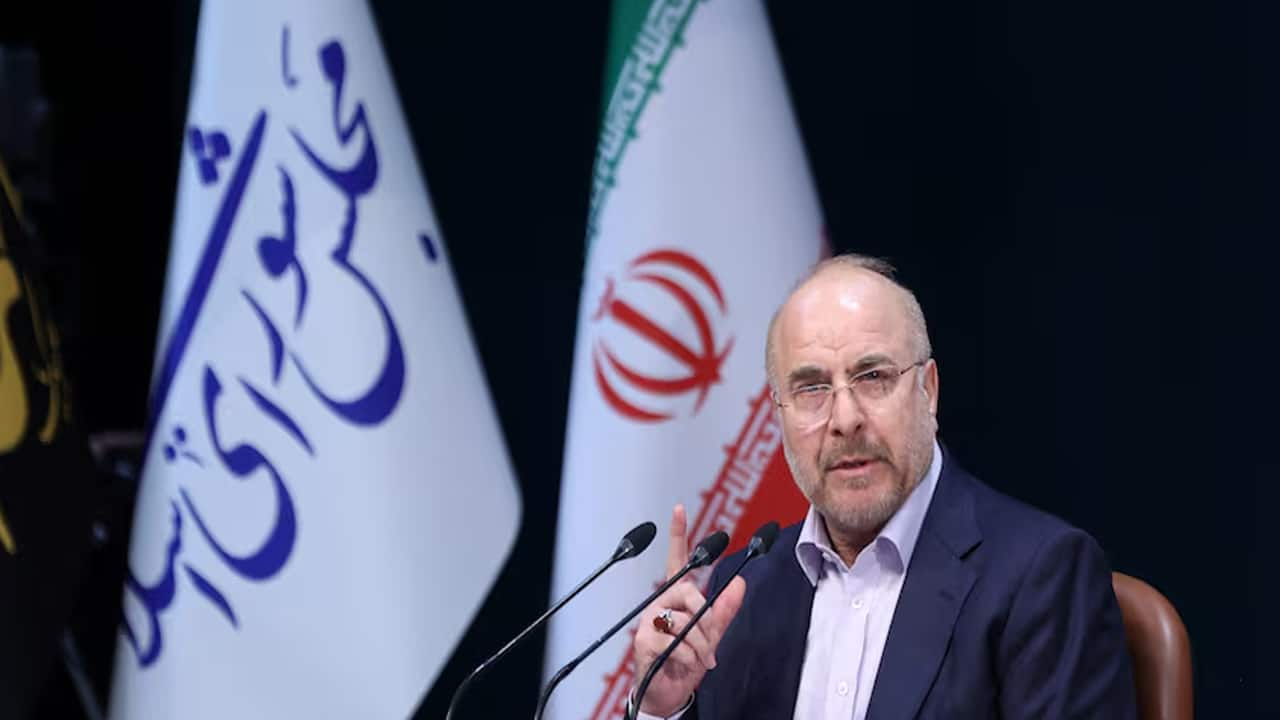
Iran’s top negotiator Mohammad Bagher Ghalibaf warned the United States against fresh attacks on Sunday. He said, "If the US makes another mistake, Iran's powerful Armed Forces will determine the geography of the battlefield." Tehran demands an end to hostilities and sanctions, while the US keeps military options open.
Iran's top negotiator Mohammad Bagher Ghalibaf has warned the United States against launching fresh attacks, saying Iran's armed forces would determine the battlefield in any renewed conflict. He also said Tehran would not accept a prolonged state of "neither war nor peace". Addressing an open parliamentary session on Sunday, Ghalibaf said Iran was prepared for either negotiations or war, but an agreement would depend on Washington accepting Tehran's conditions. "We do not care whether the US chooses the path of negotiations or war. If it accepts our seven reasonable conditions, the door to an agreement will be open," he said, according to Mehr News Agency.
"If the US makes another mistake, Iran's powerful Armed Forces will determine the geography of the battlefield," he added. Iranian media reports have identified among Tehran's key demands an end to US hostilities against Iran and its allies, the lifting of the naval blockade on Iranian ports, and the easing of restrictions on Iranian assets. US weighs military options as aircraft carrier approaches Ghalibaf's warning comes as Washington weighs its next steps while maintaining a military presence in the region. The USS Theodore Roosevelt aircraft carrier strike group is expected to reach the Middle East in the coming days after departing Singapore, The Maritime Executive reported.
Separately, people familiar with US planning told Reuters that a third aircraft carrier could move into the region to replace one of the two currently deployed there. All three could remain in the region if needed, they said. US President Donald Trump has sent mixed signals about the possibility of further strikes. Reuters reported that he could hold off on attacking Iran if Tehran and the Houthis avoid fresh provocative actions. Trump has also consulted Saudi Crown Prince Mohammed bin Salman and Turkish President Recep Tayyip Erdogan, both of whom urged him against further attacks, according to the report.
Trump reportedly told bin Salman on October 31 that he was considering an attack after the US midterm elections. The Saudi crown prince urged him to hold off, arguing that sanctions were working. Despite the reported diplomatic efforts to avoid further strikes, the US military remains prepared to escalate. Further strikes on underground nuclear facilities are among the options reportedly discussed, although the US has already attacked Iranian nuclear sites and the effectiveness of additional strikes remains uncertain. Trump said on Thursday that he could end the conflict immediately but was taking a longer-term approach at the request of countries he wanted to protect.
In a separate post on Truth Social, he said: "We don't need a deal with Iran. Those days have long since passed." Iran showcases military capabilities amid tensions Iran has also sought to demonstrate its military capabilities, recently unveiling an underground "missile city". Ghalibaf described the facility as a symbol of a shift in the regional strategic balance. Meanwhile, the US Central Command (CENTCOM) said American forces were enforcing a naval blockade while keeping the Strait of Hormuz open to commercial shipping. Under an operation called Iron Gate, US forces are also seeking to restrict the IRGC's movement of weapons and sanctioned materials through land routes and the Caspian Sea.
The IRGC claimed that six drones had targeted a US radar installation in Bahrain. Separately, Bahrain said its air defences had intercepted several Iranian aerial attacks and issued public safety alerts. The conflict began on February 28 with US-Israeli strikes that killed Iran's Supreme Leader Ayatollah Ali Khamenei. Iran retaliated by attacking US military installations and restricting shipping through the Strait of Hormuz. The latest military developments have also heightened concerns among neighbouring countries about a wider regional escalation. Iraqi Foreign Minister Fuad Hussein told France 24 that the region could not remain in a "no peace, no war" situation.
"This cannot continue; either it goes towards peace or it goes towards war," he said.