
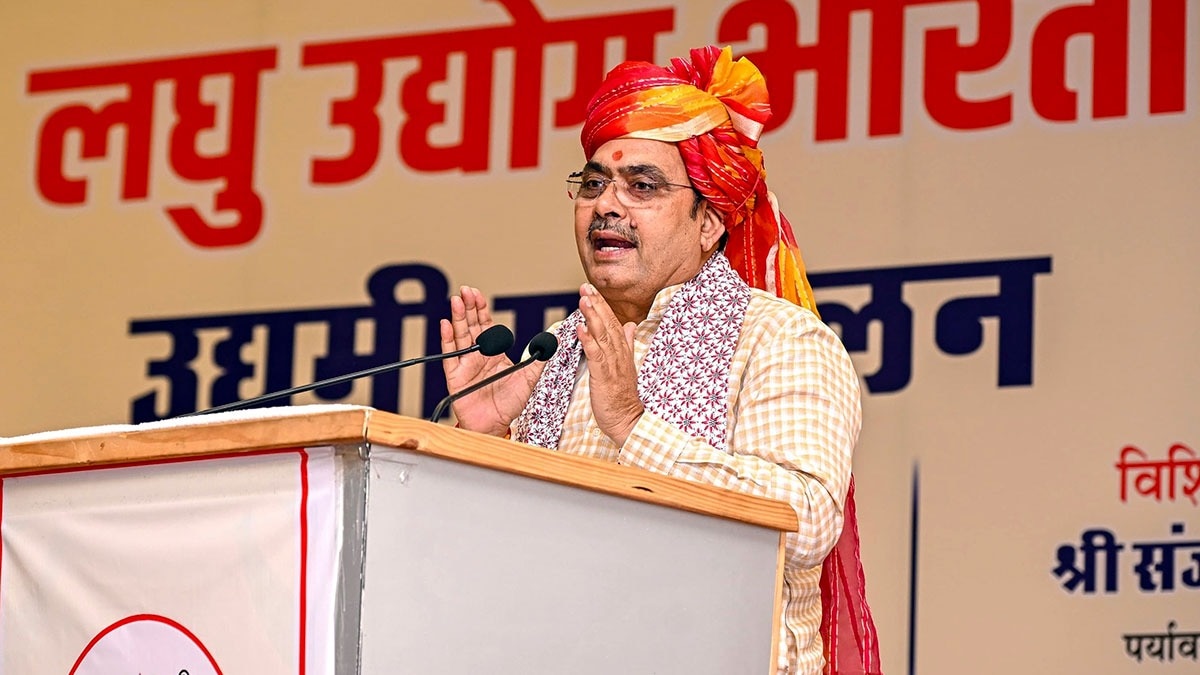
Rajasthan’s four-phase Panchayati Raj elections begin October 23 and end November 16. These polls test if Chief Minister Bhajan Lal Sharma can use his urban political strategy to win rural votes. Over 40.3 million voters will decide the fate of 14,403 Gram Panchayats, marking a major test for his leadership.
The four-phase polls will reveal whether Bhajan Lal Sharma can convert the BJP's organisational edge and governance pitch into rural electoral gains
For Rajasthan chief minister Bhajan Lal Sharma, the next electoral battle begins almost immediately after the BJP's complicated but ultimately successful performance in the urban local-body elections. The four-phase Panchayati Raj elections, beginning October 23 and ending on November 16, will test whether the political machinery and campaign strategy Sharma deployed in the cities can deliver in rural Rajasthan, too.
The scale is considerably larger. The elections cover 41 Zila Parishads, 457 Panchayat Samitis and 14,403 Gram Panchayats, with more than 40.3 million voters eligible to cast their ballots. Voting for Zila Parishad and Panchayat Samiti members will take place in four phases until November 14, while elections for the panch and sarpanch posts will continue until November 16. The elections for 41 Zila Pramukhs and 457 Pradhans are scheduled for November 25 and 27, respectively.
The rural contest is therefore a much bigger political test than the urban polls. The number of eligible voters is nearly three times the 14.4 million electorate in the September civic elections.
The urban results provide both encouragement and warning for Sharma. The BJP emerged as the largest party in 148 of the 309 urban local bodies, and the Congress in 104. But the vote-share contest was remarkably close: BJP polled 35.18 per cent against the Congress's 34.24 per cent, a difference of just 0.94 percentage points, or 99,615 votes. Independents collectively secured 27.38 per cent.
The more consequential part came after the ward results. The BJP eventually formed boards in over 200 urban local bodies, more than double of what the Congress managed. That gap was substantially wider than the initial party-wise leads, underlining the importance of post-poll negotiations, cross-voting and political management in indirect elections.
The Congress's difficulties in converting its electoral strength into control of local bodies have already become a subject of internal scrutiny. The party has constituted a committee under former Assembly Speaker C.P. Joshi to investigate cross-voting and other complaints; reports say more than 400 Congress councillors are under scrutiny. The Congress is trying to send its star campaigners to mobilise voters in its favour, besides district observers and Panchayat Samiti coordinators.
The BJP, on the other hand, is sending 90 publicity vehicles to highlight the government's achievements. CM Sharma's campaign rests on how his achievements in two years beat those of the Congress. Meanwhile, he has moved quickly to turn the urban result into a governance exercise. On October 5, he met newly elected mayors, deputy mayors and other urban-body heads and asked them to work with a 100-day action plan, with particular emphasis on sanitation, roads, drainage, sewerage, drinking water, streetlights and other basic services. He also asked them to address local grievances and prepare development roadmaps.
That push is politically important because one of the criticisms against the Sharma government has been that delivery has not matched the political expectations created after the BJP's 2023 assembly victory. The chief minister has increasingly sought to counter that perception by travelling across the state, inaugurating projects and announcing schemes. With the rural election campaign now underway, the same emphasis on visible delivery is likely to remain central to the BJP's pitch.
The BJP also appears to have moved early on organisation. Its September reshuffle brought in Sanjay Bhatia as Rajasthan in-charge, with Kavita Patidar and Kuljeet Chahal as co-in-charges, specifically amid preparations for the Panchayati Raj elections. The Congress, meanwhile, is trying to repair the organisational weaknesses exposed by the urban elections. Its strategy includes early ticket distribution, greater reliance on established grassroots workers and attempts to prevent cross-voting.
For Sharma, however, the rural contest presents a different challenge. The BJP cannot simply replicate its urban-board strategy. Village-level politics is intensely local, candidate-driven and factional, while the subsequent elections of Pradhans and Zila Pramukhs will again involve indirect contests.
The numbers also raise the stakes. The reorganisation of Panchayati Raj institutions has increased the number of Zila Parishads from 33 to 41, Panchayat Samitis from 352 to 457 and Gram Panchayats from 11,320 to 14,403. The State Election Commission says the number of elected representatives will rise to 155,138.
For Sharma, therefore, the panchayat elections are more than another round of local polls. They will test whether the political management that helped the BJP expand its control of urban local bodies can penetrate the state's vast rural network -- and whether his government's message of delivery has begun to travel beyond Rajasthan's cities.