
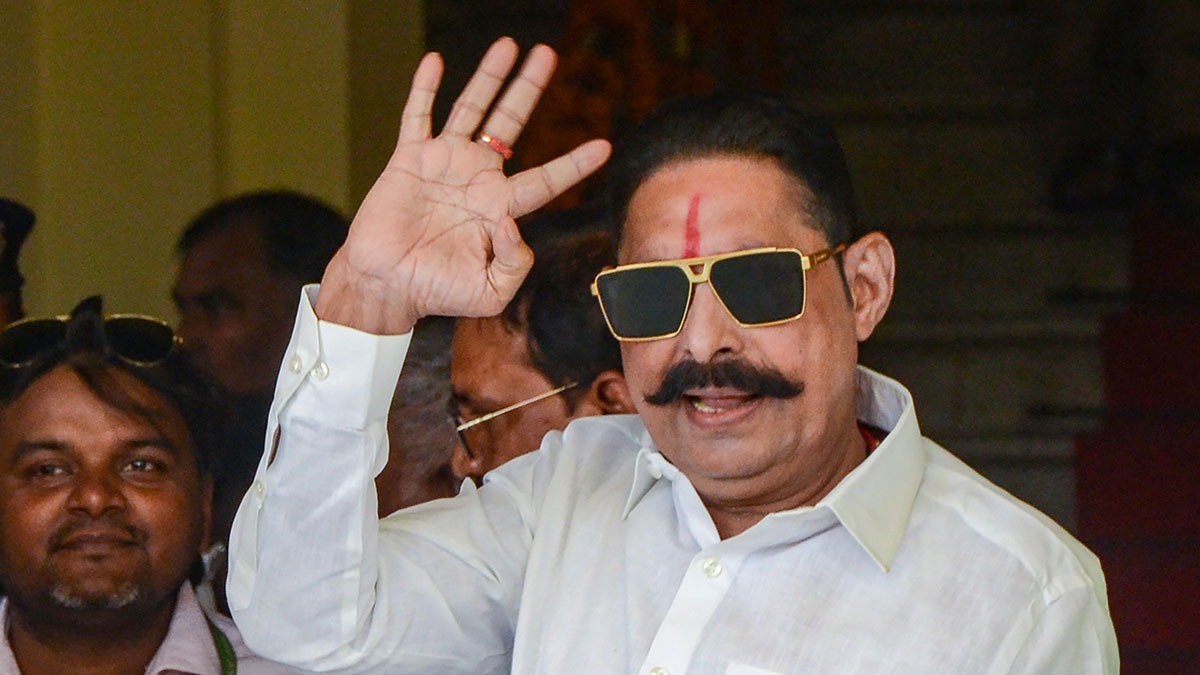
The Janata Dal (United) expelled Mokama MLA Anant Kumar Singh and his wife Neelam Devi for six years on October 24. State president Umesh Singh Kushwaha said the party took action because Singh defied directives and used derogatory language. This move tests the party’s discipline against a powerful local leader.
The expulsion of the Mokama MLA and his wife underlines an old feud, the limits of Nitish Kumar's tolerance for dissent and the risks of alienating a local strongman
On October 24, a day after polling for the Bihar legislative council elections, the Janata Dal (United) expelled Mokama MLA Anant Kumar Singh and his wife and former legislator Neelam Devi from the party for six years. The order, issued by state president Umesh Singh Kushwaha, accused Singh of defying party directives, using derogatory language against senior leaders and campaigning for a rival candidate.
The JD(U) also recommended that legislative assembly speaker Prem Kumar initiate proceedings to disqualify Singh under the 10th Schedule of the Constitution (anti-defection laws).
For a leader who has spent two decades converting local influence into political power, the expulsion marks a rupture with the party that had brought Singh back into its fold. But the action is also a test of how far the JD(U) is willing to go to enforce discipline against someone whose political strength rests on a deeply entrenched local network.
In Mokama, where the Ganga's silt carries memories of caste rivalries and violent feuds, Singh has been to locals 'Chhote Sarkar' -- a name inherited from the political legacy of his elder brother, the late Dilip Singh. Born in Nadawan village under Barh block, Anant built his influence in a landscape where caste loyalties, local patronage and the ability to mobilise supporters have mattered as much as party affiliations.
By the time he entered the legislative assembly in 2005 on a JD(U) ticket, his reputation as a strongman was established. His supporters saw him as a protector who could get things done; his critics pointed to a criminal record that included serious allegations and cases of violence.
In 2019, police recovered an AK-47 rifle, grenades and ammunition from Singh's ancestral home. He was booked under the Unlawful Activities (Prevention) Act and later sentenced to 10 years' imprisonment in an arms-related case. The Patna High Court subsequently acquitted him. His wife, Neelam Devi, won the Mokama by-election on a Rashtriya Janata Dal (RJD) ticket while he was in prison, demonstrating that the family's electoral influence could survive his absence.
Singh returned to the legislative assembly in 2025 on a JD(U) ticket, bagging 91,416 votes against RJD nominee Veena Devi's 63,210 votes. The comeback reinforced the impression that, in Mokama, Singh's personal following could outlast changes in party affiliation and periods of incarceration.
The conflict that eventually led to his expulsion from the JD(U), however, had been simmering for years. Neeraj Kumar, a sitting JD(U) MLC from the Patna Graduates' constituency, is also from Mokama and has been Singh's rival since 2015. That year, Singh contested the assembly polls as an Independent and defeated Kumar, the official JD(U) nominee. Their rivalry continued even after both became associated with the same party.
Last month, when the JD(U) renominated Kumar for a fourth consecutive term in the Patna Graduates' constituency, Singh openly backed Jan Suraaj candidate Anuj Singh instead. On October 1, he stood alongside Anuj during the filing of the latter's nomination. On October 18, he led a large roadshow through Mokama, with vehicles exceeding the permitted number and earth-mover machines showering petals. Police registered FIRs over alleged violations of the model code of conduct.
Singh's campaign became a challenge to the JD(U) leadership. He claimed to have delivered votes for Nitish Kumar over the years, and said nine of his men had been killed in the cause. He dismissed Neeraj Kumar as a lightweight who survived on Nitish's name and took jibes at Union minister Rajiv Ranjan Singh, alias Lallan Singh, saying there were "a hundred Lallan Singhs in Bihar". Senior JD(U) leaders tried to mediate, but failed. Singh continued campaigning for Anuj against the party's instructions. The confrontation became an open test of the party's authority.
On October 23 (polling day), supporters of the rival camps clashed near a booth in Mokama. Singh continued to criticise police raids on his aides and remained publicly defiant. The next morning, Lallan Singh met Nitish at the chief minister's residence. Deputy chief minister Vijay Kumar Choudhary was also present. According to party sources, the decision to expel Singh was finalised there.
The order followed within hours. Neelam Devi was expelled alongside her husband, and the JD(U) also recommended that the assembly speaker consider disqualifying Singh under anti-defection provisions.
The timing is politically significant. By acting after polling, the JD(U) leadership avoided making the expulsion an issue while voters were casting their ballots. It could now send a message of discipline without directly disrupting the election campaign.
For Singh, the expulsion does not automatically mean the loss of his assembly seat. That would require a separate decision by the assembly speaker under the 10th Schedule of the Constitution. The party's recommendation is the beginning of a process, and any disqualification could be challenged in court.
Singh's political options remain open. He has spoken about the option of forming his own party and added that the Nitish Kumar era was over and that the JD(U) would struggle to get even 12 assembly seats in the next state election.
Singh could join Jan Suraaj, return to the RJD or continue outside a major party. His local network, particularly among Bhumihars and sections of other communities that have benefited from his patronage, remains a source of political strength. The Mokama electoral record suggests his influence is not wholly dependent on any party symbol.
For the JD(U), the expulsion is an assertion of authority, but one with risks. The party has long sought to project itself as the force that ended 'jungle raj' in Bihar even as it has accommodated strongmen with substantial caste-based followings. Singh's removal allows the leadership to draw a line against open defiance.
Yet Mokama is not an ordinary constituency. Bhumihars remain an important upper-caste bloc in parts of central Bihar, and Singh has been one of their most visible local mobilisers. Alienating him could weaken the party's position in the area even if his influence does not automatically translate into a uniform community response.
The Opposition parties, meanwhile, are likely to portray the episode as evidence that the ruling alliance accommodates strongmen when they are useful and moves against them when they become inconvenient.
The immediate political winner may be Kumar but the larger question is whether the expulsion will restore discipline within the JD(U) or deepen a local rivalry that has reached the party's state-level leadership.
Singh has survived prison, electoral setbacks and changes of political allegiance. He has shown that a strong local network can sustain a politician even when formal party support disappears. Whether he can retain his assembly seat, find a new political home or continue to dominate Mokama from outside the JD(U) will depend on the speaker's decision, any subsequent legal challenge and the next round of electoral calculations.
For now, the JD(U) has acted. Singh's expulsion settles the immediate question of his place in the party but not the larger question of how much political power he retains outside it.